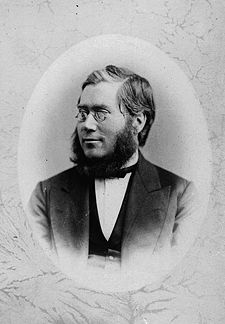
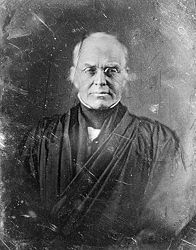
"All Christianity asks of men on this subject, is that they would be consistent with themselves; that they would treat the evidence of other things; and that they would try and judge its actors and witnesses, as they deal with their fellow men, when testifying to human affairs and actions, in human tribunals. Let the witnesses be compared with themselves, with each other, and with surrounding facts and circumstances; and let their testimony be sifted, as if were given in a court of justice, on the side of the adverse party, the witness being subjected to a rigorous cross-examination."
So wrote Professor Simon Greenleaf of Harvard Law School, in The Testimony of the Evangelists: The Gospels Examined by the Rules of Evidence. New York: J. C. & Co., 1874.
Classic Apologetics presents works from the greatest legal minds in history, in applying the rules of legal evidence to the testimonies of those who wrote the books of the Bible.
Historical Overview
Rafael Domingo and Javier Martínez-Torrón, editors. Series: Law and Christianity. Great Christian Jurists in Spanish History . Cambridge, United Kingdom; New York, NY, USA: Cambridge University Press, 2018. xiii, 395 pages; 24 cm.
Contents: Introduction / Rafael Domingo and Javier Martinez-Torron -- Isidore of Seville / Philip Reynolds -- Raymond of Penyafort / Jose Miguel Viejo-Ximenez -- Alfonso X / Joseph F. O'Callaghan -- Francisco de Vitoria / Andreas Wagner -- Bartolome de Las Casas / Kenneth Pennington -- Martin de Azpilcueta / Wim Decok -- Domingo de Soto / Benjamin Hill -- Fernando Vazquez de Menchaca / Salvador Rus -- Diego de Covarrubias y Leiva / Richard Helmholz -- Luis de Molina / Kirk R. MacGregor -- Francisco Suarez / Henrik Lagerlung -- Tomas Sanchez / Rafael Domingo -- Juan Solorzano Pereira / Matthew C. Mirow -- Gaspar Melchor de Jovellanos / Jan-Henrik Witthaus -- Francisco Martinez Marina / Aniceto Massferrer -- Juan Donoso Cortes / Jose Maria Beneyto -- Concepcion Arenal / Paloma Duran y Lalaguna -- Manuel Alonso Martinez / Carlos Petit -- Alvaro d'Ors / Rafael Domingo -- Pedro Lombardia / Alberto de la Hera and Javier Martinez-Torron.
Abstract: The Great Christian jurists' series comprises a library of national volumes of detailed biographies of leading jurists, judges and practitioners, assessing the impact of their Christian faith on the professional output of the individuals studied. Spanish legal culture, developed during the Spanish Golden Age, has had a significant influence on the legal norms and institutions that emerged in Europe and in Latin America. This volume examines the lives of twenty key personalities in Spanish legal history, in particular how their Christian faith was a factor in molding the evolution of law. Each chapter discusses a jurist within his or her intellectual and political context. All chapters have been written by distinguished legal scholars from Spain and around the world. This diversity of international and methodological perspectives gives the volume its unique character.
Olivier Descamps, Université Panthéon-Assas, Paris and Rafael Domingo, Emory University, Atlanta and University of Navarra, Spain, editors. Series: Law and Christianity. Great Christian Jurists in French History. Cambridge, United Kingdom; New York, NY, USA: Cambridge University Press, 2019.
Introduction / Olivier Descamps and Rafael Domingo -- Ivo de Chartres (Uves de Chartres) / Christof Rolker -- Stephen of Tournai (Étienne de Tournai) / Ken Pennington -- Guillaume Durand / Orazio Condorelli -- Jacques de Revigny / Paul J. du Plessis -- Pierre de Belleperche / Yves Mausen -- Charles Dumoulin / Wim Decock -- John Calvin (Jean Calvin) / John Witte, Jr -- Jacques Cujas / Xavier Prevost -- Francois Hotman / Mathias Schmoeckel -- Hugues Doneau / Christian Hattenhauer -- Jean Bodin / Daniel Lee -- Jean Domat / David Gilles -- Henri François d'Aguesseau / Isabelle Brancourt -- Robert-Joseph Pothier / Olivier Descamps -- Jean-Etienne-Marie Portalis / Nicolas Laurent-Bonne -- Alexis de Tocqueville / Mary Ann Glendon -- Paul Viollet / Anne-Sophie Chambost -- Paul Fournier / Brigitte Basdevant-Gaudemet and Rafael Domingo -- Raymond Saleilles / Marco Sabbioneti -- Maurice Hauriou / Julien Barroche -- Léon Duguit / M.C. Mirow -- Georges Ripert / Frédéric Audren -- Jacques Maritain / William Sweet -- Robert Schuman / Rafael Domingo -- Gabriel le Bras / Kathleen Cushing -- Jean Carbonnier / Laetitia Guerlain -- Michel Villey / Luisa Brunori.
Abstract: French legal culture, from the Middle Ages to the present day, has had an impressive influence on legal norms and institutions that have emerged in Europe and the Americas, as well as in Asian and African countries. This volume examines the lives of twenty-seven key legal thinkers in French history, with a focus on how their Christian faith and ideals were a factor in framing the evolution of French jurisprudence. Professors Olivier Descamps and Rafael Domingo bring together this diverse group of distinguished legal scholars and historians to provide a unique comparative study of law and religion that will be of value to scholars, lawyers, and students. The collaboration among French and non-French scholars, and the diversity of international and methodological perspectives, gives this volume its own unique character and value to add to this fascinating series.
Daniel L. Dreisbach and Mark David Hall, editors. Series: Law and Christianity. Great Christian Jurists in American History. Cambridge, United Kingdom; New York, NY, USA: Cambridge University Press, 2019.
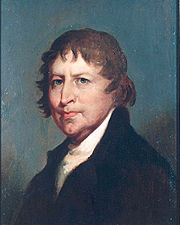
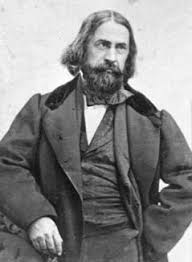
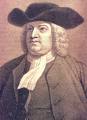
Introduction: Christianity and American law / Daniel L. Dreisbach -- Roger Williams and John Cotton / Glenn A. Moots -- John Winthrop and the covenantal ideal / Darren Staloff -- Friendly laws : William Penn's Christian jurisprudence / Andrew R. Murphy -- "The friendly jurisprudence and early feminism of john dickinson / Jane E. Calvert -- "Roger Sherman, Oliver Ellsworth, and the formation of America's Constitutional order / Mark David Hall -- John Jay : the first Chief Justice / Wendell Bird -- James Wilson / Donald L. Drakeman -- Was Justice Joseph Story a Christian Constitutionalist? / James Stoner -- Harvard's evangelist of evidence : Simon Greenleaf's Christian common sense / Daniel David Blinka -- John Marshall Harlan the elder, Christian jurist / Linda Przybyszewski -- Judicial conservatism and Protestant faith : the case of Justice David J. Brewer / Linda Przybyszewski -- John T. Noonan, Jr. : Catholic jurist and judge / Charles J. Reid, Jr -- The Integrative Christian jurisprudence of Harold J. Berman / John Witte -- Antonin Scalia : devout Christian, worldly judge / Thomas C. Berg -- The insights and transitions of Mary Ann Glendon / Paolo G. Carozza -- A reformed liberalism : Michael McConnell's contributions to Christian jurisprudence / Nathan S. Chapman -- The Jurisprudence of Robert P. George / Gerard V. Bradley.
Math professor and college president. Read more about Adams here.
WORKS
The Relation of Christianity to civil government in the United States: A Sermon, preached in St. Michael's Church, Charleston, February 13th, 1833, before the convention of the Protestant Episcopal Church of the Diocese of South-Carolina / by J. Adams. 2nd edition. Charleston: A.E. Miller, 1833. 64 pp.; 24 cm.
George M. Haushalter. Reminiscences of Sherlock Andrews. 1933. 27 pp.
James Harrison Kennedy and Wilson M. Day. The Bench and Bar of Cleveland. Cleveland, 1889. 362 pp. Extracts. "The lawyer who stood foremost of all the members of the bar in Cleveland, and of all who came there to attend court, as Sherlock J. Andrews. ... Mr. Andrews made one of the most eloquent speeches we ever heard in Ohio. As a defense of the Christian religion, it was masterly."
Aquinas, Thomas
(1225?-1274)
Influential early church writer. Read more about Aquinas here.
Parergon juris canonici anglicani: or, a commentary, by way of supplement to the canons and constitutions of the Church of England. Not only from the Books of the Canon and Civil Law, but likewise from the Statute and Common Law of this Realm. Whereunto is prefix'd, by way of Introduction, First, A brief Account of the Canon Law in general; how and from whence it had its Rise and Beginning in the Church; and how it advanced itself, by the Subtlety of the Romish Clergy, after the Seat of the Roman Empire was removed to Constantinople, and Barbarism had invaded the Politer Nations of Europe. Secondly, The Reader has also here a Particular of the Books wherein this Law was written: With the several Authors Names, the respective Times wherein they compiled them, and the best Commentators thereon: With many other Curious and Historical Remarks on this Law, &c. By John Ayliffe, L. L. D. And late Fellow of New College in Oxon. The second edition. London, M.DCC.XXXIV. [1734]. 653 pp.
Also here.
A New Pandect of Roman civil law, as anciently established in that empire; and now received and practised in most European nations: with Many useful Observations thereon; shewing, Wherein that Law differs from the Municipal Laws of Great-Britain, from the Canon Law in general, and from that Part of it now in Use here with us in England. Whereunto is prefix'd, By Way of Introduction, A Preliminary Discourse, touching the Rise and Progress of the Civil Law, from the most early Times of the Roman Empire: Wherein is also comprized a particular Account of the Books themselves containing this Law, the Names of the Authors and Compilers of them, the several Editions, and the best Commentators thereon. By John Ayliffe, LL. D. late Fellow of New College, Oxon. London, M.DCC.XXXIV. [1734]. 713 pp.
Bacon, Sir Francis / Baron Verulam, Viscount St. Albans
(1561-1626)
English philosopher, statesman and essayist. Learn more about Sir Bacon here.
WORKS
Lord Bacon's Essays, or counsels moral and civil, Translated from the Latin by William Willymott, In two volumes. London: printed: and sold by H. Parson, J. Brotherton and W. Meadows, A. Bettesworth, S. Ballard, R. Gosling, and C. King, 1720. Volume 2 of 2.
The Works of Francis Bacon, Baron of Verulam, Viscount St. Alban, and Lord High Chancellor of England. London, Printed for A. Millar, 1753. Lowndes, Bibliographer's manual, 1857 ed., v. 1, p. 93./ Vol. 2 has imprint: London, Printed for D. Midwinter, W. Innys, D. Browne, C. Davis, J. and R. Tonson, A. Millar, and J. Ward./ "The life of Francis Bacon": vol. 1, pp. l-xxxv./ Bound in leather; corners repaired; rebacked in leather, stamped in gold and blind; red and black leather labels on spines, stamped in gold; speckled edges./ Quotations from Thomson, Pope, Dodley, and Walpole on fly leaf of vol. 1./ From the library of Paul Louis Feiss. Volume 2 of 3.
Bandy, Alan S.
WORKS
"Word and Witness: An Analysis of the Lawsuit Motif in Revelation Based on the Witness Terminology". From Global Journal of Classical Theology, v. 6, n. 1, May 2007. Abstract: "The admonition to 'be a witness for Jesus,' may conjure up several connotations in the mind of a twenty-first century Christian. Most common, perhaps, is the idea of telling someone about Jesus in an evangelistic presentation. This may include sharing one's personal testimony about coming to faith in Christ, or it may simply involve being a
good neighbor. However, one may observe a formal disjunction between the concept of witness in the New Testament [NT] and its modern usage. On one hand, the concept of witness in the NT may include the proclamation of the apostles, which would indubitably involve an evangelistic component.1 On the other hand, however, it includes strong legal and judicial connotations.2 In other words, those who are witnessing are doing so as if they are standing trial for the veracity of their testimony. The disjunction, therefore, results from the absence of the connotation of standing on trial in the modern conception."
1 Edward G. Selwyn, "Eschatology in I Peter," in The Backgound of the New Testament and Its Eschatology: Studies in Honor of C. H. Dodd, ed. W. D. Davies and D. Daube (Cambridge: Cambridge University Press, 1956), 395. He argues: "I sometimes wonder whether the term khrugma has not been worked too hard, and whether the word marturi,a and its cognates would not better describe the primitive and indispensable core of the Christian message. At any rate, if we examine the comparative occurrences in the New Testament of the two sets of terms, we find the occurrences of the verbs alone which speak of 'witness' considerably outnumber the occurrences of khrus, sein, while the occurrences of the noun marturi,a outnumber those of the noun khrugma by more than six to one."
2 Allison A. Trites, The New Testament Concept of Witness (Cambridge: Cambridge University Press, 1977), 2.
Baldwin, Henry
(1780-1844)
Associate Justice of the Supreme Court. Read about Baldwin here.
The Four Gospels from a Lawyer's Standpoint. Boston: Houghton, Mifflin, 1899. xi, 58 pp.; 18 cm. (TM): In this brief book, Edmund Bennett (1824-1898), a probate judge in New York for over two decades and Dean of the School of Law at Boston University for 23 years, gives an overview of the peculiarities of each gospel, the confirmations of authenticity and veracity of the narratives by small details easily overlooked and not credibly the product of collusion, variations in the gospels, and alleged inconsistencies in the gospels. Though it is by no means a work of deep scholarship, it is a competent and very readable summary of some important points and a model of clear presentation for a nonspecialist audience.
Commentaries on the laws of England: in four books. From the last London edition, with the last corrections of the author. / by Edward Christian. Volume 1 of 4. New-York, 1822. Extract: The Rights of Persons: Of the Clergy.
Commentaries on the laws of England: in four books. From the last London edition., with the last corrections of the author. / by Edward Christian. Volume 4 of 4. New-York, 1822. Extracts: Contents, "Of Offenses Against God and Religion".
Commentaries on the laws of England: in four books. From the last London edition, with the last corrections of the author. / by Edward Christian. Volume 4 of 4. New-York, 1822. Extracts: Contents, "Of the Benefit of Clergy".
See the endorsement of Blackstone's work by Abraham Lincoln from his letter to James T. Thornton, December 2, 1858, Collected Works of Abraham Lincoln. Volume 3.
Yours of the 29th. written in behalf of Mr. John H. Widmer, is received. I am absent altogether too much to be a suitable instructer for a law-student. When a man has reached the age that Mr. Widner has, and has already been doing for himself, my judgment is, that he reads the books for himself without an instructer. That is precisely the way I came to the law. Let Mr. Widner read Blackstone's Commentaries, Chitty's Pleading's---Greenleaf's Evidence, Story's Equity, and Story's Equity Pleading's, get a license, and go to the practice, and still keep reading. That is my judgment of the cheapest, quickest, and best way for Mr. Widner to make a lawyer of himself.
And from his letter to J. M. Brockman, Esq. Springfield, Ills. Sep. 25. 1860, Collected Works of Abraham Lincoln. Volume 4.
Dear Sir: Yours of the 24th. asking "the best mode of obtaining a thorough knowledge of the law" is received. The mode is very simple, though laborious, and tedious. It is only to get the books, and read, and study them carefully. Begin with Blackstone's Commentaries, and after reading it carefully through, say twice, take up Chitty's Pleading, Greenleaf's Evidence, & Story's Equity &c. in succession. Work, work, work, is the main thing.
Christian, Edward. Preface and "Life of the Author," from Blackstone, William, Commentaries on the laws of England: in four books: with an analysis of the work.. From the 19th London edition. / with a life of the author and notes by Edward Christian, plus Chitty, Lee, Hovenden, and Ryland, and also references to American cases by a member of the New-York Bar."/ Includes bibliographical references and index. New York: W.E. Dean, 1853. Vol. 1 of 2. Analysis of Blackstone's work here.
"The Commentaries of Blackstone continue to be the text book of the student and of the man of general reading, notwithstanding the alterations in the law since the time of their author. The great principles which they unfold remain the same, and are explained in so simple and clear a style, that, however much the details of the law may be changed, they will always be read with interest. It is no small commendation of Blackstone, that many of the modern improvements adopted in England and in the United States were suggested by him: and that the arrangement which he used in treating the different subjects, has been followed in a great degree by the Revisers of the Statutes of New-York.
William Carey Jones, editor. Commentaries on the Laws of England. San Francisco, Bancroft-Whitney, 1915-1916. Volume 1 of 2. 1598 pp. Volume 2 of 2. 1354 pp.
Samuel F. Mordecai. Law lectures; a treatise, from a North Carolina standpoint, on those portions of the first and second books of the Commentaries of Sir William Blackstone which have not become obsolete in the United States. Volume 1 of 2. 774 pp. Volume 2 of 2. 760 pp.
The Palladium of Conscience; or, The foundation of religious liberty displayed, asserted, and established, agreeable to its true and genuine principles, above the reach of all petty tyrants, who atempt to lord it over the human mind. Containing Furneaux's Letters to Blackstone. Priestley's Remarks on Blackstone. Blackstone's Reply to Priestley. And Blackstone's Case of the Middlesex-elections; with some other tracts, worthy of high rank in every gentleman's literary repository, being a necessary companion for every lover of religious liberty. And an interesting appendix to Blackstone's Commentaries on the laws of England. 1773. pp. [6], iv, [1], 6-119, [1], xii, 155, [1] p. 23 cm. (8vo and 4to)
Blaiklock, E. M.
(1903-1983)
Classics scholar.
WORKS
The Archaeology of the New Testament. Grand Rapids: Zondervan Pub. House, [1970]. 192 pp. illus., facsims., maps (part col.), ports. 23 cm. Nelson; Rev. and updated edition, 1984. 186 pages.
Buy this book here.
The Cities of the New Testament. London: Pickering & Inglis, 1965.
128 pp. illus. (part col.) 22cm. Buy this book here.
The Christian in Pagan Society. Originally published in 1951 by the Inter-Varsity Press, with a Second Edition (completely reset) in May 1956. Prepared for the web in April 2005 by Michael Farmery & Robert I. Bradshaw.
American jurist and legal lexicophrapher. Read about Bouvier here and biography at the Tarlton Law Library, University of Texas School of Law.
"He is best known for his able legal writings. His Law Dictionary Adapted to the Constitution and Laws of the United States of America and of the Several States of the American Union (1839, revised and brought up to date by Francis Rawle, under the title of Bouvier's Law Dictionary, 2 vols., 1897) has always been a standard."--1911 Encyclopedia Britannica.
Archbishop Whately, in his preface to the Elements of Rhetoric, says, "It has been declared, by the highest legal authorities, that 'Christianity is part of the law of the land;' and, consequently, any one who impugns it is liable to prosecution. What is the precise meaning of the above legal maxim I do not profess to determine, having never met with any one who could explain it to me; but evidently the mere circumstance that we have religion by law established dues not of itself imply the illegality of arguing against that religion." It seems difficult, says a late accomplished writer (Townsend, St. Tr. vol. ii. p. 389), to render more intelligible a maxim which has perplexed so learned a critic. Christianity was pronounced to be part of the common law, in contradistinction to the ecclesiastical law, for the purpose of proving that the temporal courts, as well as the courts spiritual, had jurisdiction over offences against it. Blasphemies against God and religion are properly cognizable by the law of the land, as they disturb the foundations on which the peace and good order of society rest, root up the principle of positive laws and penal restraints, and remove the chief sanctions for truth, without which no question of property could be decided and no criminal brought to justice. Christianity is part of the common law, as its root and branch, its mainstay and pillar,-as much a component part of that law as the government and maintenance of social order. The inference of the learned archbishop seems scarcely accurate, that all who impugn this part of the law must be prosecuted. It does not follow, because Christianity is part of the law of England, that every one who impugns it is liable to prosecution. The manner of and motives for the assault are the true tests and criteria. Scoffing, flippant, railing comments, not serious arguments, are considered offences at common law, and justly punished, because they shock the pious no less than deprave the ignorant and young. The meaning of Chief-Justice Hale cannot be expressed more plainly than in his own words. An information was exhibited against one Taylor, for uttering blasphemous expressions too horrible to repeat. Hale, C. J., observed that "such kind of wicked, blasphemous words were not only an offence to God and religion, but a crime against the laws, state, and government, and therefore punishable in the court of King's Bench. For, to say religion is a cheat, is to subvert all those obligations whereby civil society is preserved; that Christianity is part of the laws of England, and to reproach the Christian religion is to speak in subversion of the law." Ventr.293. To remove all possibility of further doubt, the English commissioners on criminal law, in their sixth report, p. 83 (1841), have thus clearly explained their sense of the celebrated passage:-" The meaning of the expression used by Lord Hale, that' Christianity was parcel of the laws of England,' though often cited in subsequent cases, has, we think, been much misunderstood. It appears to us that the expression can only mean either that, as a great part of the securities of our legal system consist of judicial and official oaths sworn upon the Gospels, Christianity is closely interwoven with our municipal law, or that the laws of England, like all municipal laws of a Christian country, must, upon principles of general jurisprudence, be subservient to the positive rules of Christianity. In this sense, Christianity may justly be said to be incorporated with the law of England, so as to form parcel of it; and it was probably in this sense that Lord Halo intended the expression should be understood. At all events, in whatever sense the expression is to be understood, it does not appear to us to supply any reason in favor of the rule that arguments may not be used against it; for it is not criminal to speak or write either against the common law of England generally, or against particular portions of it, provided it be not done in such a manner as to endanger the public peace by exciting forcible resistance; so that the statement that Christianity is parcel of the law of England, which has been so often urged in justification of laws against blasphemy, however true it may be as a general proposition, certainly furnishes no additional argument for the propriety of such laws." If blasphemy mean a railing accusation, then it is, and ought to be, forbidden. Heard, Lib. & Sland. § 338. See 2 How. 127. 197-201; 11 Serg. & R. Venn. 394; 8 Johns. N.Y. 290; 10 Ark. 259; 2 Harr. Del. 553, 569.
A Treatise on Logic; or, The laws of pure thought; comprising both the Aristotelic and Hamiltonian analyses of logical forms, and some chapters of applied logic. Second edition. Cambridge [Mass.] Sever and Francis, 1864. xv, 450 pp. diagrs. 20 cm.
Hume's celebrated argument against the credibility of miracles is a fallacy which results from losing sight of the distinction between Testimony and Authority, between Veracity and Competency. He argues, that it is contrary to all experience that a Law of Nature should be broken, but it is not contrary to experience that human testimony should be false; and therefore we ought to believe that any amount of Testimony is false, in preference to admitting the occurrence of a miracle, as this would be a violation of Law. We answer, that the miraculous character of an event is not a matter of Intuition, but of Inference; hence, it is not to be decided by Testimony, but by Reasoning from the probabilities of the case, the only question being whether, in view of all the circumstances, the Conclusion is competent that the occurrence was supernatural. The Testimony relates only to the happening of the event considered merely as an external phenomenon; the question respecting the nature of this event, whether it is, or is not, a violation of Physical Law, whether it is an effect of this or that Efficient Cause, cannot be determined by Intuition and Testimony, but is a matter for Judgment founded on Reasoning, in view of all the circumstances of the case. If doubtful of our own Competency to form a correct opinion on this point, we may defer to the Authority of another, who is familiar with the kind of Reasoning by which such questions are settled. Now we have abundant evidence from experience, that no event whatever, regarded simply as an external phenomenon, can be so strange and marvellous that sufficient Testimony will not convince us of the reality of its occurrence. To the contemporaries of our Saviour, not even bringing a dead man to life would have appeared so incredible as the transmission of a written message five thousand miles, without error, within a minute of time. Yet this feat has been accomplished by the Magnetic Telegraph. Why do we decide, then, that the raising of Lazarus was, and the transmission of intelligence by telegraph is not, a miracle? Evidently not by Intuition, but by reasoning from the very different circumstances of the two cases. The fact, that the eyes of the blind were opened, or a storm was reduced to a calm, or the dead were raised, is established by Intuition and Testimony, which have established many other facts quite as wonderful; the character of this fact, whether miraculous or not, is to be settled in a very different manner. We say, then, that Hume's argument, which is based exclusively upon an appeal to experience and Testimony, is totally inapplicable to the question respecting the credibility of a miracle. Testimony has nothing to do with the correct inference of a Conclusion from its Premises.
We can touch only very briefly on the Criticism of recorded Testimony, and of writings in general. As we must avail ourselves, in the construction of Science, of the experience of former generations, in respect to which the Testimony of eye- and ear-witnesses is no longer directly accessible, we are obliged to consider the credibility of this, Testimony as affected by the channels of transmission through which it has been passed. There are but two such channels, Tradition and Ancient Writings. The former of these may be left out of account; for if the lapse of time has been considerable, the probability that the Testimony, if transmitted merely by word of mouth, has been materially altered or falsified, is so great, that the report can be received only with extreme caution. But it has already been mentioned; that the invention of the art of writing has rendered it possible for the experience of a former generation to be handed down, through an indefinite lapse of centuries, in as perfect a state as that in which it was first communicated to those who were the contemporaries of the events narrated. This is possible, we say; the question whether it has been actually so transmitted is what we have to consider in the Criticism of Ancient Writings.
When a document purporting to be the recorded Testimony of certain individuals of a former generation is presented to us, we have first to inquire whether it is actually the handwriting, or the composition as taken down by dictation, or a faithful report, made at the time, of the substance of the evidence of the individuals whose names it bears, or to whom it is attributed. The establishment of either of these three points is the proof of what is called the Genuineness of the writing. It is comparatively unimportant which of the three is proved, as either of them gives us assurance that the document is a faithful record of the Testimony of the persons whose evidence is to be weighed. Thus, even if we were sure that the Testimony of the Evangelists was originally written out by their own hands, we certainly do not possess their autograph copies; still, the Gospels are Genuine, if we have sufficient evidence that they are faithful records, made at the time, (or correct transcripts of such records,) of what the Evangelists said.
But a second question must be answered before we can accept the evidence furnished by the document. We must be satisfied, not only that the Testimony is Genuine,-that it was actually given by those from whom it purports to come, but that it is Authentic, -that this Testimony is a true and faithful narrative of what actually happened. Proofs of the Genuineness of the writing amount, at the utmost, only to bringing the witnesses into court and establishing their identity; proofs of the Authenticity must be found by sifting their evidence, and applying to it all the tests and means of verification which we possess, in order to ascertain whether they are telling the truth. If not Genuine, the document is said to be Spurious; if not Authentic, it is false.
As most of the tests and proofs of the Genuineness and Authenticity of a writing are such as readily suggest themselves to the inquirer, it is unnecessary to consider them here at any length. Generally, they may be divided into two classes, called respectively the External and the Internal Evidences of the point to be proved. The External Evidences of Genuineness are to be found either in other and admitted writings of the supposed author, or in the works of writers who were either his contemporaries, or nearly of the same antiquity; and the evidence is either direct, if the disputed writing is therein explicitly attributed to him, or indirect, if these works quote as his production passages which are found in the document. This indirect testimony has the greater force, for on account of its casual or incidental character there is less reason to suspect that it has been forged. The External Evidences of the Authenticity of the writing, considered as a narrative of facts, are too numerous to mention. They are found in allusions to the same facts, or to incidents obviously connected with them, by contemporary authors; in customs, traditions, and institutions, which have come down to later times, and the origin of which cannot be accounted for, except on the supposition that the reported events actually took place; in coins, medals, and inscriptions, belonging to the same age, or one immediately subsequent, and connected by equally close relations with the alleged facts; in the notoriety which such incidents must have obtained, the interest which must have been felt in them, and the consequent probability that falsifications and forgeries respecting them would never have been attempted, or would have been detected and disproved at the time.
Of the Internal Evidence, it has been justly remarked, that it is weak to establish either Genuineness or Authenticity, but powerful to disprove both. As Hamilton remarks, "We can easily conceive that an able and learned forger may accommodate his fabrications both to all the general circumstances of time, place, people, and language under which it is supposed to have been written, and even to all the particular circumstances of the style, habit of thought, personal relations, &c. of the supposed author." On the -other hand, a single anachronism, well made out, in respect either to events, institutions, customs, or even the use of language, is as fatal to the document's claim to antiquity, as a well-established alibi is to the success of a criminal prosecution. Bentley's Dissertation upon the Epistles of Phalaris might have been limited to pointing out two or three of the numerous anachronisms which he detected in them, if his only object in writing it had been to prove that these alleged Epistles were an impudent forgery. In respect to the Authenticity of a narrative, it is to be observed, that the credibility of certain facts is one thing, and the proof of their actual occurrence is another. For establishing the former, Internal Evidence is sufficient; for the latter, it is powerless, being entirely inapplicable. By saying that a narrative of certain events bears with it Internal Evidence of its truth, we mean only that the events are possible, that they are consistent with each other, - that they harmonize with what we know from other sources concerning the men of that country and that age, - that they are conformable to the ordinary course of things.
De Bracton, Henry / Henry of Bratton (Henricus de Brattona or Bractona)
(c. 1210-1268)
English judge and writer of English law. Read about Bracton here and here.
WORKS
De Legibus Et Consuetudinibus Angliæ. Bracton on the Laws and Customs of England. This online text is based on George Woodbine's edition of the original and Samuel Thorne's translation and is fully searchable, using a range of criteria including section heading, tractate, folio number, page number and key words (boolean searches). English translation Copyright (c) 1968-1977 by the President and Fellows of Harvard College. Latin text Copyright (c) 1922-1942 by Yale University Press.
"The king himself ought not to be under man but under God, and under the Law, because the Law makes the king. Therefore let the king render back to the Law what the Law gives him, namely, dominion and power; for there is no king where will, and not Law, wields dominion."
Bradley, Joseph P.
(1813-1892)
Supreme Court Justice. Read more about Bradley here.
WORKS
Miscellaneous Writings of the late Hon. Joseph P. Bradley, associate Justice of the Supreme Court of the United States, with a sketch of his life by his son, Charles Bradley, and a review of his "judicial record" by William Draper Lewis, and an account of his "dissenting opinions" by A.Q. Keasbey. Newark, N.J., 1901. 432pp.
"Whatever may be our own views, and however well settled and grounded, we cannot, without danger to society and its dearest interests, turn our backs upon the religious institutions which play so important a part in humanizing and refining mankind. No other religious belief, or disbelief, could have done so much for the elevation and refinement of the human race as Christianity has done during the last eighteen hundred years."
The United States a Christian nation. Philadelphia, Winston, 1905. 98 pp. 20 cm. Haverford library lectures. Contents: The United States a Christian nation.--Our duty as citizens.--The promise and the possibility of the future. Also here.
..."I could go on indefinitely, pointing out further illustrations both official and non-official, public and private; such as the annual Thanksgiving proclamations, with their following days of worship and feasting; announcements of days of fasting and prayer; the universal celebration of Christmas; the gathering of millions of our children in Sunday Schools, and the countless volumes of Christian literature, both prose and poetry. But I have said enough to show that Christianity came to this country with the first colonists; has been powerfully identified with its rapid development, colonial and national, and to-day exists as a mighty factor in the life of the republic. This is a Christian nation ..."
... "By these and other evidences I claim to have shown that the calling of this republic a Christian nation is not a mere pretence but a recognition of an historical, legal and social truth."
The Pew for the Pulpit. New York [etc., etc.] Fleming H. Revell co., 1897. 76 pp. 1897. "The substance of the monograph was originally given as an address to the students in the Divinity Department of Yale University ... on April 2d, 1897."
American Citizenship. New Haven [Conn.]: Yale University Press, 1902. 131 pp.; 20 cm. Yale lectures on the responsibilities of citizenship.
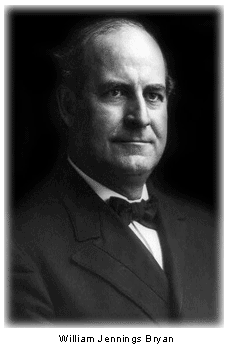
American political leader. Read about Bryan here and here.
WORKS
Bryan on Belief. Christian Observer, June 19, 1907, p. 8.
"I do not understand all the mysteries of the Bible, but if we live up to all the things in the Bible we can understand we will be kept so busy that we will not have time to worry over the mysterious. My observation is that the people who are all the time worrying about the mysterious things are mighty little concerned about the plainest things in the Bible, that they could apply with profit to themselves. Living in the midst of mystery, I shall not for that reason refuse to accept a religion that will mould our lives for good."
The Menace of Darwinism. A reissue of chapter four from the
author's volume In His Image, together with comments on the importance of its appeal, reasons for its separate publication and an abstract of the remaining chapters.
The Last Message of William Jennings Bryan. New York Chicago [etc.] Fleming H. Revell company. 1925. 84 pp. Limited preview. "The story of the last message by George F. Milton": p. 7-11./ "Address delivered at the funeral service of William Jennings Bryan, by Rev. Joseph R. Sizoo": p. 71-80. This is the story of Bryan's undelivered address at the Scopes trial regarding Christianity vs. Evolution. The sudden ending of the trial prevented Bryan from delivering his closing arguments, he died a few days later.
Burlamaqui, Jean Jacques
(1694-1748)
Swiss legal and political theorist. Columbia Encyclopedia: His chief works are Principes du droit naturel [principles of natural law] (1747) and Principes du droit politique [principles of political law] (1751). He attempted to demonstrate the reality of natural law by tracing its origin in God's rule and in human reason and moral instinct. He believed that both international and domestic law were based on natural law. Read about Burlamaqui here.
WORKS
Principles Of Natural And Political Law [1748],
Counsellor Of State, And Late Professor Of Natural and Civil Law at Geneva. Translated [In 1752] into English by Mr. Nugent. Fifth Edition, Corrected. Cambridge, Printed at the University Press, by W. Hilliard, and sold at his bookstore, and by the Booksellers in Boston.
1807. Also here, at the Online Library of Liberty. 1791 edition.
The Principles of politic law:
being a sequel to The principles of natural law. By J. J. Burlamaqui, ... Translated into English by Mr. Nugent,
printed for J. Nourse, 1752. 372 pp.
Callahan, Ethelbert
(1829-?)
Attorney and politician. Read more about Callahan here.
WORKS
The Lawyers of the Bible. Indianapolis: Hollenbeck Press, 1912. 77 pp.; 20 cm. A lecture delivered beofre the Indiana University School of Law, January 23, 1911.
Carson, Hampton L. (Hampton Lawrence)
(1852-1929)
Attorney General of Pennsylvania. Read about Carson here.
WORKS
The Supreme Court of the United States: its history: and its centennial celebration, February 4th, 1890; prepared under the direction of the Judiciary Centennial Committee. Philadelphia, 1891.
The History of the Supreme Court of the United States: with biographies of all the chief and associate justices. Philadelphia, c. 1902-1904. Vol. 1 of 2. 378 pp. Vol. 2 of 2. 359 pp.
Lawyer. Judge. Mayor of the City of Carthage, Missouri.
WORKS
Beyond a Reasonable Doubt. Rev. edition. Joplin, Mo.: College Press, 1992. 247 pp.; 22 cm.
"We do not have to take an irrational leap of faith. God has given us the evidence. Christianity is the truth."
An Answer to the Brief remarks of William Berriman, D.D., on Mr. Chandler's Introduction to the history of the Inquisition: in a letter to the said Doctor / By Samuel Chandler. The second edition. London: Printed for John Gray, 1733. 56 pp.; 20 cm.
A Critical History of the life of David: in which the principal events are ranged in order of time; the chief objections of Mr. Bayle, and others, against the character of this prince, and the Scripture account of him, and the occurrances of his reign, are examined and refuted; and the Psalms which refer to him, explained / by Samuel Chandler. London: Printed by S. Chandler, for J. Buckland, and J. Coote, 1766.
Volume 1 of 2 , 344 pp. Volume 2 of 2, 494 pp.
The History of Persecution: from the patriarchial age to the reign of George II. / by S. Chandler. A new edition, to which are added, the Rev. Dr. Buchanan's notices of the present state of the inquisition at Goa; also an appendix, containing hints on the recent persecutions in the British Empire, some circumstances relating to Lord Viscount Sidmouth's bill, a circumstantial detail of the steps taken to obtain the new Toleration Act, with the act itself, and other important matter / by Charles Atmore. Hull: C. Atmore and J. Craggs; London: Sold by Longman, Hurst, Rees, Orme and Brown, 1813. 528 pp.: port.; 22 cm.
Sermons on the following subjects, viz. The religion of Christ. ... Objections against a resurrection answered. The second edition. London, 1759-1769. Volume 1 of 4, 492 pp.; Volume 2 of 4, 517 pp.; Volume 3 of 4, 444 pp.; Volume 4 of 4, 489 pp.
Vindication of the History of the Old Testament in answer to the misrepresentations and calumnies of Thomas Morgan, By Samuel Chandler. London: printed for J. Noon, R. Hett, and J. Davidson, 1743. xxxi, [1],256, [4],257-610, [2] pp. ; 80.
"In 1908 he published two volumes, "The Trial of Jesus from a Lawyer's Standpoint and was lauded as the most comprehensive historian of the trial of the Savior, and the first to treat the event from an unbiased, systematic, legal viewpoint. Of this work the Literary Digest said: 'It would seem probably that nothing more exhaustive upon this topic will ever be produced, since it evidently covers all the material available. The amount of erudition disclosed in this treatment is surprising, and the capacity to reduce it all to an argument so clear that the ordinary reader can grasp it easily, should give the book a very wide general reading,' and the Christian Herald characterized it as 'the strongest, the fullest and the most satisfactory presentation of the whole subject,' and a book that "deserves to be ranked among the notable contributions to historical and legal literature." This was followed by The Jew; a tribute by a Gentile (1910), in which he seeks to show that, in proportion to population, the Jew has produced more eminently intellectual and spiritual men than any other race of mankind."--Extract from Harrison Genealogy Repository
Eusebius; or, The True Christian's Defense against a late book entitul'd The Moral philosopher. Cambridge: W. Thurlbourn, 1739. Volume 1 of 2. 580 pp. 20 cm.
Eusebius, Volume II; or, The True Christian's farther defense against the late principles and reasonings of The moral philosopher. By John Chapman. London, 1741. 532 pp. Volume 2 of 2.
Citizens for Objective Public Education
(Fl. 21st Century)
"Citizens for Objective Public Education (COPE) is a not-for-profit Corporation formed exclusively for educational and religious purposes within the meaning of Section 501(c)(3) of the Internal Revenue Code. COPE?s mission is to promote objectivity in public school curricula that address religious questions and issues so that the educational effect of the teaching is religiously neutral." Read about COPE here.
Life Sketches of Eminent Lawyers: American, English, and Canadian: to which is added thoughts, facts and facetiae. Kansas City, Mo.: Lawyers' International Pub. Co., 1895. 2 vol.: ports.; 20 cm.
BTh, DipLaw, DipMin, MA, MTh, ThD. Australian Baptist theologian, political commentator, solicitor and author. Principal, Morling College, Australia. Read about Dr. Clifford here.
WORKS
Leading Lawyers Look at the Resurrection. Sutherland: Albatross Books, 1991.
With Philip Johnson. Shooting for the Stars. Sutherland: Albatross Books, 1993.
With Philip Johnson. Sacred Quest. Sutherland: Albatross Books, 1995; a revised edition of Shooting for the Stars.
With Ric Chapman. The Gods of Sport. Sutherland: Albatross Books, 1995.
The Mission of the Church and the New Age Movement. Lilydale: Bible College of Victoria, 1995.
Leading Lawyers' Case for the Resurrection. Alberta, Canada: Canadian Institute for Law, Theology and Public Policy,1996.
With Philip Johnson. Riding the Rollercoaster: How The Risen Christ Empowers Life. Sydney: Strand, 1998.
With Ric Chapman. The International Gods of Sport. Sydney: Strand, 1999.
With Philip Johnson. Jesus and the Gods of the New Age. Oxford: Lion, 2001/Colorado Springs: Victor, 2003.
With John Drane and Philip Johnson. Beyond Prediction: The Tarot and Your Spirituality. Oxford: Lion, 2001.
"Reframing a Traditional Apologetic to Reach 'New Spirituality' Seekers," in Encountering New Religious Movements: A Holistic Evangelical Approach, Irving Hexham, Stephen Rost and John Morehead, eds. Grand Rapids: Kregel, 2004, pp 193-208.
"Review of New Religions and the Nazis by Karla Poewe, Routledge, New York and London, 2006. Published in Global Journal of Classical Theology, 6/1, May 2007.
"Apologetics, Persuasion, and Pastoral Care" in Tough-Minded Christianity: Honoring the Legacy of John Warwick Montgomery, eds. William Dembski and Thomas Schirrmacher. Nashville: B & H Academic, 2008.
Apologetic Preaching and Teaching For the Church and the Marketplace. Macquarie Park, NSW: Morling Press, 2011.
With Philip Johnson. The Cross Is Not Enough: Living as Witnesses to the Resurrection. Grand Rapids: Baker Books, 2012.
Objection Overruled! Let's Hear the Case for the Resurrection of JesusPublished in Global Journal of Classical Theology, v.12, n. 1, October 2014. Abstract: "In a 2013 article, Matthew Ferguson asserted that the legal paradigm is an inappropriate analogy to apply to the resurrection of Jesus. That simply is not so. The reason for the legal apologetic method?s ongoing significance can be related to humanity's ongoing search for truth and meaning and their appreciation of the role of law, testimony, and evidence in any such quest. The legal paradigm is one of common usage. As well, the central tenet of the Christian truth claim, i.e., the resurrection of Jesus, is one that is often presented factually in the New Testament. Contrary to Ferguson's assertion, the legal analogy is not a 'case-closed mentality' but rather an 'open-to-investigation mentality. This is not cramming 'religion down everyone's throat,'?but it is treating the reader with human dignity and respect by taking the resurrection of Jesus seriously."
The law of nature is that which God at the time of creation of the nature of man infused into his heart, for his preservation and direction; and this is lex aeterna, the moral law, called also the law of nature. ...
And by this law, written with the finger of God in the heart of man, were the people of God a long time governed, before the law was written by Moses, who was the first reporter or writer of law in the world. The Apostle in the Second Chapter to the Romans saith, Cum enim gentes qu? legem non habent naturaliter ea qu? legissuntfactunt. And this is within the command ofthat moral law, honora patrem, which doubtless doth extend to him that is pater patriae. And that Apostle saith, Omnis anima poteslalibus sublimioribus subdita sit. And these be the words of the Great Divine, Hoc Drus in Sacra Scripluris jubet, hoc lex naturae dictari, ut quilibet subditm obediat superio, ... This law of nature, which indeed is the eternal law of the Creator, infused into the heart of the creature at the time of his creation, was two thousand years before any laws written, and before any judicial or municipal laws.
Cited in Calvin's Case, 77 Eng. Rep. 377, 392 (1609).
"Three Died that Day".
Through his specifically Christian writings, Lewis used logic to explore the meaning of Christianity. In Mere Christianity--which played a decisive role in my conversion to Christ--Lewis cogently explains in simple language original sin, the transcendent Creator God, and the transforming work of Jesus Christ.
... In 1973, in the midst of the Watergate crisis, I visited the home of a friend who read to me from Mere Christianity. In that book, I encountered a formidable intellect and a logical argument that I found utterly persuasive. That night in the driveway of my friend's home I called out to God in a flood of tears and surrendered my life to Christ.
Since November 1963, the years have diminished both John Kennedy and Aldous Huxley. Later disclosures about Kennedy's habitual immorality have diminished his place in history. Toward the end of his life, Huxley retreated into drugs. He urged his followers, "Ignore death up to the last moment; then, when it can't be ignored any longer, have yourself squirted full of morphia and shuffle off in a coma."
By contrast, Lewis offered a muscular faith. "In Christ," he said, "a new kind of man appeared; and the new kind of life which began in Him is to be put into us."
"God," he contended, "cannot give us peace and happiness apart from Himself, because it is not there. There is no such thing."
Today, because of Lewis, there are millions of readers like me who can attest that they too have found God. And Lewis's influence in the marketplace of ideas spreads daily. Of him it can be truly said: "Now he belongs to the ages."
Loving God. Basingstoke: Marshalls, 1984, 1983. 255 pp.; 18 cm. "Take it from one who was inside the Watergate web looking out, who saw firsthand how vulnerable a cover-up is: Nothing less than a witness as awesome as the resurrected Christ could have caused those men to maintain to their dying whispers that Jesus is alive and Lord."
Cooley, Thomas McIntyre
(1824-1898)
Jurist. 25th Justice and a Chief Justice of the Michigan Supreme Court. Read about Cooley here and here.
WORKS
Third edition with Andrew C. McLaughlin. The General Principles of Constitutional Law in the United States of America. 3rd edition. Boston: Little, Brown, 1898. li, 423 pp.; 20 cm.
Preface: "THE manual which follows has been prepared for the use of students in law schools and other institutions of learning. The design has been to present succinctly the general principles of constitutional law, whether they pertain to the federal system, or to the state system, or to both. Formerly, the structure of the federal constitutional government was so distinct from that of the States, that each might usefully be examined and discussed apart from the other; but the points of contact and dependence have been so largely increased by the recent amendments to the federal Constitution that a different course is now deemed advisable. Some general principles of constitutional law, which formerly were left exclusively to state protection, are now brought within the purview of the federal power, and any useful presentation of them must show the part they take in federal as well as state government. An attempt has been made to do this in the following pages.
"The reader will soon discover that mere theories have received very little attention, and that the principles stated are those which have been settled, judicially or otherwise, in the practical working of the government."
--Thomas M. Cooley. University of Michigan, Ann Arbor, March, 1880.
Preface to the Second edition: "IN the preparation of this edition, such changes in the text and notes of the first edition have been made as have been required by the many important decisions upon constitutional questions rendered within the last ten years. While the aim has been to keep the book a manual and not to make it a digest, it will be found, it is hoped, to treat briefly all important points covered by the cases decided up to this time."
--Alexis C. Angell. Detroit, August, 1891.
Preface to the Third edition: "IN the preparation of the third edition of this work, I have been guided and aided by the results of ten years' experience in using the book with my classes. While I have endeavored to leave the text unaltered as far as seemed consistent with a careful revision, I have made occasional alterations, usually by expanding condensed statements, sometimes to correct a principle altered or modified by recent decisions. Because of the great development of some branches of constitutional law, for example, the law of interstate commerce, I have found it necessary to rearrange, and in large measure rewrite, some pages of the earlier editions. I should have preferred to leave the text as it was written by its distinguished author; but inasmuch as the book is widely used by students in colleges and law schools, it seemed unwise simply to use footnotes to call attention to new and important decisions which have modified the statements of the text. Besides new matter inserted in the pages of the earlier edition, I have added a chapter dealing with State Constitutions. This chapter is in large measure a condensation of Chapters III. to VI. of Judge Cooley's Constitutional Limitations, and where possible I have used the language of that treatise in preference to my own."
--Andrew C. Mclaughlin. University of Michigan, Ann Arbor, September, 1893.
Jon Roland, editor of Fourth edition. The General Principles of Constitutional Law in the United States of America. Fourth edition. University Press, John Wilson and Son, Cambridge, 2002. Electronic edition.
Preface to the Fourth edition: "This digital edition is essentially the third edition, but the Table of Cases has been moved to a position before the Index, and the footnotes will have been moved to the ends of their chapters, and will have had the page numbers prepended, followed by a colon, when complete. As time permits, I intend to add notes to bring the work up to date." -- Jon Roland, Austin, Texas, July 19, 2002.
SECTION I. -- RELIGIOUS LIBERTY.
The Constitution. -- The Constitution as originally adopted declared that "no religious test shall ever be required as a qualification to any office or public trust under the United States."[1] By amendment it was farther provided that "Congress shall make no law respecting an establishment of religion, or prohibiting the free exercise thereof."[2] Both these provisions, it will be seen, are limitations upon the powers of Congress only. Neither the original Constitution nor any of the early amendments undertook to protect the religious liberty of the people of the States against the action of their respective state governments. The fourteenth amendment is perhaps broad enough to give some securities if they should be needful.
Establishment of Religion. -- By establishment of religion is meant the setting up or recognition of a state church, or at least the conferring upon one church of special favors and advantages which are denied to others.[3] It was never intended by the Constitution that the government should be prohibited from recognizing religion, or that religious worship should never be provided for in cases where a proper recognition of Divine Providence in the working of government might seem to require it, and where it might be done without drawing any invidious distinctions between different religious beliefs, organizations,
or sects. The Christian religion was always recognized in the administration of the common law; and so far as that law continues to be the law of the land, the fundamental principles of that religion must continue to be recognized in the same cases and to the same extent as formerly. The propriety of making provisions for the appointment of chaplains for the two houses of Congress, and for the army and navy, has been sometimes questioned; but the general sentiment of the country has approved it, and the States make corresponding provision for legislative bodies and state institutions. The federal legislation has never gone farther; it has never undertaken to prescribe a religious test for any purpose. Neither has it ever assumed the authority to prohibit the free exercise of religion anywhere. But the freedom of religion cannot be extended to prevent the punishment of crimes. Polygamy and bigamy are crimes none the less because encouraged by the teachings of a religious sect. "To call their advocacy a tenet of religion is to offend the common-sense of mankind."[1]
State Guaranties. With the exception of the provisions above made, the preservation of religious liberty is left to the States, and these without exception have constitutional guaranties on the subject. In the main these are alike, and they may be summed up as follows:
1. They establish a system, not of toleration merely, but of religious equality. All religions are equally respected by the law; one is not to be favored at the expense of others, or to be discriminated against, nor is any distinction to be made between them, either in the laws, in positions under the law, or in the administration of the government.
[1] "Whilst legislation for the establishment of a religion is forbidden and its free exercise permitted, it does not follow that everything which may be so called can be tolerated. Crime is not the less odious because sanctioned by what any particular sect may designate as religion." Field, J., Davis v. Season. 133 U. S. 333.
2. They exempt all persons from compulsory support of religious worship, and from compulsory attendance upon the same.
3. They forbid restraints upon the free exercise of religion according to the dictates of conscience, or upon the free expression of religious opinions.[1]
These are adopted as fundamental principles. No man in religious matters is to be discriminated against by the law, or subjected to the censorship of the State or of any public authority; and the State is not to inquire into or take notice of religious belief or expression so long as the citizen performs his duty to the State and to his fellows, and is guilty of no breach of public morals or public decorum.[2]
Blasphemy, &c. -- But the courts of the Union and of the States, in administering the common law, find it necessary to take notice that the prevailing religion of the country is Christian,[3] and that because of that fact certain conduct may constitute a breach of public decorum, and therefore be illegal, though it might not be where a different religion prevailed. The law of blasphemy depends largely for its definition and application upon the generally accepted religious belief of the people; and in the law of contracts many provisions might be found to be illegal in a Christian country which would be enforced where the Mohammedan or some other form of religion prevailed. Questions of public policy, as they arise in the common law, must always be largely dependent upon the prevailing system of public morals, and the public morals upon the
[1] In State v. District Board, 76 Wis. 177, the mere reading of the King James version of the Bible in the public schools was held to violate provisions like the above. For a discussion of kindred cases, see note to this case in 29 Am. Law Register, 321, and compare Moore v. Monroe, 64 Iowa, 367, where it was held that such reading did not make the school a place of worship.
[2] Cooley, Const. Lim., ch. 13.
[3] Vidal v. Girard's Executors, 2 How. 127.
prevailing religious belief.[1] Legislation may also recognize the general religious sentiments of the people in the police regulations it establishes and in the statutory offences it demies. Thus, it may prohibit secular employments on the first day of the week, that day being observed as a day of rest and worship by religious people generally;[2] and it may condemn and provide for the punishment of any conduct which is condemned by the common voice of Christian nations, though admitted elsewhere, such as cruel sacrifices, the practice of polygamy, &c.[3] And it may require that, all religious worship and observances shall be conducted in accordance with the ordinary rules of order, and punish whatever extravagances tend to a breach of the public peace. But even the law of blasphemy must be so administered as to preserve liberty of discussion and argument upon the most vital points.[4]
Exemptions. -- Whether or not it be wise or politic to exempt the property used for religious purposes from taxation, as is commonly done, it cannot be said to be in a legal sense unconstitutional to do so. As has before been said, the selection of subjects for taxation is always a matter of policy, and the legislation will exempt from the burden such as a general regard to the interests of the political community may seem to render advisable.[5] If it be unwise or unjust, legislation must correct the evil. But exemptions, to be valid, must be impartial as between sects.
[1] People v. Ruggles. 8 Johns. (N. Y.) 290; Commonwealth v. Kneeland, 20 Pick. (Mass.) 206; State v. Chandler, 2 Harr. (Del.) 553.
[2] Commonwealth v. Wolf, 3 S. & R. (Penn.) 48; Frolickstein v. Mobile, 40 Ala. 725.
[3] Spear, Religion and the State, 315-318.
[4] People v. Ruggles, 8 Johns. (N. Y.) 290, 293
[5] But such exemptions are mere favors; they are to be strictly construed. Matter of Mayor, &c. of New York, 11 Johns. (N. Y.) 77 , Broadway Baptist Church v. McAtee, 8 Bush (Ky.), 508. And they may be repealed. Christ Church v. Philadelphia, 24 How 300
Corwin, Edward S.
(1878 -1963)
Third McCormick Professor of Jurisprudence and first chairman of the Department of Politics, was considered the lleading expositor of the intent and meaning of the Constitution. Read about Corwin here and here.
The Higher Law Background of American Constitutional Law, Part 2.
Harvard Law Review. Vol. 42, Issue 3 (January 1929), pp. 365-409.
"Every spiritual or ecclesiastical corporation receives its being from a spiritual combination ... there is no man constrained to enter into such a condition, unless he will; and he that will enter, must also willingly bind and engage himself to each member of that society to promote the good of the whole, or else a member actually he is not." Quoting Thomas Hooker from Walker, Life Of Thomas Hooker, 1891. pp. 124-25.
George Chalmers. Opinions of eminent lawyers, on various points of English jurisprudence:
chiefly concerning the colonies, fisheries and commerce, of Great Britain: collected, and digested, from the originals, in the Board of trade, and other depositories, Volumes 1-2
Volumes 1 - 2, Reed and Hunter, 1814.
Rodney Loomer Mott. Due Process Of Law, a historical and analytical treatise of the principles and methods followed by the courts in the application of the concept of the "law of the land." Indianapolis, Bobbs-Merrill, 1926. lxxxi, 702 pp. 24 cm.
Law, Lawyers and Honesty. Bridgeport, Conn., 1922. 153pp. "With the unfortunate exceptions of notable departures, it may be assumed that the structure of the civil laws is founded entirely on the laws of God."
Legal Counsel for the Foundation for Moral Law and teacher of Professional Responsibility for the Oak Brook College of Law. Ordained pastor with the Association of Free Lutheran Congregations; teacher of Apologetics and other subjects for the Free Lutheran Seminary. Colonel, Alabama State Defense Force. Read more about Eidsmoe here. Website here.
"I am committed to the belief that the Bible is God's inspired and inerrant word, that the Bible is relevant to the issues of today, and that one of today's greatest needs is for the articulation of a comprehensive biblical view of current issues and a comprehensive biblical view of law. I am further committed to the belief that America's constitutional heritage is based on solid biblical principles and that an understanding of this constitutional heritage is essential to the preservation of American freedom. Christianity and the Constitution . . . [is] a detailed study of the religious beliefs of the founders of this nation and the role the United States of America plays in the plan of God. I urge writers in every field of academic discipline to think through their positions carefully, in the light of God's word, the Bible." --Contemporary Authors Online, Thomson Gale, 2007.
Christianity and the Constitution: The Faith of Our Founding Fathers. Baker Publishing Group, August 1995. 473 pp. Foreword by D. James Kennedy. Buy this book here.
The Christian ministry: a work for the Gospel's sake. A Sermon delivered at Portland, June 27, 1855, before the Maine missionary society, at its forty-eighth anniversary. Augusta: Printed at the office of the Age, 1855. 55 pp. 22 cm.
Associate Professor, Newcastle Law School, New South Wales, Australia. Read about Foster here and here. Blog, Law and Religion Australia.
WORKS
Jesus: Dead or Alive? Evaluating the evidence for the Resurrection. March 2013. Abstract: This paper (a slightly updated version of one I produced a few years ago) considers how the rules that courts use to evaluate evidence, can be used to evaluate the truth of the claim that Jesus of Nazareth rose from the dead.
Fraser, Donald
(1755?-1820)
Apologist.
WORKS
A collection of select biography: or, The bulwark of truth
being a sketch of the lives and testimonies of many eminent laymen, in different countries, who have professed their belief in, and attachment to the Christian religion --whether distinguished as statesmen, patriots, philosophers, &c. : --to which are prefixed two letters to Thomas Paine, containing some important queries and remarks relative to the probable tendency of his Age of reason
The Law established by the gospel. A sermon preached March the 22d, 1738-9. at a monthly exercise of prayer, at the Reverend Mr. Wilson's ... The second edition. London, 1756. 37 pp.
The Law in the hand of Christ. A sermon preached at Broad-Mead, in Bristol, May 24, 1761. By John Gill, ... London, 1761. 39 pp.
Goddard, Edwin C.
(1865-1942)
Professor of law at the University of Michigan. Read about Goddard here.
WORKS
The Law in the United States in its Relation to Religion.
From Michigan Law Review, v. 10, n. 3. January 1912, pp. 161-177. Cited in Appellee's Brief, People of the State of Illinoi Ex Rel. Vashti McCollum v. Board of Education of Schooll District no. 71, Champaign County, Illinois (Appellees).
"It has often been suggested that this provision of the Constitution [Article VI, Section 3] grew out of the influence of French atheism, especially upon Franklin and Jefferson, and through them upon the whole Constitutional Convention. but Jefferson was not a member of that convention, being in Europe as Ambassador to France at that time. Every one of its members was a believer in God, and in future reward and punishment, and most of them, including the presiding officer, Washington, were church members."
Royall Professor of Law, Harvard University, 1834. Doctor of Laws degree by Harvard in 1834, Doctor of Laws by Amherst in 1845, and again from the University of Alabama in 1852. H. W. Howard Knott, Dictionary of American Biography: "While engaged in tutorial work he prepared what was originally intended as a text-book on evidence, published in 1842 as A Treatise on the Law of Evidence. The profession at once hailed it as the ablest extant work on the subject, distinguished alike for its deep learning, clarity of style, and practical utility. He added a second volume in 1846, and a third in 1853. In its completed form it came to be regarded as the foremost American authority, and passed through numerous editions under successive editors." Learn more about Greenleaf here. The Law Magazine: or Quarterly Review of Jurisprudence. London: W. Benning and Co., Law Booksellers, 1845. Events of the Quarter, p. 350. "It is no mean honor to America that her schools of jurisprudence have produced two of the first writers and best esteemed legal authorities of this century--the great and good man, Judge Story, and his worthy and eminent associate, Professor Greenleaf. Upon the existing Law of Evidence more light has shone from the New World than from all the lawyers who adorn the courts of Europe." Disclaimer: Greenleaf is known to have been associated with Freemasonry and was author of A Brief Inquiry into the Origin and Principles of Free Masonry (1820).
"Christianity founds its claim to our belief upon the weight of the evidence by which it is supported. This evidence is not peculiar to the department of theology; its rules are precisely those by which the law scans the conduct and language of men on all other subjects, even in their daily transactions. This branch of the law is one of our particular study. It is our constant employment to explore the mazes of falsehood, to detect its doublings, to pierce its thickest veils; to follow and expose its sophistries; to compare, with scrupulous exactness, the testimony of different witnesses to examine their motives and their interests; to discover truth and separate it from error. Our fellow-men know this to be our province; and perhaps this knowledge may have its influence to a greater extent than we or even they imagine. We are therefore required by the strongest motives,-- by personal interest, by the ties of kindred and friendship, by the claims of patriotism and philanthropy, to examine, and that not lightly, the evidences on which Christianity challenges our belief; and the degree of credit to which they are entitled.
"The Christian religion is part of our common law, with the very texture of which it is interwoven. Its authority is frequently admitted in our statute-books; and its holy things are there expressly guarded from blasphemy and desecration. If it be found, as indeed it is, a message of peace on earth and good will to men; exhibiting the most perfect code of morals for our government, the purest patterns of exalted virtue for our imitation, and the brightest hopes, which can cheer the heart of man; let it receive the just tribute of our admiring approval, our reverential obedience, and our cordial support. I would implore the American lawyer unhesitatingly to follow in this, as in the other elements of the law, the great masters and sages of his profession; and while with swelling bosom he surveys the countless benefits rendered to his country by this his favorite science, let him not withhold from the Fountain and Source of all Law the free service of undissembled homage."
Quote from The American Bible Society's manual: or brief view of the history and operations of the American Bible Society, and of the Bible cause in general, New York: American Bible Society, 1852: "The Bible is the only foundation on which our institutions can securely rest, whether political, social, or religious. Amid the fluctuations to which all free institutions are exposed, and especially ours, with a population, many of whom are unaccustomed to liberty, and but faintly imbued with Bible truths, the Word of God is the only anchor of safety."
Correspondence to American Bible Society, Cambridge, November 6, 1852. Harvard University - Harvard Law School Library / Simon Greenleaf Papers, 1792-1853. Religious Matters, Correspondence: Box 24, Folder 9, Correspondence A-Z, 1850-1852. Also published in
HON. SIMON GREENLEAF, LATE LAW PROFESSOR in CAMBRIDGE UNIVERSITY,
MASS.
CAMBRIDGE, November 6th, 1852.
GENTLEMEN:
I have received the communication of your Secretary, of October 20, containing the highly gratifying intelligence that an increased effort is about to be made for the more general distribution of the Holy Scriptures. I cannot refrain from expressing the thankfulness I feel for this intelligence. Whatever is done in this direction is done for the happiness and the best interest of our country. The experience of all ages has taught us that republican institutions can have no permanent basis but in the moral virtue of the people. Intelligence alone has proved insufficient for this purpose. "Intellect without principle" is the attribute of the worst of beings. Despotism may exist independent of morality; but republics soon perish when the people become corrupt. The efforts of Christian patriots, therefore, must be directed to elevate and sustain the moral character of our citizens; and no method is so efficient to this end as to imbue them with the knowledge and wisdom of the Bible. Of its Divine character, I think no man who deals honestly with his own mind and heart can entertain a reasonable doubt. For myself, I must say, that having for many years made the evidences of Christianity the subject of close and patient study, the result has been a firm and increasing conviction of the authenticity and plenary inspiration of the Bible. It is indeed the Word of God. It opens up to our view the only true source of moral obligation, or of public and private duty, and enforces these with the only sanctions that can affect the mind, and reach the conscience of man; namely, the omniscience, and goodness, and mercy of God, and the certain retributions of the life to come. Without these sanctions, the laws are no longer observed; oaths lose their hold on the conscience; promises are violated; frauds are multiplied, and moral obligation is dissolved. And these securities natural religion does not furnish : they are found in the Bible alone. In sublimity of thought, in grandeur of conception, in purity and elevation of moral principle, in the practical wisdom of its teachings, and the universality and perpetuity of their application, and, above all, in the high and important character of its themes, the Holy Bible is not even approached by any human composition. It is only this that can make men wise unto salvation.
Our republican institutions have been the admiration of intelligent men of all nations, both for the profound wisdom exhibited in their construction, and for the success with which they have been administered. But it should never be forgotten, that these foundations were laid by men trained with the Bible in their hands as their household book, and the book of their common schools, and early taught to hold its precepts in deep reverence as the rule of their conduct in after life. This made them what they were, and led our nation to its present height of prosperity and renown. I am deeply convinced, that the continuance of these blessings and the happiness of the whole people will depend mainly on the degree in which the Holy Scriptures are familiarly studied and known, and held in reverence by each member of the community. The distribution, therefore, of the Bible, and its introduction into all the schools, belongs to the highest class of patriotic duties. While others are administering the constitution and the laws, your labours supply the vital element of them both; and in the consciousness of this you doubtless find one of the highest incentives to perseverance in the glorious work.
Trusting that this free expression of my views of this subject may find its apology in the wish of the Secretary that I would so express them, permit me to remain,
C.f. Stephen Abbott Northrop, D.D., A Cloud of Witnesses, Kansas City: The Christian Evidence Publishing Co, 1902, p. 198. Also here.
The Testimony of the Evangelists. New York: 1874. HTML version of his primary essay, with hyperlinks to his references.
(TM): We are indebted to Simon Greenleaf (1783-1853), professor of Law at Harvard University, for one of the most interesting in the series of apologetic works by lawyers's tradition that stretches back to Hugo Grotius's Truth of the Christian Religion. Greenleaf's work begins with a short, thought-provoking monograph on the application of the rules of evidence to the gospel accounts, stressing the canons of the ancient document rule and the principles of cross-examination in the evaluation of the testimony of the witnesses to the resurrection. Following this, and filling the bulk of the book in the online editions, there is a very extensive harmony of the gospels, drawn up according to the scheme of Edward Robinson's Harmony of the Four Gospels in Greek, with running commentary in the footnotes dealing with various skeptical objections and doubtful points in the narratives. The book is rounded out with Greenleaf's abridgment of Robinson's essay on the harmonization of the resurrection narratives and an examination of the trial of Jesus. A translation of M. Dupin's response to the critical arguments of Salvator is contained in all editions from the second onward. The copy of the second edition linked here contains Greenleaf's signature.
The North American Review, v. 53, n. 133, October 1846, pp. 382-432. "It is the production of an able and profound lawyer, a man who has grown gray in the halls of justice and the schools of jurisprudence; a writer of the highest authority on legal subjects, whose life has been spent in weighing testimony and sifting evidence, and whose published opinions on the rules of evidence are received as authoritative in all the English and American tribunals; for fourteen years the highly respected colleague of the late Mr. Justice Story, and also the honored head of the most distinguished and prosperous school of English law in the world."
New York Observer, October 24, 1846, p. 170. "The author is a lawyer, very learned in his profession, acute, critical, and used to raising and meeting practical doubts. Author of a treatise on the law of evidence, which has become a classic in the hands of the profession which he adorns, and teacher in one of the Law Seminaries which do honor to our country in the eyes of Europe, he brings rare qualifications for the task he assumes. That he should, with the understanding and from the heart, accept the Gospel as the truth, avow it as his Hope, and seek to discharge a duty to his fellow-men by laying before them the grounds on which he founds this acceptance and this hope, are cheering circumstances to the Christian, and present strong appeals to the indifferent.
Sully, Maximilien de Béthune, duc de. The Memoirs of the Duke of Sully, prime-minister to Henry the Great . A new edition, revised and corrected, with additional notes, some letters of Henry the Great, and a brief historical introduction. Volume 1. London, 1810. 547 pp. 5 vols.
The President Steamer. Times Picayune, published as The Daily Picayune, May 21, 1841, p. 2.
The Steam Ship President. From the New York Herald; Philadelphia Inquirer, published as Pennsylvania Inquirer, v. XXIV, n. 134, June 8, 1841, p. 2.
The Steamer President. New Bedford Register (New Bedford, Massachusetts), vol. III, iss. 21; June 16, 1841, p. 1.
Sumner's Evidence of Christianity Derived From Its Nature and Reception -- ch. 10 extract.
Peregrine Bingham. New cases in the Court of Common Pleas, and other courts. With tables of the cases and principal matters. Meath v Winchester. Vol. 3. From Trinity term, 6 William IV. 1836, to Trinity Term, 7 William IV. 1837 ... both inclusive. London, Saunders and Benning, 1837. Extract.
Reports of cases argued and determined in the Court of King's Bench with tables of the names of cases and principal matters by Edward Hyde East. Morewood v Wood. Extract.
Horne's Introduction to the Scriptures -- extract. London: Longmans, Green, and Co. 1877.
Joseph Salvador. The Jewish Account of the Trial of Jesus, plus "The Trial of Jesus Before Caiaphas and Pilate" by M. Dupin, translated by John Pickering, LL.D., Counselor-at-Law, and President of the American Academy of Arts and Sciences.
Magoun, G. F. Address Delivered before the Iowa State Bar Association, at Des Moines, May 17, 1877. Proceedings of the Iowa State Bar Association: Held at Des Moines, Iowa, 1874-1881 By Iowa State Bar Association, A. J. Small, Iowa State Bar Association, Iowa State Bar Association (1874-1881? Compiled by A. J. Small. Published by The Association, 1912. 262 pages. Address first published in 11 Western Jurist, vol. 11, 1877, p. 321.
"One profession in every generation influences everything into which evidence enters, because to itself the art of presenting it is integral. It came about, therefore, naturally, that an American authority in that branch of law, Professor Greenleaf, furnished my own profession an acute and sound treatise on the Testimony of the Four Evangelists to the Christian Religion. And it had come about as naturally that special theological truths should be established by methods not altogether alien to those pursued on secular themes. If there be, besides, any sound analogies between human relations and those disclosed by religion, if governmental relations run upward as well as laterally, -- if law as "that rule of action which is prescribed by some superior, and which the inferior is bound to obey," exists in the universal realm of Him who could not be Creator without being Law-Giver and Executive, there could have been no mystery in its becoming "difficult to say whether the religious system of Calvin or the religious system of the Arminians, has been the more marked by legal character."
Nancy J. Kippenhan.1Seeking Truth on the Other Side of the Wall: Greenleaf's Evangelists Meet The Federal Rules, Naturalism, And Judas. Liberty University Law Review, v. 5, n. 1, Faculty Publications and Presentations, Paper 25, Fall 2010, pp. 1-47.
More than 150 years after Testimony was published, it is fair to ask whether Greenleaf's persuasive analytical construct would still lead today's jurists to the same conclusions. Does the testimony of the evangelists stand the test of today's evidentiary inquiry, such that it would be admitted into today's court of justice? This Article answers in the affirmative. Section II of this Article reviews Greenleaf's original analysis, updates his analytical principles to the current Federal Rules of Evidence,25and then applies those rules to the canonical Gospels. Section III of this Article applies the same critical evidentiary analysis to the non-canonical testimony of the Gospel of Judas to determine whether the content of that document meets the same level of credibility as the canonical Gospels. Section IV concludes with a discussion of the significance of these analyses: if the canonical Gospels are indeed credible evidence, what conclusions should be drawn from their testimony? An objective reader, coming to the question as a juror with an open mind, will find ample factual support on both sides of the wall for the truth exposited in the Gospel accounts. 1Assistant Professor of Law, Liberty University School of Law (B.S., M.B.A., Rensselaer Polytechnic Institute; J.D., magna cum laude, Widener University School of Law). I wrote this article in full recognition of the humility (some may say audacity) needed to approach Greenleaf's Testimony, and with no intent of rewriting his seminal text. My purpose is solely to introduce his acute analysis, in refreshed form, to a new generation of legal minds, 'remaining always ready to give a reasoned answer to anyone who asks you to explain the hope you have in you.' I Peter 3:15. 25 FED. R. EVID. (2009).
Letter, written May 4, 1839. Published in North American, v. 1, n. 56. May 29, 1939, p. 1. "The Bible is the only faithful picture of real life -- the only true history of man -- the only unvarnished narrative of his sins, and of the just retribution of his holy Sovereign. It is the only historical book which gives a true account of the human family in all its relations, and its motives of conduct. Man falsifies his own history, -- God has written it with the pen of truth. Its fidelity is evinced in the fact that it has never become obsolete. The man delineated in the Bible, is the man of every age of the world, from the creation to our own days, and will be such to the end of time. And if it is important to man to learn the moral nature of his race, and to learn it early, let him be taught it in his youth, among the rudiments of his education, from the fountain of all truth -- the Bible."
"Our country is a Christian country. The Christian religion is acknowledged, more or less directly, as that of the people, in the laws and usages of every State in the Union."
"Children who have been taught God's word from the Bibles of strangers, will not easily be induced, in maturer age, to make war upon their benefactors. When Sweden was compelled by Napoleon, to declare war against England, and a form of prayer for the success of their arms was sent to the several churches, the Delecarlians refused to read it, saying it was a mistake; for the English who had sent them bread in their famine, and Bibles too, could not be their enemies!"
"The Bible in Schools" Published from The Indiana Journal.June 23, 1839, p. 1. Also published in the Cincinnati Daily Gazette.
C. S. Art. VIII.--Greenleaf on Evidence. Published in American Jurist and Law Magazine, v. 27, n. 2. Boston: Freeman and Bolles, 1842, pp. 379-408. Review of A Treatise on the Law of Evidence.
Massachusetts Bible Society. New Hampshire Sentinel, June 3, 1847, p. 1, column D. Anniversary speeches held on June 2, 1847.
"Rev. Dr. Pierce presided, and opened the exercises by a very appropriate address, in which, among other illustrations of the moral influence of the Word of God, he alluded to the fact that desertions from the American army in the revolutionary war were almost entirely prevented by the introduction of the practice of requiring the soldiers to swear allegiance to their country upon the Bible."
"... Prof. Greenleaf adverted to several points in which the Bible has most essentially and favorably modified the codes of international law. All Eastern and Pagan lawgivers do not distinguish between the act and the intent, but Christianity does. They nowhere enjoin the law of love, the Bible does. They do not discourage litigation, the Bible does. They do not improve the condition of woman, Christianity does."
n.g. A Treatise on the Law of Evidence. Published in Boston Daily Atlas, September 9, 1853. Review of A Treatise on the Law of Evidence.
"Among the American law writers, who are quoted with approval in the English Courts, probably none rank higher than Mr. Greenleaf; and this new volume will doubtless be hailed at Westminster Hall, no less than here, as a most valuable and learned acquisition to the science of law."
George P. Sanger. Remarks of George P. Sanger, Esq., on the Death of Hon. Simon Greenleaf. Published in Boston Daily Atlas, v. 22, n. 87. October 11, 1853. Obituary.
"Judge Hoar said, in substance: among those eminent lawyers who have never held judicial station, the name and opinions of Mr. Greenleaf stand highest as authority in all matters of law. He gained this high position by incessant and devoted labor in his profession."
Letter by C. T. S.The Wisconsin State Register. December 15, 1883, p. 1. "Paine's Age of Reason." Quote from Greenleaf and list of prominent Christians: Greenleaf, Story, Marshall, Jay, Seward, Waite, Chase, Gladstone, Burke, Senator George F. Edmunds of Vermont, Thomas Hendricks of Indiana, Columbus Delano and General J. H. Devereux of Ohio, J. W. Stevenson of Kentucky, Judge Andrews of Ohio, S. Corning Judd of Chicago, Judge Sheffey of Virginia, Professor Coffee of Pennsylvania, Robert C. Winthrop of Massachusetts.
"My object in this writing is to show any one who may thoughtlessly conclude that Paine's and Ingersoll's arguments are either sound or smart; that by that conclusion they put many names of eminence for sound reason and worth into the category of fools, and elevate men of very superficial attainments into the position of judges."
The Law Magazine: or Quarterly Review of Jurisprudence. London: W. Benning and Co., Law Booksellers, 1845. Events of the Quarter, p. 350. "It is no mean honor to America that her schools of jurisprudence have produced two of the first writers and best esteemed legal authorities of this century--the great and good man, Judge Story, and his worthy and eminent associate, Professor Greenleaf. Upon the existing Law of Evidence more light has shone from the New World than from all the lawyers who adorn the courts of Europe."
Art. IV--The Law of Carriers.
The Law Magazine: or Quarterly Review of Jurisprudence, v. 11. London: W. Benning and Co., Law Booksellers, 1849. pp. 127-135.
"The works of the late Mr. Justice Story, Chancellor Kent, Professor Greenleaf and others, and the decisions of most of the courts of the several States, exhibit such sound and close reasoning, such full and copious investigation of the subjects which engage their attention, that an English lawyer or an English judge cannot fail to derive advantage from referring to them. We therefore make no apology, on account of the work being an American production, for bringing it before the notice of our readers."
Books and Editorial Notices. Western Jurist, v. 10. Des Moines, Iowa: Mills & Co., 1876. pp. 754-755. Review of A Treatise on the Law of Evidence, vol. 1, 13th edition. "Respecting the merits of Greenleaf on Evidence, nothing need be said. It has, for the last quarter of a century, nearly, been the standard work on that subject, not only in America, but in Great Britain, and in all countries where the common law obtains. Indeed, its superiority is so thoroughly recognized, as that a modern English author of a work on the subject of evidence, admits that his is taken substantially from Greenleaf. This is the thirteenth edition, and the learned editor, John Wilder May, Esq., author of 'the Law of Insurance,' etc., has restored in this edition the original text, as it was left by the learned author himself, placing the subject matter of the additions which had been made by Mr. Redfield among the notes, but showing to whom credit was due therefore."
n.g. Art. 3--Legal Education. The Law Magazine: or Quarterly Review of Jurisprudence, v. 6. London: W. Benning and Co., Law Booksellers, 1847. pp. 175-200.
Short Notes of New Books.
The Law Magazine: or Quarterly Review of Jurisprudence, v. 8. London: W. Benning and Co., Law Booksellers, 1848, pp. 326-328. Review of A Treatise on the Law of Evidence as administered in England and Ireland, with Illustrations from the American and other Foreign Laws by John Pitt Taylor. "Mr. Taylor has however not produced, what perhaps his title-page might have led the reader to suppose, a work entirely his own, but he has moulded and founded his book, as he ingenuously tells us in his preface, on Dr. Greenleaf's American Treatise. The work on Evidence by that celebrated jurist is well known among English as well as American lawyers, and is justly appreciated by all for its admirable arrangement, logical order and lucid manner in which the principles of the law affecting Evidence are expounded. It bears the impress of the characteristic mark which so eminently distirnguishes the great American jurists of the present century, namely, the extraction of principles from authorities carefully read and examined, instead of a string of cases thrown together crude and undigested. Mr. Taylor we think has acted wisely in taking for his foundation the scientific work of Professor Greenleaf. To borrow, as he has done, larely from its pages, can never detract from but on the contrary is likely to enhance the value of the present work, and we agree with Mr. Taylor, that, so long as "really useful and accurate information' is afforded to the profession, it is immaterial in whose language it is conveyed, and certainly a more lucid style and logical arrangement than that of the American jurist could not have been chosen. The method adopted by Professor Greenleaf has accordingly been followed by Mr. Taylor."
Also, "Events of the Quarter," pp. 329-330. An obituary of Justice Kent.
n.g. On Presumptions in Criminal Cases. The Law Magazine: or Quarterly Review of Jurisprudence, v. 23. London: W. Benning and Co., Law Booksellers, 1855. pp. 374-388.
See the endorsement of Greenleaf's work by Abraham Lincoln from his letter to James T. Thornton, December 2, 1858, Collected Works of Abraham Lincoln. Volume 3.
Yours of the 29th. written in behalf of Mr. John H. Widmer, is received. I am absent altogether too much to be a suitable instructer for a law-student. When a man has reached the age that Mr. Widner has, and has already been doing for himself, my judgment is, that he reads the books for himself without an instructer. That is precisely the way I came to the law. Let Mr. Widner read Blackstone's Commentaries, Chitty's Pleading's---Greenleaf's Evidence, Story's Equity, and Story's Equity Pleading's, get a license, and go to the practice, and still keep reading. That is my judgment of the cheapest, quickest, and best way for Mr. Widner to make a lawyer of himself.
And from his letter to J. M. Brockman, Esq. Springfield, Ills. Sep. 25. 1860, Collected Works of Abraham Lincoln. Volume 4.
Dear Sir: Yours of the 24th. asking "the best mode of obtaining a thorough knowledge of the law" is received. The mode is very simple, though laborious, and tedious. It is only to get the books, and read, and study them carefully. Begin with Blackstone's Commentaries, and after reading it carefully through, say twice, take up Chitty's Pleading, Greenleaf's Evidence, & Story's Equity &c. in succession. Work, work, work, is the main thing.
See the endorsement of Greenleaf's work by Henry Barton Dawson here. Published in The Sons of Liberty in New York. Platt & Schram, 1859 - New York (State) - 118 pp. pp. 68-70. Also here.
Diary and Letters of Rutherford B. Hayes. Volume 1. CHAPTER VI, STUDYING LAW, 1842-1845 -- AT COLUMBUS AND AT THE HARVARD LAW SCHOOL. Cambridge, August 28, 1843, p. 112.
After having studied law for ten months under friend Sparrow in Columbus, it was deemed best that I should enter the Law School of Harvard University, where I could receive the instructions of those eminent jurists and teachers, Story and Greenleaf. In accordance with this opinion of myself and friends, I came here and entered the Law School last week. The term commences today. Whatever resolution and ability I have shall now be brought out. I have much lost time to regain and my mind to discipline. The institution, teachers, and students I like.
Diary and Letters of Rutherford B. Hayes. Volume 1. CHAPTER VI, STUDYING LAW, 1842-1845 -- AT COLUMBUS AND AT THE HARVARD LAW SCHOOL. September 1, 1843, p. 113.
I have now finished my first week in the Law School. I have studied hard and am confident that my real gain is as great as I should have had in two weeks in an office. Our lectures have all the advantages of recitations and lectures combined, without their disadvantages. We have no formal lectures. Professors Story and Greenleaf illustrate and explain as they proceed. Mr. Greenleaf is very searching and logical in examination. It is impossible for one who has not faithfully studied the text to escape exposing his ignorance; he keeps the subject constantly in view, never stepping out of his way for the purpose of introducing his own experience.
Diary and Letters of Rutherford B. Hayes. Volume 1. CHAPTER VI, STUDYING LAW, 1842-1845 -- AT COLUMBUS AND AT THE HARVARD LAW SCHOOL. February 26, p. 145.
The summer session of the Law School commenced today. One hundred and six students made their appearance. Professor Greenleaf made the opening address. The only thing in it worthy of remark was his idea of a lawyer. "A lawyer is engaged in the highest of all human, pursuits, the application of the soundest reason and purest morality to the ordinary affairs of life. He should have a clear head and a true heart always acting at his fingers' ends."
Diary and Letters of Rutherford B. Hayes. Volume 1, Chapter 7. BEGINNING LAW PRACTICE--LOWER SANDUSKY, 1845-1848. May 7, 1845, p. 164.
I am now fairly settled. Let me see how I will arrange my plans for study and business. Read Greenleaf's "Evidence" and Story's "Agency" so as to finish them both in six weeks. Read a chapter in the Testament (German); one case a week in Smith's "Leading Cases" touching some topic of "Agency" or "Evidence." Read a little Bacon and Burke; study Livy an hour in the morning, and logic at night. Poetry and light literature Sunday. Attend church regularly, and do all my business promptly.
Book Reviews. Michigan Law Journal, vol. 5, Detroit: Michigan Law Journal Co., 1896. pp. 105-107. Review of Greenleaf on Evidence, 15th edition.
"Greenleaf on the law of evidence has been the principal treatise on thta branch of the law in the United States since 1842. It has been and is the standard in that branch as Kent and Blackstone are in the Common Law. Starkey [sic] and Phillips had written their treatises on evidence, and American Notes had been published with the text, but a necessity existed for a treatise,which should not only set forth the Common Law of evidence, but should especially adopt the same to American ways and classes of business. ... Take the treatise as it now exists in the fifteenth edition, it is as complete a commentary on the law of evidence as can be found in any book in this country or Europe. No student of the law, who desires to know the law of evidence of the United States, and who desires at the same time to know the reasons and philosophy of it, can afford to be without the completed edition of Greenleaf on the law of evidence."
C. H. H. Book Reviews. American Law Register, v. 48, from January to December, 1900. Philadelphia, pp. 629-630. Review of Greenleaf on Evidence, 16th edition, v. 1, 1899.
Book Reviews. Yale Law Journal, v. 9, October,1899-July 1900, p. 72. Review of A Treatise on the law of Evidence, 16th edition, vol. 1.
The issuance of Vol. I of the Sixteenth Edition of Greenleaf on Evidence is a testimonial monument to the ever increasing popularity of that treatise.
The main object of the new edition is to keep the book on its high plane of excellence, and to accomplish this the text of earlier editions have been carefully revised. Some parts of it have been wholly re-written by Professor Wigmore, and yet no part of Greenleaf's text has been left out or lost track of. A careful comparison of the first volume of the above edition shows a marked improvement over all previous editions. For the addition of four new chapters on the subject of Real Evidence Relevency. Circumstantial Evidence, Exceptions to Hearsay Rule, Regular Entries in course of Business, make the book more complete and admirable than ever before. One of the marked changes, or rather we should say improvements, which the student will be quick to appreciate, is the fact that the text of the new edition states the law fully and completely, while the notes give full references to the authorities on which the law rests. The fact that Vol. I is edited by Professor Wigmore, whose many years of study of the rules of law which it illuminates will make the new edition need no recommendation to the lawyer or the student, for to quote from Greenleaf is to quote law.
Cutler, Benjamin C. (Benjamin Clarke) (1798-1863). Gray, Horatio, (1828-1903). Memoirs of Rev. Benjamin C. Cutler, D. D., late rector of St. Ann's Church, Brooklyn, N.Y. 1830 entry: "Sept. 4.-On Wednesday I went to Portland, and saw the Hon. Simon Greenleaf and his family; had formed the highest opinion of him as a true Christian and Churchman. Conversed freely and at length, and was not disappointed. What a valuable man to the world is a man of high and holy principles, large capacity of mind, and great energy! Oh! could my eyes have seen the human nature conjoined with divinity, in the man Christ Jesus! "'A veil of interposing night
His radiant face conceals.'"
A publication of the Simon Greenleaf School of Law. Orange, California. Vol. 1 (academic year 1981-82)- v. 7 (academic year 1987-88).; 7 volumes; 21 cm. Succeeding Title: Simon Greenleaf review of law and religion, Anaheim, Calif.: Simon Greenleaf University, Vol. 8 (academic year 1988-1989); 1 volume; 21 cm.
John Warwick Montgomery. "Editor's Introduction to this Inaugural Issue and to Bennett's Four Gospels, pp. 1-14.
Edmund H. Bennett, L.L.D., Late Dean of the Boston University School of Law. The Four Gospels from a Lawyer's Standpoint (1899), pp. 15-74.
Joseph P. Gudel. "An Examination & Critique of Thomas Paine's Age of Reason," pp. 75-102.
"Books from France: The Trial of Jesus; Human Rights After Helsinki; Jacques Ellul," pp. 104-106.
Coming in the Next Issue, pp. 107-109.
The Simon Greenleaf Law Review. Volume 2. 1982. Extracts.
John Warwick Montgomery. "Editor's Introduction," pp. 1-2.
Francis Schaeffer. "Christian Faith and Human Rights," pp. 3-12.
Elmer Gelinas. "The Natural Law According to Thomas Aquinas," pp. 13-36.
David S. Prescott. "California Criminal Justice: A System in Search of Itself," pp. 37-121. NOT EXTRACTED.
Janet LaRue. "Abortion: Justice Harry A. Blackmun and the Roe v. Wade Decision," pp. 122-145. NOT EXTRACTED.
Craig Savord. "A Legal Look at the Check Kiting Problem," pp. 146-151. NOT EXTRACTED.
Harold Lindsell and the Editor. Review, pp. 152-161. NOT EXTRACTED.
Coming in Next Issue, p. 162. NOT EXTRACTED.
Harold Lindsell. Editor's Introduction, pp. 1-2.
John Warwick Montgomery. "The Marxist Approach to Human Rights: Analysis & Critique," pp. 3-202.
Steve Kumar, Executive Director of the New Zealand Apologetics Society. "E.M. Blaiklock (1903-1983): Tribute to a 20th Century Apologist," pp. 203-206.
Coming in the Next Issue, pp. 207-209.
The Simon Greenleaf Law Review. Volume 4. 1984. Extracts.
John Warwick Montgomery. "Editor's Introduction," pp. ix-xiii.
Lord Chancellor Hailsham. The Door Wherein I Went, pp. 1-68.
George B. Johnston. "The Development of Civil Trial by Jury in England and the United States in Light of Lord Hailsham's Hamlyn Revisited," pp. 69-92.
Leon E. Grumbling. "Alf Ross and Valid Law: The Checkmate of a Scandinavian Legal Realist," pp. 93-106. NOT EXTRACTED.
Raymond B. Marcin. "The City of Babel: Ancient & Modern," pp. 107-118. NOT EXTRACTED.
Virginia C. Armstrong. "Law, Politics and the Social Sciences -- A Troubled Trinity," pp. 119-224. NOT EXTRACTED.
Reviews, pp. 225-240.
Coming in the Next Issue, p. 243. NOT EXTRACTED.
The Simon Greenleaf Law Review. 1985. Volume 5. Extracts.
John Warwick Montgomery. "Editor's Introduction," pp. 1-5. NOT EXTRACTED.
Herbert T. Krimmel and Martin J. Foley. "Abortion and Human Life: A Christian Perspective," pp. 7-24. NOT EXTRACTED.
John Warwick Montgomery. "The Rights of Unborn Children," pp. 25-74. NOT EXTRACTED.
Meredith G. Kline. "Lex Talionis & The Human Fetus," pp. 75-92. NOT EXTRACTED.
David K. Clark. "An Evaluation of the Quality of Life Argument for Infanticide," pp. 93-114. NOT EXTRACTED.
James J. Scofield Johnson. "Unconscionability & the Federal Chancellors: A Survey of U.C.C. Section 2-302 Interpretations in the Federal Circuits During the Early Eighties," pp. 115-184. NOT EXTRACTED.
Fred Hayes. "Fee Setting for the Christian Attorney," pp. 185-194.
Reviews, pp. 195-214.
Canon Joseph Robinson, Master of The Temple Church. "Lord Diplock (1907-1985): A Tribute," pp. 215-222.
Coming in the Next Issue, p. 223. NOT EXTRACTED.
The Simon Greenleaf Law Review. 1986. Volume 6. Extracts.
John Warwick Montgomery. "Editor's Introduction to Volume VI," pp. 1-2.
Rev. Felix V. A. Boyse. "Cyprian, Lawyer and Bishop: A Study in Christian Leadership. The 1985 Warburton Lecture at Lincoln's Inn, London," pp. 3-30. NOT EXTRACTED.
Edward Carpenter. "The Theological Thought of Thomas Sherlock (1678-1781): Master of the Temple," pp. 31-64.
William Webster. "The Fitness of the Witnesses of the Resurrection of Christ Consider'd; In Answer to the principal Objections against them," pp. 65-98.
William Webster. "The Credibility of the Resurrection of Christ, upon the Testimony of the Apostles," pp. 99-146.
"A 17th-Century Barrister in Church: The Dairy of John Manningham of the Middle Temple, 1602-1603," pp. 147-232. NOT EXTRACTED.
Lloyd Paul Stryker. "Barristers and Solicitors -- A Plea for a Divided Bar," pp. 233-256. NOT EXTRACTED.
Reviews, pp. 257-268. NOT EXTRACTED.
Coming in the Next Issue, p. 269. NOT EXTRACTED.
John Warwick Montgomery. "Editor's Introduction to Volume VII," pp. 1-6.
John Warwick Montgomery. "Simon Greenleaf's Appellate Brief in Defence of 'The Athens 3'," pp. 7-48.
Thomas O. Alderman. "Secularism, Neutrality & The Establishment of Religion," pp. 49-66. NOT EXTRACTED.
Thomas R. Trueax. "Oliver Wendell Holmes, Jr.: Secularizer of American Jurisprudence," pp. 67-80.
John T. Moen. "A Lawyer's Logical and Syllogistic Look at the Facts of the Resurrection," pp. 81-112.
Jeffrey E. Bauer. "The Logician's Model of Judgment and the Resurrection of Christ," pp. 113-138.
David Prescott. "Antony Flew's Presumption of Atheism Revisited: A Christian Lawyer's Perspective," p. 139-164.
Roger Martin. "R. A. Torrey -- Defender of the Faith," pp. 165-200.
Martin Cothran. "Reason & Imagination: G. K. Chesterton's Case for Christianity, with a Chesterton Bibliography," pp. 201-230.
Reviews, pp. 231-248.
Editor's Note, p. 249.
Grieve, Val
(1926-1998)
Solicitor in Manchester, England. Read about Grieve here.
WORKS
A Fool for Christ. An address given at the London Easter Meeting of the Lawyers-- Christian Fellowship on April 1, 1985, at Niblett Hall, Temple, London, England. "One of the main reasons I am a Christian is that I believe the Christian faith is the most relevant thing to this world in which we live. Frequently, I am asked, "Why did you change from being an atheist and a communist to become a Christian?" I give two reasons. Firstly, I have found that Christianity is true. Looking at the evidence for the resurrection, we begin to see that this marvellous thing called 'Easter' actually happened! (Let me recommend to you the book, Who Moved the Stone? by another lawyer, Frank Morrison, --it is compulsive reading at Easter. He started to write a book disproving the resurrection, but after looking at all the evidence, ended up writing the best book ever written, proving the resurrection). So that is one reason why I became Christian: I found that Christianity is true.
"The second reason why I became a Christian was that I found that, far from being foolishness, the Christian faith is the most relevant thing to the world in which we live. And this is the theme of my message this evening."
Your Verdict on the Empty Tomb of Jesus. 1996 Rev. ed. Carlisle: OM Pub., 1996. 112 pp.; 18 cm. "Ever since I became a Christian, I have carefully examined the evidence for the resurrection, the physical return from the dead of Jesus Christ. My purpose in writing this book is to present this evidence to you. I claim that logic must point in the direction of his resurrection on an actual day and date in our history when, if you had been there, you could have touched the living Jesus and heard him speak."
Grotius, Hugo
(1583-1645)
(TM):Hugo Grotius (10 April, 1583 - 28 August, 1645) was a Dutch jurist, statesman, and Christian apologist, described as the 'Father of International Law.'
Grotius was born on Easter Day in 1583 in Delft, Holland, to a lawyer who was the town burgomaster, and who also served as curator of the University of Leyden. He began his education at the age of eleven at the University of Leyden, and graduated at fifteen, editing the encyclopaedic work of Martianus Capella that same year.
He accompanied Olden Barneveldt, the eminent Dutch statesman, on his embassy to France, gaining the favor of Henry IV, making the acquaintance of many leading men of France and picking up the French language. This had lasted roughly a year, after which Grotius acquired the degree of doctor of law, and became a lawyer at The Hague beginning in 1599. In 1607 he became fiscal general, and in 1608 he married his wife Maria, who was described as intelligent and courageous. In 1613 he became council pensionary at Rotterdam, meanwhile producing literary works in a variety of fields, many of which were in Latin and gained him great notoriety.
Grotius was a Remonstrant, and aligned himself with Arminian Protestantism in a control for the Dutch government. In 1618 the arrest of Arminian leaders was ordered during a military coup, and Grotius was imprisoned, and sentenced to life. Three years later he escaped with the help of his wife, and resettled in Paris until 1631, producing legal works, including the crowning achievement De Jure Belli ac Pacis. He returned to Holland in 1631, and was shipwrecked on a voyage traveling from Stockholm for Lübeck in 1645, and, exhausted, soon fell sick, and died at Rostock, Sweden.
Mathias said of Grotius (and Clarke): ?GROTIUS and Dr. CLARKE present to us the faith, doctrine, and evidences in the form of propositions, with ample and learned illustrations, with force of reasoning, and with logical precision.? The Pursuits of Literature: A Satirical Poem in Four Dialogues, With Notes, Part the Third, 3rd ed. (London: T. Becket, 1797)
[Christus patiens. English.] Christ's Passion: a tragedy, with annotations. London: Printed and are to be sold by Jos. Blare, MDCXCVIII [1698]
[14], 107, [5] pp., [1] leaf of plates: ill.
Justice Joseph Story. A Discourse pronounced upon the inauguration of the author as Dane Professor of Law in Harvard University: on the twenty-fifth day of August, 1829. Boston; (Cambridge), 1829:
"... Upon the general theory of the law of nations much has been written by authors of great ability and celebrity. At the head of the list stands that most extraordinary man, Grotius, whose treatise de Jure Belli et Pacis was the first great effort in modern times to reduce into any order the principles belonging to this branch of jurisprudence, by deducing them from the history and practice of nations, and the incidental opinions of philosophers, orators, and poets. His eulogy has been already pronounced in terms of high commendation, but so just and so true, that it were vain to follow, or add to his praise.*
*Sir James MacKintosh, in his Introductory Discourse. "
Hugo Grotius, his Discourses: I. Of God and his providence, II. Of Christ, his miracles and doctrine : with annotations and the authors life: an appendix concerning his judgment in sundry points controverted. London: Printed by James Flesher for William Lee, 1652. [14], 116 pp., [1] leaf of plates: port.
[Baptizatorum puerorum institutio. English.] The Whole Duty of a Christian, both in faith and practice: succinctly explain'd in familiar verse: by way of question and answer: with exact references to the texts of scripture. Done into English from the Latin catechism of Hugo Grotius. London: printed and sold by John Morphew, 1711. 16 pp.
Grotius, His Arguments for the Truth of Christian religion. London: Printed for Jonathan Robinson, 1686. [16], 168 pp. Translation of: De veritate religionis Christianae. "Virgil's fourth eclogue faithfully translated": p. 137-141./ "Imprimatur, Dec. 16, 1685, Z. Isham"/ Errata on p. [16]./ Reproduction of original in Huntington Library./
Clement Barksdale, translator. The Magistrate's Authority in matters of religion asserted. Or The right of the state in the Church. A discourse written in latine by Hugo Grotius: Englished by C.B. M.A.London: printed for Joshua Kirton at the Kings Armes in St. Paul's Church-yard, 1655. [8], 316, [34] pp.
[De veritate religionis Christianæ. English.] Clement Barksdale, translator. Against paganism, Judaism, Mahumetism. Londoni: Printed for the author, and are to be sold by John Barksdale, 1676. [4], 95, [3] pp.
[De veritate religionis Christianæ. English.] Truth of the Christian Religion in Six Books: translated into English. By the Rev. Spencer Madan. Birmingham: re-printed by E. Piercy, 1797. 201,[1] pp. -- Preface by Spencer Madan -- Testimonies.
[De veritate religionis Christianæ. English.] The Truth of the Christian Religion in Six Books. The Fifth edition corrected. London: Printed by J.L. for Luke Meredith, 1700. [28], 242, [8] pp. in French at Project Gutenberg. English alternate.
"There can be no reason given but this one; that upon diligent inquiry such as becomes prudent men to take ... they found, that the report which was spread abroad, concerning the miracles that were done by him, was true and founded upon sufficient testimony."
Lord Chancellor in the English Constitution. Read more about Lord Hailsham here.
WORKS
The Door Wherein I Went. London: Collins, 1975. 311 pp., [1] leaf of plates: port.; 24 cm. Printed in Simon Greenleaf Law Review, n. 4. 1984. Introduction by John Warwick Montgomery.
By one who thinks with that eminent judge, Sir Matthew Hale, that religion is the first concern of man. Address to the Deists: or, an inquiry into the character of the author of the book of Revelation. The second edition with additions. London, 1792. 143 pp.
The Sum of Religion. Written by Judge Hale, Lord Chief Justice of England, and was found in the closet, amongst his other papers after his decease. [London], 1796. 1 pp.
Some Necessary and Important Considerations directed to all sorts of people. Taken out of the writings of that late worthy and renowned judge Sir Matthew Hales [sic]; Wherein is discovered his own experience of the inward and invisible guidance of the Spirit of God Edition: The tenth edition. [Four lines from Psalms] [New York]: Printed and sold by William Bradford in New-York, 1736. 24 pp.
Justice of New South Wales, Australia court of appeals. Retired in 2012. Read about Justice Handley here and here.
WORKS
A Lawyer Looks at the Resurrection. Reprinted from Kategoria: A Critical Review, v. 15. 1999. Disclaimer: Handley refers to "Q", a hypothetical document for which there is no physical proof (per Eta Linnemann), and he believes a 4th century Jewish inscription near Caesaria demonstrates 1st century evidence of Nazareth, per Finegan, The Archeology of the New Testament, Princeton University Press, Princeton, 1969 (Nazareth, p. 36).
Building on a Firm Foundation - Address given at the Annual Law Service in Wollongong. January 29, 2001. This address was given at a service in Wollongong in the Diocese of Sydney to mark the beginning of the 2001 Law Term.
"Everything good in other religions is present in the Christian faith but it alone has Christ. The Christian faith is based on history, and the existence of Jesus of Nazareth is confirmed from first century Roman and Jewish sources. He claimed to be the Son of God who had come to share our common humanity and earthly life in order to rescue us from spiritual death. He said that to do this He would have to die but He would then come back to life. Three days after He was dead and buried He was seen alive again walking, talking and eating. His return to life was a supernatural event that could only come from God and it verified all His claims about Himself. Jesus was God's solution for the human condition.
"Christ is no optional extra in the menu of faiths. If that were true He had no need to come and die in our place."
Hanft, Frank William
(Fl. 20th Century)
Minnesota attorney. Professor of law at the University of North Carolina.
WORKS
You Can Believe: A Lawyer's Brief for Christianity. Indianapolis & New York: Bobbs-Merrill, 1952. 187 pp. Contents: The purpose of the discussion -- The case for atheism -- The case for atheism in modern dress -- Opening the case for religion -- The magnitude of God -- Fallacies -- The infinite personality -- Materialism -- The miracles -- The Bible -- Christianity -- Belief in Christ -- The Christian life -- World conflict.
Read more about President Hayes here, here and here.
WORKS
Diary and Letters of Rutherford B. Hayes. Volume 1. CHAPTER VI, STUDYING LAW, 1842-1845 -- AT COLUMBUS AND AT THE HARVARD LAW SCHOOL. Cambridge, August 28, 1843, p. 112.
After having studied law for ten months under friend Sparrow in Columbus, it was deemed best that I should enter the Law School of Harvard University, where I could receive the instructions of those eminent jurists and teachers, Story and Greenleaf. In accordance with this
opinion of myself and friends, I came here and entered the Law School last week. The term commences today. Whatever resolution and ability I have shall now be brought out. I have much lost time to regain and my mind to discipline. The institution, teachers, and students I like.
Cambridge, August 29, 1843.--Read Blackstone again and again--incomparable for the beauty and chasteness of its style, the amount and profundity of its learning.
Diary and Letters of Rutherford B. Hayes. Volume 1. CHAPTER VI, STUDYING LAW, 1842-1845 -- AT COLUMBUS AND AT THE HARVARD LAW SCHOOL. September 1, 1843, p. 113.
I have now finished my first week in the Law School. I have studied hard and am confident that my real gain is as great as I should have had in two weeks in an office.
Our lectures have all the advantages of recitations and lectures combined, without their disadvantages. We have no formal lectures. Professors Story and Greenleaf illustrate and explain as they proceed. Mr. Greenleaf is very searching and logical in examination. It is impossible for one who has not faithfully
studied the text to escape exposing his ignorance; he keeps the subject constantly in view, never stepping out of his way for the purpose of introducing his own experience.
Judge Story, on the other hand, is very general in his questions so that a person well skilled in words affirmative and negative shakings of the head need never more than glance at the text to be able to answer his interrogatories. He is very fond of digressions to introduce amusing anecdotes, high-wrought eulogies of the sages of the law, and fragments of his own experience. He is generally very interesting, often quite eloquent. His manner of speaking is almost precisely like that of Corwin. In short, as a lecturer he is a very different man from what you would expect of an old and eminent judge; not but that he is great, but he is so interesting and fond of good stories. His amount of knowledge is prodigious.
Diary and Letters of Rutherford B. Hayes. Volume 1. CHAPTER VI, STUDYING LAW, 1842-1845 -- AT COLUMBUS AND AT THE HARVARD LAW SCHOOL. February 26, p. 145.
The summer session of the Law School commenced today. One hundred and six students made their appearance. Professor Greenleaf made the opening address. The only thing in it worthy of remark was his idea of a lawyer. "A lawyer is engaged in the highest of all human, pursuits, the application of the soundest reason and purest morality to the ordinary affairs of life. He should have a clear head and a true heart always acting at his fingers' ends."
Diary and Letters of Rutherford B. Hayes. Volume 1. CHAPTER VI, STUDYING LAW, 1842-1845 -- AT COLUMBUS AND AT THE HARVARD LAW SCHOOL. February 27, p. 146.
Heard Mr. Greenleaf's introductory lecture in Kent and Cruise. In addition to the writers on the laws of nations mentioned by Mr. Kent, he spoke of Wheaton as one of the best compilers of the true doctrines who has yet treated of the subject. The great English writer he said was a mere case lawyer who seldom ventured into the water, but hugged the shore, sailing from headland to headland. The style of Kent, I have heard, was vague and general; such as to leave no clear and distinct ideas upon the mind. I do not find it so. From one day's acquaintance, I have ventured to form a favorable opinion of the "Commentaries."
Diary and Letters of Rutherford B. Hayes. Volume 1. CHAPTER VI, STUDYING LAW, 1842-1845 -- AT COLUMBUS AND AT THE HARVARD LAW SCHOOL. May 26, p. 151.
I heard Dr. Walker preach this morning from the text, "Faith without works is dead." Luther found so much in
the Epistle of James which conflicted with his own favorite doctrines, that he pronounced it "strange." And others have thought it of little worth because Christ is mentioned but once or twice and then coldly; because the doctrines of the resurrection and regeneration are scarcely noticed; and because it treats so much of the principles of mere morality. But these are not good reasons for putting up one inspired writer above another--Paul above James. It would rather seem to be wise to adopt views by which passages apparently conflicting may be harmonized and discrepancies explained and reconciled.
The great controversy concerning faith and works depends, in a great measure, for its origin and continuance on the ambiguity of the two words, faith and works. If by works is meant the mere outward act, there may be salvation without works, as a man may have great generosity without the opportunity or means of exhibiting it. So, on the other hand, the acts of generosity may be performed without merit. If by faith is meant only the intellectual acts of belief and approval of what is true and good, this
without works is dead. But if by faith is meant the internal disposition, which will manifest itself in outward acts whenever opportunity occurs, this faith is essential to salvation. So that while Paul and James use different language, their doctrines are the same; they view the subject from different positions, but their views are the same. Paul looks to the origin of the act, James to the consummation of the disposition. It is interesting in this connection to trace the differences between the Jewish and the
Christian dispensation. That was a dispensation of works, this of faith. In that, the external rites and observance were the all important. In this, the feelings, the heart is regarded. In another aspect, the difference appears striking. The religion of the Bible is one of obedience and progress. The Old Testament contains a system of rules to be strictly followed in forms and ceremonies, suited to the childhood of our race in this respect. The New Testament looks to principles of action; if these are right all is right. But rules may be outgrown, while principles are eternal. So that while the Jewish dispensation, being temporary, has passed away, the Christian is eternal and must remain.
Now, in the use of the writings of the two apostles, we must consider the crying sin of the age in which we live and the people before whom we appear. If it is to speculation and mysticism, then the efficacy of works, as appears in the Epistle of James, should be preached; if to outward observances, pompous ceremony, rites, etc., then justification by faith as declared by Paul should be proclaimed.
Diary and Letters of Rutherford B. Hayes. Volume 1, Chapter 7. BEGINNING LAW PRACTICE--LOWER SANDUSKY, 1845-1848. April 15, 1845, p. 163.
[According to] D'Aubigne's "History of the Reformation," Christianity has two features which especially distinguish it from all human systems: (1) That the only mediator between God and man is Jesus Christ. (2) That salvation is a gift of God--a matter of grace. . . . D'Aubigne constantly affirms that, in his opinion, the Reformation was the immediate work of the Divine hand.
Now, it seems to me that Providence interferes no more in the greatest affairs of men than in the smallest, and that neither individuals nor nations are any more the objects of a special interposi-
tion of the Divine Ruler than the inanimate things of the world. The Creator gave to every creature of his hand its laws at the time of its creation and whatever can happen in accordance with those laws He doubtless foresaw, and it cannot be supposed that his laws are so imperfect that special interpositions are necessary to render them capable of fulfilling their design, nor that it is possible for them to be violated. The Reformation like other revolutions was agreeable to principles which have existed since
the world began.
Diary and Letters of Rutherford B. Hayes. Volume 1, Chapter 7. BEGINNING LAW PRACTICE--LOWER SANDUSKY, 1845-1848. May 7, 1845, p. 164.
I am now fairly settled. Let me see how I will arrange my plans for study and business. Read Greenleaf's "Evidence" and Story's "Agency" so as to finish them both in six weeks. Read a chapter in the Testament (German); one case a week in Smith's "Leading Cases" touching some topic of "Agency" or "Evidence." Read a little Bacon and Burke; study Livy an hour in the morning, and logic at night. Poetry and light literature Sunday. Attend church regularly, and do all my business promptly.
Diary and Letters of Rutherford B. Hayes. Volume 1, Chapter 9. ESTABLISHING PRACTICE IN CINCINNATI, 1850. February 10, p. 281.
Finished Starkie on "Evidence" yesterday. Shall tomorrow begin Greenleaf, reading it in connection with the Ohio Reports. During the last week have read pretty diligently with friend Herron Story's "Promissory Notes," in connection with Ohio Reports. Shall continue it next week. Shall
also add logic and to speak German to my list of studies. I have called on Dr. Schmidt, and from my conversation with him think a little brushing up of my German may be well "worth my while."
This forenoon heard Dr. Humphrey, of Louisville, son of old President Humphrey of Amherst, preach in the First Presbyterian Church. He is a graceful, animated, and entertaining speaker, without much depth or strength.
Diary and Letters of Rutherford B. Hayes. Volume 3, Chapter 27. GOVERNOR OF OHIO -- FIRST TERM, 1868-1869. COLUMBUS, OHIO, November 13, 1869, p. 72.
I have the Thanksgiving proclamations of twenty-seven
States--all recognizing religion, nearly all the religion of the Bible, and several the Divinity of Christ. More are coming, doubtless. Our Legislature for many years has passed a joint resolution annually authorizing a thanksgiving and frequently in terms which recognized the religion of the Bible. The last Legislature omitted to do so by a mere accident this year, but in [the] Sixty-fifth volume Ohio Laws, page 306, passed one last year. If you wish to borrow my bundle of Thanksgiving proclamations I will send them to you. All state institutions have religious exercises, some of them chaplains paid under state laws. The meetings of the two houses of the General Assembly are always opened with prayer in accordance, sometimes, with resolutions (passed unanimously usually), and sometimes by common consent. The inaugurations of governors are prefaced by religious exercises.
Diary and Letters of Rutherford B. Hayes. Volume 3, Chapter 27. GOVERNOR OF OHIO -- FIRST TERM, 1868-1869. COLUMBUS, OHIO, November 10, 1869, p. 70.
I take the Bible side, largely because this war on the Good Book is in disguise a war on all free schools.
Diary and Letters of Rutherford B. Hayes. Volume 3, Chapter 36. PRESIDENT - SECOND YEAR - CIVIL SERVICE REFORM - POTTER INVESTIGATION - RESUMPTION OF SPECIE PAYMENTS - VETO OF CHINESE EXCLUSION BILL. March 18, 1878, p. 469. Hayes lists his daily agenda.
I rise at about 7 A. M.; write until breakfast, about 8:30 A. M. After breakfast, prayers - i. e., the reading of a chapter in the Bible, each one present reading a verse in turn, and all kneeling repeat the Lord's Prayer; then, usually, write and arrange business until 10 A. M. ... My health is now, and usually, excellent. I have gone to church at least once every Sunday since I became President.
Diary and Letters of Rutherford B. Hayes. Volume 4, Chapter 40. REVIEW OF ADMINISTRATION--ITS MANY ACHIEVEMENTS--PARTICIPATION IN LOCAL INTERESTS--ATTITUDE TOWARD NEWSPAPER ABUSE -- FIRST MEETING OF SLATER TRUSTEES -- INDUSTRIAL EDUCATION - GREAT FLOODS IN OHIO -- DECEMBER, 1881-FEBRUARY, 1883. April 30, p. 75.
In the afternoon Lucy and I attended the laying of the corner-stone of the large new Catholic church--the St. Joseph's Church. We were much interested in the ceremonies. Bishop Gilmore delivered a strong and interesting address on the topic, "The public has a right to know what doctrines will be
taught in the building whose corner-stone we have just laid." It was liberal and fair. For the most part it would have been approved by Christians generally. He said among other things that our institutions were founded by earnest Christian people; especially was this the case in New England and Maryland. Although freedom of conscience as to forms and sects is secured in our Constitution, yet the Christian religion is at the foundation.
Diary and Letters of Rutherford B. Hayes. Volume 4, Chapter 41. GARFIELD'S CHARACTER -- PROGRESS IN THE SOUTH--LIBERALITY TO THE CHURCH -- DEVOTION TO THE CAUSE OF EDUCATION -- PRESIDENT NATIONAL PRISON ASSOCIATION -- PAYNE'S ELECTION TO SENATE BAD POLITICS -- INTEREST IN WESTERN RESERVE UNIVERSITY -- THE CINCINNATI RIOT -- NOMINATIONS OF BLAINE AND CLEVELAND -- 1883-1884. October 15, p. 168
Our County Bible Society holds its yearly meeting soon. As one of the vice-presidents of the general society of the county, as a non-church member, a non-professor of religion, I may say why men of the world, friends of their country and of their race, should support the religion of the Bible--the Christian religion. To worship -- "the great Creator to adore" -- the wish to establish relations with the Omnipotent Power which made the universe, and which controls it, is a deeply seated principle of
human nature. It is found among all races of men. It is well-nigh universal. All peoples have some religion. In our day men who cast off the Christian religion show the innate tendency by spending time and effort in Spiritualism. If the God of the Bible is dethroned the goddess of reason is set up. Religion al-
ways has been, always will be. Now, the best religion the world has ever had is the religion of Christ. A man or a community adopting it is virtuous, prosperous, and happy.
Byron has said, "If our God was man -- or man, God-- Christ was both"; and continuing he said, "I never arraigned his creed, but the use--or abuse--made of it."
What a great mistake the man makes who goes about to oppose this religion! What a crime, if we may judge of men's acts by their results! Nay, what a great mistake is made by him who does not support the religion of the Bible!
Diary and Letters of Rutherford B. Hayes. Volume 4, Chapter 43. THE DEATH OF GENERAL GRANT -- ACTION IN BEHALF OF NATIONAL MONUMENT -- REUNION OF OLD REGIMENT -- REGRETS CONTINUED WAVING OF "BLOODY SHIRT" -- FORAKER ELECTED GOVERNOR -- DEATH OF HENDRICKS -- DANGERS OF VAST FORTUNES -- 1885-1886.
November 9, p. 247.
I must sometime maintain my proposition that a non-professor of religion - "a mere
man of the world"--who wishes well to his country and his fellow men ought actively to aid in the circulation of the Bible, and in adding to its influence. The general course of my argument is this: All peoples will have some religion. Death leads the mind to consider the future, to a contemplation of Deity.
Hence religion, or this is religion. Now, the best religion the world has ever known is the religion of the Bible. It builds up all that is good. It suppresses or diminishes all that is bad. With it men are happy and nations are prosperous. Where it is not found vice and crime prevail.
Diary and Letters of Rutherford B. Hayes. Volume 4, Chapter 50. VISIT TO BERMUDA -- THE MANY COURTESIES RECEIVED--RELIGIOUS CONVICTIONS--PRESIDES AT FIRST MOHONK NEGRO CONFERENCE -- SPEAKS AT OTTAWA, KANSAS -- PIONEER MEETING AT DELAWARE -- INTEREST IN WESTERN RESERVE UNIVERSITY -- DEATH
OF GENERAL NOYES -- APRIL-OCTOBER, 1890. May 17, 1890, p. 574.
Writing a few words for Mohonk Negro Conference, I find myself using the word Christian. I am not
a subscriber to any creed. I belong to no church. But in a sense, satisfactory to myself and believed by me to be important, I try to be a Christian, or rather I want to be a Christian and to help do Christian work.
Diary and Letters of Rutherford B. Hayes. Volume 4, Chapter 51. LOYAL LEGION ACTIVITIES -- MRS. DAVIS'S "IN MEMORIAM" -- VISIT TO CHICAGO -- STANLEY AT TOLEDO -- DEATH OF DOCTOR JOHN DAVIS -- REVIEW OF MRS. HAYES'S LIFE -- DEATH OF GENERAL DEVENS -- WEALTH AND POVERTY -- DEATH OF GENERAL SHER-
MAN -- EXPENSES IN WHITE HOUSE -- OCTOBER 1890-APRIL 1891. November 24, p. 615.
The religion of the Bible is the best in the world. I see the infinite value of religion. Let it be always encouraged. A world of superstition and folly have grown up around its forms and ceremonies. But the truth in it is one of the deep sentiments in human nature.
Diary and Letters of Rutherford B. Hayes. Volume 5, Chapter 54. PRESIDENTIAL NOMINATIONS 1892 -TRIP TO NEW ENGLAND, ADDRESS AT FRAMINGHAM - G. A. R. ENCAMPMENT AT WASHINGTON, MARCHES IN PROCESSION - THE LESSON OF SEVENTY YEARS -- MOHONK INDIAN CONFERENCE- AT CHICAGO FOR COLUMBIAN FAIR
DEDICATION - DEATH OF MRS. HARRISON - ELECTION OF CLEVELAND - LAST ACTIVITIES - 1892-1893.
January 8, p. 143.
I am a Christian according to my conscience in belief, not of course in character and conduct, but in purpose and wish;-- not of course by the orthodox standard. But I am content, and have a feeling of trust and safety.
Diary and Letters of Rutherford B. HayesThe Sketch, p. 96.
Rutherford Birchard Hayes was born in Delaware, Ohio, October 4, 1822. He began to prepare for college
in the law office of Sherman Finch in Delaware in 1834. He continued his preparatory studies at Norwalk Seminary 1835-1836, and at the school of Isaac Webb in Middletown, Connecticut, 1837-1838 and entered Kenyon College, Gambier, Ohio, in October or November 1838. He graduated August 3, 1842. He began the study of law at Columbus, Ohio, October 1842, and completed his preparation for the bar at the law school
of Harvard College 1843-1845 under Justice Story and Professor Greenleaf. He was admitted to the [bar] at Marietta, Ohio, in 1845--March 10--and began the practice of his profession at Lower Sandusky, Ohio (now Fremont, Ohio). ...
12th Chief Justice of New South Wales, Australia. Read about Herron here and here. Disclaimer: Herron was a Freemason.
WORKS
The Trial of Jesus of Nazareth. Address at the Pitt Street Congregational church on Palm Sunday, March 22, 1970, reprinted in The Ministry, The Voice of the Seventh-Day Adventist Ministry, vo. 45, n. 4, April 1972.
"Let any objective reader put side by side the four Gospels and add to them the account in Acts of the Apostles and he will be struck, as any judge accustomed to evaluate evidence is always struck, with one outstanding fact. It is this: that while there may be a great variety of detail or form of expression or narration of or emphasis put on occurrences, underneath it all, the substance and weight of the narration are true."
Hobbes, Thomas
(1588-1679)
Philosopher. Read more about Hobbes here and here and here.
The Elements of Law, Natural and Politic, edited with a preface and critical notes by Ferdinand Tönnies, to which are subjoined selected extracts from unprinted mss. of Thomas Hobbes. London, 1889. 240 pp. "10. And seeing our faith, that the Scriptures are the word of God, began from the confidence and trust we repose in the church; there can be no doubt but that their interpretation of the same Scriptures, when any doubt or controversy shall arise, by which this fundamental point, that Jesus Christ is come in the flesh, is not called in question, is safer for any man to trust to, than
his own, whether reasoning, or spirit; that is to say his own opinion."
A Course of legal study: addressed to students and the profession generally. 2nd edition., rewritten and much enlarged. Volume 1. Baltimore, 1836. 2 vols. Volume 1 and Volume 2.
A Circular to students at law in the United States. Baltimore, 1844. 12 pp. In this circular, Hoffman is recommended by Supreme Court Justice Joseph Story, The Philadelphia Inquirer, The Baltimore Patriot, The Philadelphia Daily Sun, and The Philadelphia United States Gazette.
King's counsel and bencher of the Inner Temple in 1831.
WORKS
The Law of Libel: in which is contained a general history of this law in the ancient codes, and of its introduction, and successive alterations, in the law of England. Comprehending a digest of all the leading cases upon libels, from the earliest to the present time. By Francis Ludlow Holt. 1st American, from the 2d London ed., with references to American cases. By Anthony Bleecker. New York: Pub. by Stephen Gould, law bookseller, J. T. Murden, printer, 1818. xii, [13]-328 pp. 22 cm.
Integrity and Religion to be Principally Regarded By Such as Design Others to Stations of Publick Trust: A Sermon preach'd before His Excellency, Jonathan Belcher, Esq; His Majesty's Council, and the Assembly of the province of the Massachusetts-Bay in New-England, on the anniversary for the election of counsellors for said province, May 26. 1736. Boston: Printed by J. Draper, printer to His Excellency the Governour and Council, for J. Eliot, 1736. 55 pp. "The man of true integrity acts always under a sense of his duty to God."
The Works of that learned and judicious divine Mr. Richard Hooker, containing eight books of The laws of ecclesiastical polity, and several other treatises. To which is prefixed the life of the author, by Isaac Walton. To this edition is subjoined a new index to the whole. Oxford, MDCCXCIII. [1793]. Volume 1 of 3. 507 pp. Volume 2 of 3. Volume 3 of 3.
The Laws of Ecclesiastical polity. G. Routledge, 1888. 288 pp.
Laws for the Church are not made as they should be unless the makers follow such direction as they ought to be guided by. Wherein that Scripture standeth not the Church of God in any stead, or serveth nothing at all to direct, but may be let pass as needless to be consulted with, we judge it profane, impious, and irreligious to think. For although it were in vain to make laws which the Scripture hath already made, because what we are already there commanded to do on our parts there resteth nothing but only that it be executed; yet because both in that which we are commanded, it concerneth the duty of the Church by law to provide that the looseness and slackness of men may not cause the commandments of God to be unexecuted, and a number of things there are for which the Scripture hath not provided by any law, but left them unto the careful discretion of the Church; we are to search how the Church in these cases may be well directed to make that provision by laws which' is most convenient and fit. And what is so in these cases, partly Scripture and partly reason must teach to discern. Scripture comprehending examples and laws, laws some natural and some positive, examples neither are there for all cases which require laws to be made, and when they are they can but direct as precedents only. Natural laws direct in such sort that in all things we must for ever do according unto them; positive, so that against them in no case we may do anything, as long as the will of God is that they should remain in force. Howbeit, when Scripture doth yield us precedents, how far forth they are to be followed; when it giveth natural laws, what particular order is thereunto most agreeable; when positive, which way to make laws unrepugnant unto them; yea, though all these should want yet what kind of ordinances would be most for that good of the Church which is aimed at, all this must be by reason found out. And, therefore, "To refuse the conduct of the light of Nature," saith St. Augustine, "is not folly alone, but accompanied with impiety." The greatest amongst the school divines, studying how to set down by exact definition the nature of a human law (of which nature all the Church's constitutions are), found not which way better to do it than in these words, " Out of the precepts of the law of Nature, as out of certain common and undemonstrable principles, man's reason doth necessarily proceed unto certain more particular determinations, which particular determinations being found out according unto the reason of man, they have the names of human laws, so that such other conditions be therein kept as the making of laws doth require," that is, if they whose authority is thereunto required do establish and publish them as laws. And the truth is that all our controversy in this cause concerning the orders of the Church is, what particulars the Church may appoint. That which doth find them out is the force of man's reason. That which doth guide and direct his reason is, first, the general law of Nature, which law of Nature and the moral law of Scripture are in the substance of law all one. But because there are also in Scripture a number of laws particular and positive, which being in force may not by any law of man be violated, we are in making laws to have thereunto an especial eye. As for example, it might perhaps seem reasonable unto the Church of God, following the general laws concerning the nature of marriage, to ordain in particular that cousins-german shall not marry. Which law notwithstanding ought not to be received in the Church if there should be in the Scripture a law particular to the contrary, forbidding utterly the bonds of marriage to be so far forth abridged. The same Thomas, therefore, whose definition of human laws we mentioned before, doth add thereunto this caution concerning the rule and canon whereby to make them: "Human laws are measures in respect of men whose actions they must direct, howbeit such measures they are, as have also their higher rules to be measured by, which rules are two, the law of God and the law of Nature. So that laws human must be made according to the general laws of Nature, and without contradiction unto any positive law in Scripture, otherwise they are ill made. Unto laws thus made and received by a whole Church, they which live within the bosom of that Church must not think it a matter indifferent either to yield or not to yield obedience, Is it a small offence to despise the Church of God? "My son, keep thy father's commandment," saith Solomon, "and forget not thy mother's instruction, bind them both always about thine heart." It doth not stand with the duty which we owe to our heavenly Father, that to the ordinances of our Mother the Church we should show ourselves disobedient. Let us not say we keep the commandments of the one, when we break the law of the other, for unless we observe both we obey neither. And what doth let, but that we may observe both, when they are not the one to the other in any sort repugnant? For of such laws only we speak, as being made in form and manner already declared, can have in them no contradiction unto the laws of Almighty God. Yea, that which is more, the laws thus made God himself doth in such sort authorize, that to despise them is to despise in them Him. It is a loose and licentious opinion which the Anabaptists have embraced, holding that a Christian man's liberty is lost, and the soul which Christ hath redeemed unto Himself injuriously drawn into servitude under the yoke of human power, if any law be now imposed besides the Gospel of Jesus Christ, in obedience whereunto the Spirit of God, and not the constraint of men, is to lead us, according to that of the blessed Apostle, "Such as are led by the Spirit of God are the sons of God," and not such as live in thraldom unto men.
Their judgment is, therefore, that the Church of Christ should admit no law-makers but the Evangelists. The author of that which causeth another thing to be, is author of that thing also which thereby is caused. The light of natural understanding, wit, and reason, is from God; He it is which thereby doth illuminate every man entering into the world. If there proceed from us anything afterwards corrupt and naught, the mother thereof is our own darkness, neither doth it proceed from any such cause whereof God is the author. He is the author all that we think or do by virtue of that light which Himself hath given. And therefore the laws which the very heathens did gather to direct their actions by, so far forth as they proceeded from the light of Nature, God himself doth acknowledge to have proceeded even from Himself, and that He was the writer of them in the tables of their hearts. How much more, then, is He the author of those laws which have been made by His saints, endued further with the heavenly grace of His Spirit, and directed as much as might be with such instructions as His sacred word doth yield? Surely if we have unto those laws that dutiful regard which their dignity doth require, it will not greatly need that we should be exhorted to live in obedience unto them. If they have God himself for their author, contempt which is offered unto them cannot choose but redound unto Him.
The Works of that learned and judicious divine Mr. Richard Hooker, containing eight books of The laws of ecclesiastical polity, and several other ... Oxford, MDCCXCIII. [1793]. 507 pp. vol. Volume 1 of 3. Extract:
The Scripture is fraught even with Laws of Nature, insomuch that Gratian defining natural Right (whereby is meant the right, which exacteth those general Duties that concern Man naturally even as they are Men) termeth natural Right, that which the Books of the Law and the Gospel do contain. Neither is it vain that the Scripture aboundeth with so great store of Laws in this kind: for they are either such as we of ourselves could not easily have found out, and then the benefit is not small to have them readily set down to our hands; or if they be so clear and manifest that no Man endued with Reason can lightly be ignorant of them, yet the Spirit, as it were, borrowing them from the School of Nature, as serving to prove things less manifest, and to induce a persuasion of somewhat which were in itself more hard and dark, unless it should in such sort be cleared, the very applying of them unto cases particular is not without most singular use and profit many ways for Men's instruction.--pp. 264-265.
Of Law there can be no less acknowledged, than that her
Seat is the Bosom of God, her Voice the Harmony of the World: All things in Heaven and Earth do her homage, the very least as feeling her care, and the greatest as not exempted froom her Power--p. 289.
An Introduction to the Critical Study and Knowledge of the Holy Scriptures, Volume 1, 1825 edition,
1841 edition,
1852 edition,
1877 edition. Edited by Thomas Hartwell Horne, John Ayre and Samuel Prideaux Tregelles. 14th edition., London: Longmans, Green, 1877. Extract on alleged contradictions, Extract on the benefits of Christianity.
An Introduction to the Critical Study and Knowledge of the Holy Scriptures, Volume 2,
1825 edition,
1877 edition. Edited by Thomas Hartwell Horne, John Ayre and Samuel Prideaux Tregelles. 14th edition., London: Longmans, Green, 1877. Scripture extracts.
An Introduction to the Critical Study and Knowledge of the Holy Scriptures, Volume 3, 1825 edition,
1877 edition. Edited by Thomas Hartwell Horne, John Ayre and Samuel Prideaux Tregelles. 14th edition, London: Longmans, Green, 1877.
An Introduction to the Critical Study and Knowledge of the Holy Scriptures, Volume 4,
1825 edition,
1877 edition. Edited by Thomas Hartwell Horne, John Ayre and Samuel Prideaux Tregelles. 14th edition., London: Longmans, Green, 1877. Pages missing or need replacement: 212-213, 379, 396-397.
"To the library of every lover of the Holy Scriptures, who has the leisure to peruse it, this elaborate work will form a most valuable addition; but to the Biblical Student, and to young Ministers, it is at once indispensable and invaluable; no single work on any of the four main branches of Biblical Study which are here so copiously treated, having, we believe, ever issued from the press, which comprehends so much information in itself, or points out, by references so ample, where that information may be obtained without which the Scriptures can neither be fully understood, nor explained. Almost every author of note has been consulted by the industry of the Author, and the most important contributions of the learning, research, and observation of others, will be here found collected, and arranged with a sober and temperate judgment, and under the guidance of the light of evangelical truth. The last is an important circumstance, and renders the work safe as well as instructive." Wesleyan-Methodist Magazine, 1, June 1822, p.373.
Miscellaneous -- "Death of the Rev. Hartwell Horne" . From North Wales Chronicle (Bangor, Wales), February 1, 1862; Issue 1815.
"We regret to announce the death of the Rev. Thomas Hartwell Horne, B.D. rector of the united parishes of St. Edmund the King and St. Nicholas Acons, Lombard-street, London. The reverend gentleman was the author of one of the most celebrated works in Biblical literature, "An Introduction to the Critical Study of the Holy Scriptures." So struck was Dr. Howley, bishop of London, with this work that he offered ordination to Mr. Horne, who was at the time devoting himself generally to the pursuits of literature. He held for many years an important literary appointment in the British Museum. His ordination took place in 1819, and for a long time he did parochial duty in London, chiefly at St. James's Church, Westmorland street, St. Marylebone. In 1833, Dr. Howley who had at that time become Archbishop of Canterbury, presented him to his city rectory, which he held up to the time of his death, which occured on Monday. Mr. Horne was in the 82d year of his age.--Globe.
Hudson, Raymond M.
(Fl. 20th Century)
Washington D.C. attorney.
WORKS
Charles E. George, editor. Rights of Religion and the Bible in Public and Private Schools. From The Lawyer and Banker and Central Law Journal, v. 20, n. 5, September/October 1927, pp. 285-297; v. 20, n. 6, November/December 1927, pp. 354-367. These essays cite many legal precedents supporting the Christian nation claim.
"...In conclusion, it seems clear that from every standpoint--educational, literary, historical, professional, legal, business, financial, social, mental, moral and spiritual--the bible and the principles enunciated therein are helpful and beneficial as well to the young pupil as the adult and the teaching of same in the public and private schools is not only not prohibited by the Federal Constitution, but on the other hand, that document as construed by the Supreme Court, denounces as invalid any State constitution, statute, or regulation, attempting to prevent or restrict such teaching in the public and private schools of the Word of God."
Ingram, Edward Joseph
(1869-1947)
Attorney.
WORKS
On the witness stand, He who was and now is. [Los Angeles], [Hoffman Press], 1931, 101 pp. Note(s): "This volume ... follows in natural order [the author's] 'Criminal [and] illegal trial of the Nazarene peasant' ... [and uses] the legal method in putting ... witnesses upon the stand ... and interrogating them ... [on the] resurrection."--Page [4]-5./ Reproduction: Electronic reproduction./ [S.l.] :/ HathiTrust Digital Library,/ 2010.
Innes, A. Taylor (Alexander Taylor)
(1833-1912)
Attorney.
WORKS
Marcus Dods and Alexander Whyte, editors. Handbooks for Bible Classics and Private Students. Church and state: A Historical handbook. Second edition. Edinburgh: T. & T. Clark, 1890.
The Trial of Jesus Christ: A Legal Monograph. Edinburgh: T. & T. Clark;; New York: Imported by Charles Scribner, 1899. 123 pp.; ill.; 21 cm.
The Law of Creeds in Scotland: A Treatise on the Relations of Churches in Scotland Established and Not Established to the Civil Law. Edinburgh and London: William Blackwood and Sons, 1902. 409 pp.
Johnson, Philip
(Fl. 21st Century)
Modern legal apologist. Founder and CEO of Global Apologetics & Mission and lectures in the World's Religions in Sydney, Australia.
Skeptic Surprised. Review of Who Moved the Stone? by Frank Morison. March 6, 2000.
This book explores whether Jesus of Nazareth rose from the dead. The author indicates at the outset that he was not favourably disposed to believe that the resurrection was a real event of history. The author explores the events found in the four gospels concerning the last week of Jesus' life. The author argues that the negative claims or skeptical arguments to explain the resurrection away fail. The author cites what he believes is positive evidence and arguments to accept that Jesus did rise from the dead and that the Christian faith is something to be believed in.
One point needs to be noted. Many popular Christian authors have asserted that Frank Morison was a lawyer. This is incorrect. Frank Morison is a pseudonym for Albert Henry Ross (1881-1950). He was a prolific writer and worked in a London advertising agency. However he never studied the law. Readers interested in this biographical background can refer to another book available from Amazon - Ross Clifford, Leading Lawyers Case for the Resurrection (Edmonton: Canadian Institute for Law, Theology & Public Policy, 1996).
Faith on Trial focusses on questions associated with the authenticity and integrity of the New Testament gospels, especially those concerning the death and resurrection of Jesus of Nazareth. The author, Pamela Ewen, is a practising lawyer in the field of commercial law and is a committed Christian. Her approach to these questions involves juridical methods of assessing documentary evidence, the testimony of witnesses, and collateral legal proofs as accepted in the American common law system.
The text fits into a genre of Christian apologetics known as juridical apologetics. Other apologists in this genre include Simon Greenleaf, Francis Lamb, Joseph Evans Sagebeer, Irwin Linton, Clarence Bartlett, John Warwick Montgomery and Ross Clifford.
The book is crisply written. There is a tight argument based on legal criteria of proof, which is employed to argue in favour of the gospel records. The author's presentation is pitched at a level that non-lawyers will find easy to follow.
The author relies not just on juridical canons, but also buttresses her case with reference to other apologetic writers. Although I concur with the author's position on the gospels, I am not convinced she has set forth "the best possible case". Ewen relies on some writings whose arguments are not mainstream in either New Testament scholarship or apologetics. I refer to her use of Ian Wilson's books supporting the Turin Shroud, and Carsten Thiede's Eyewitness to Jesus. The Shroud is an area where apologists are on shaky ground. Thiede argues very strongly, but not conclusively, that some gospel papyri fragments were found among the Dead Sea Scrolls. This argument has not received much acceptance in New Testament scholarship ever since O'Callahan made the claims in the early 1970s. Also absent from her bibliographical citations are the works of some of the legal apologists listed above. She would have benefitted from reading more widely in this genre.
I wonder whether Ewen would have done better to cast her work in the form of a "legal brief" that advises a barrister or requires a judge's ruling in chamber, or opted for the genre of a moot trial (as did Thomas Sherlock in the 18th century). One difficulty for juridical apologists like Ewen is the tendency to overstate the conclusions reached when employing the canons of proof from the criminal code and the civil code. This problem does have a bearing for example on the conclusions drawn about the "ancient documents rule". Many apologists since Greenleaf first argued the point, have overstated their case with this rule. Ewen would have profitted from reading the appendix in Ross Clifford's Leading Lawyers Case for the Resurrection (1996) on this very matter.
Perhaps Ewen should have interacted with the critiques of atheists and sceptics, particularly since her apologia is directed to a "tough-minded" audience.
The book is worthwhile reading and reflecting on. Christian apologists however would be advised to read more widely in the genre of juridical apologetics. The untrained layperson may be too impressed with the cogency of Ewen's arguments simply because of her credentials as a lawyer. We have yet to see a careful and comprehensive evaluation of legal apologetic literature (a long neglected area of study where more than 70 apologists have contributed since Hugo Grotius' day). A layperson, unaware of the limitations of legal argument could end up in deep waters when dialoguing with a specialist. Those who are sceptical of Ewen's position should be willing to read more widely in apologetic literature. Partisanship on both sides can lead to the phenomenon of two ships passing each other without either side understanding the other's position.
Johnson, William Samuel
(1727-1819)
Connecticut jurist and statesman. Signer of the U.S. Constitution. His father was Samuel Johnson, the well-known Anglican clergyman, Berkeleian philosopher, and first president of King's College, New York. Read about Johnson here, here, here and here.
WORKS
n.g. Obituary. Connecticut Courant, November 23, 1819, p. 3.
British Orientalist and jurist. Read more about Jones here and here.
WORKS
Dissertations and miscellaneous pieces relating to the history and antiquities, the arts, sciences, and literature of Asia. Dublin, MDCCXCIII. [1793]. 659 pp. Dissertation I. On the Gods of Greece, Italy, and India; Written in 1784.
"Who more accurately versed in the rabbinical doctrines, than Paul? Who possessed clearer ideas of all ancient astronomical systems, than Newton; or of scholastic metaphysics, than Locke? In whom could the Romish Church have had a more formidable opponent, than in Chillingworth, whose deep knowledge of its tenets rendered him so competent to dispute them? In a word, who more exactly knew the abominable rites and shocking idolatry of Canaan, than Moses himself? Yet the learning of those great men only incited them to seek other sources of truth, piety, and virtue, than those in which they had long been immersed. There is no shadow, then, of a foundation for an opinion, that Moses borrowed the first nine or ten chapters of Genesis from the literature of Egypt; still less can the adamantine pillars of our Christian faith be moved by the result of any debates on the comparative antiquity of the Hindus and Egyptians, or of any enquiries into the Indian theology."
Baron John Shore Teignmouth, 1751-1834. Memoirs of the life, writings, and correspondence of Sir William Jones. 6th edition. London, J. Hatchard, 1815. 636 pp. incl. front. (port.) facsim. 29 x 24 cm.
The testimony of Sir William Jones to the verity and authenticity of the Old and New Testament is well known, from the care with which it has been circulated in England; but as it has a particular claim to be inserted in the memoirs of his life, I transcribe it from his own manuscript in his Bible:
"I have carefully and regularly perused these Holy Scriptures, and am of opinion, that the volume, independently of its divine origin, contains more sublimity, purer morality, more important history, and finer strains of eloquence, than can be collected from all other books, in whatever language they may have been written."
This opinion is repeated, with little variation of expression, in a discourse addressed to the society, in February 1791:
"Theological enquiries are no part of my present subject; but I cannot refrain from adding, that the collection of tracts, which we call, from their excellence, the Scriptures, contain, independently of a divine origin, more true sublimity, more exquisite beauty, purer morality, more important history, and finer strains both of poetry and eloquence, than could be collected within the same compass, from all other books that were ever composed in any age, or in any idiom. The two parts of which the Scriptures consist, are connected by a chain of compositions, which bear no resemblance in form or style to any that can be produced from the stores of Grecian, Indian, Persian, or even Arabian learning: the antiquity of those compositions no man doubts; and the unstrained application of them to events long subsequent to their publication, is a solid ground of belief, that they were genuine compositions, and consequently inspired. But if any thing be the absolute exclusive property of each individual, it is his belief; and I hope I should be one of the last men living, who could harbour a thought of obtruding my own belief on the free minds of others."
Quote is published pp. 126-127 in the following work:
The Works of Sir William Jones. In six volumes. Volume 1 of 6. London, MDCCXCIX. [1799]. 603 pp.
Kelley, William Darrah
(1814-1890)
American congressman and abolitionist. Read more about Kelley here.
With Wilson Miles Day; b. 1850. The Bench and Bar of Cleveland. Cleveland: Cleveland Printing and Pub. Co., 1889. 358 pp.: ports; 26 cm.
Kent, James
(1763-1847)
Jurist and commentator on law. Read more about Kent here
WORKS
Commentaries on American law. 12th edition edited by O.W. Holmes Jr., 14th edition edited by John M. Gould. Boston, 1896. Vol. 1 of 4. 1008 pp.
Vol. 2 of 4. 1071 pp.
Vol. 3 of 4. 795 pp.
Vol. 4 of 4. 748 pp.
Contents and "Of the Rights of Persons," from Commentaries on American law. 12th edition / edited by O.W. Holmes Jr., 14th edition / edited by John M. Gould. Boston: Little, Brown, 1896. 1071 pp. Volume 2 of 4.
"Shortly before my father's death," records Judge
William Kent, "the conversation having turned upon
the foreign custom of attending places of amusement
on Sunday, my father said, 'I am by no means an
ascetic in religion as you know, yet I was brought up
strictly to regard the Sabbath, and I should like my
children always to regard it.'"
His manner became serious, and after a few minutes
he went on:
"My children, I wish to talk to you. During my
early and middle life I was, perhaps, rather sceptical
with regard to some of the truths of Christianity.
Not that I did not have the utmost respect for religion,
and always read my Bible, but the doctrine of the
atonement was one I never could understand, and I
felt inclined to consider as impossible to be received
in the way divines taught it. I believe I was rather
inclined to Unitarianism; but of late years my views
have altered. I believe in the doctrines of the prayer-
books, as I understand them, and hope to be saved
through the merits of Jesus Christ."
As all civil governments derive their authority from the will of God, it is evident that His law must be regarded as the sole basis of their power. It is true that human society, in the present age of the world, embraces a variety of artificial relations and peculiarities, which had no existence at the time when the law was given; yet these, for the most part, are mainly compounded of original elements, instituted by God at the creation. In adapting His law to those fixed and permanent relations, which constitute the chief elements of the moral system, it cannot be supposed that He would overlook any of their possible modifications; and hence, we find, on examination, that His law is "exceeding broad," and applicable to the minutest circumstances of human life. Notwithstanding the rapid changes which have marked the world's history, He has never found it necessary, either to modify or repeal a single general principle; nor have any of his laws become obsolete. He is the Author of the Jewish code, and of
the Abrahamic institutions, and has repealed and altered them as was best.
The Bible constitutes, in fact, the only perfect charter of civil liberty, and standard of social rights and duties; it is the Magna Charta of the world. No human legislator has ever yet been able to devise a single feature of law, possessing any value, either in the moral or municipal
departments, that cannot be directly traced to some one or more of the elementary principles made known to us in the Bible. The municipal code of the Jewish Theocracy, when compared with the legislation of modern nations,
must be recognized, at once, as the original fountain from whence we have derived nearly all our notions of judicial policy. It has been the chief business of law-makers, in civilized nations, to select, collate, and modify particular features of that code, so as to make them conform to existing
relations and habits of those for whom they are designed to be remodeled.
If the authority of civil governments is derived from the will of God, as constituting a distinct feature of his moral administration for the race -- if the Bible comprises a full outline of the rights and duties of communities, as well as of individuals, and if it be true, as He has declared it to be,
that civil governments are "His ministers for good," -- "revengers to execute wrath upon him that doeth evil," -- the conclusion is absolutely irresitible, that they are bound by obligations of the deepest solemnity, to carry out, and enforce, by adequate penalities, the pure and unadulterated law of God concerning the social state, to the full extent of their ability. Yet, as no human government possesses the attribute of omniscience, God has reserved to himself the right of judging the heart; and He has left to the civil magistrate the single duty of influencing or restraining the conduct. Take, as an example, the sin of lewdness. The law of God, looking at the heart as the source and fountain of the evil, prohibits, as well the indulgence of an impure desire, as the gratification of lust; while the civil magistrate is necessarily confined to the prevention, or punishment of impure and injurious action. This is a distinction which results from the incapacity of the civil power; and it runs through the whole catalogue of sin. Man judges from the external appearance; but God knoweth the heart.
Although civil government was never designed to exercise its coercive powers in reference to matters that are purely spiritual; yet, as it is always composed of individuals who are personally accountable to God for all the influences which they exert, and as those influences are greatly increased by the position which they occupy, it is clearly their duty to acknowledge their subordination to the divine appointment, and their obligation to the entire
will of Jehovah. "Execute judgment beween a man and his neighbor" -- "Execute judgment in the morning," -- "Be wise-- kiss the Son." -- Ps. 2.
No man should ever be ELECTED TO OFFICE, therefore, who is either immoral, -- "Take ye wise men," etc. -- or who does not acknowledge that God is the universal Governor, and that all men are bound, individually, as well as collectively, to obey his will, however manifested, whether in the constitution of things, or by direct revelation. God has said, that when the wicked bare rule, the people mourn. Legislators, in constructing a system of laws for the guidance of the people, and for the direction of the executive and judicial departments, are bound to see that it will not only accord in all its parts with the divine economy, but that it will operate efficiently,
so far as is practicable, to compel obedience to the entire will of Jehovah, on all matters that concern the social stale. "He that ruleth over men must be just, ruling in the fear of God." -- "And they shall rule the people with just judgment." As the will of God can be more perfectly learned from the Bible than any other source, it is equally their duty to see that the people at large enjoy appropriate means of reading the Holy Scriptures, in order that they may accurately understand the measure of their duty, and the nature of their rights. They cannot otherwise discharge the one or protect the other. Religious knowledge is absolutely essential to civil liberty. The intelligently religious, infidelity herself being judge, have proved themselves, in every age of the world, to be the inexorable foes of tyranny, and the most staunch advocates of rational freedom. Nor are the judicial and executive departments exempt from a single responsibility. As the interpreters and executors of law, they are bound to give it that construction which will best accord with the constitution of things, and with the divine requirements of righteousness and truth.
If communities are held responsible by God in their national capacities, for national acts, in the same manner as individuals, it follows, that they are bound, on all suitable occasions, publicly to recognize their dependence and accountability, and gratefully to invoke the continuance of
his providential care and protection. They have no right, upon any other principle, to exemption from those terrible means of national chastisement, war, pestilence, and famine.
The conduct of Benjamin Franklin, in the American Congress, in proposing a solemn and public act of devotion and prayer, when that body was afflicted by the distraction of its councils, was not less philosophical and prudent, than it was needful and appropriate. While civil governments are administered upon the principles here indicated, it is obvious that, inasmuch as their acts are commended to the public conscience, they will find little difficulty in securing the respect and confidence of the good, and the fear, if not the obedience, of those who are inclined to be vicious. Such a course of
administration will cultivate, in the community, an increasing sense of obligation, and tend to the diminuation of crime.
Knapp, Samuel
(1783-1838)
Disclaimer: Knapp is known to have been associated with Freemasonry. Learn more about Knapp here.
Thomas Cooke, editor. The Works of John Locke. Ninth edition. London, Printed for T. Longman, B. Law and Son, J. Johnson, C. Dilly, G.G. and J. Robinson, T. Cadell, J. Sewell, W. Otridge, W. Richardson, F. and C. Rivington, W. Goldsmith, T. Payne, Leigh and Sotheby, S. Hayes, R. Faulder, B. and J. White, W. Lowndes, G. and T. Wilkie, and J. Walker, 1794. 9 volumes, front. (port.) 23 cm.
Volume 1 of 9. 590 pp. Volume 1. Preface to the works. Life of the author. An analysis of Mr. Locke's doctrine of ideas. An essay concerning human understanding, to the end of Book III, Chap. VI.
Thomas Cooke, editor. The Works of John Locke. Ninth edition. Volume 2 of 9. 492 pp. Volume 2. An essay concerning human understanding concluded. Defence of Mr. Locke's opinion concerning personal identity. Of the conduct of the understanding. Some thoughts concerning reading and study for a gentleman. Elements of natural philosophy. A new method of a common-place-book.
Thomas Cooke, editor. The Works of John Locke. Ninth edition. Volume 3 of 9. 498 pp. Volume 3. A letter to the Right Rev. Edward Lord Bishop of Worcester, concerning Mr. Locke's Essay of human understanding. Mr. Locke's reply. An answer to Remarks upon an Essay concerning human understanding. Mr. Locke's reply to the Bishop of Worcester's answer to his second Letter.
Thomas Cooke, editor. The Works of John Locke. Ninth edition. Volume 4 of 9. 495 pp. Volume 4. Some considerations of the consequences of lowering the interest, and raising the value of money. Short observations on a printed paper, entitled, 'for encouraging the coining silver money in England, and after, for keeping it here'. Further considerations concerning raising the value of money. Two treatises of government.
Thomas Cooke, editor. The Works of John Locke. Ninth edition. Volume 5 of 9. 585 pp. Volume 5. A letter concerning toleration, being a translation of the Epistola de tolerantia. A second letter concerning toleration. A third letter for toleration. A fourth letter for toleration.
Thomas Cooke, editor. The Works of John Locke. Ninth edition. Volume 6 of 9. 429 pp. Volume 6. The reasonableness of Christianity. A vindication of the Reasonableness of Christianity, from Mr. Edward's Reflectons. A second vindication.
Thomas Cooke, editor. The Works of John Locke. Ninth edition. Volume 7 of 9. 447 pp. Volume 7. A paraphrase and notes on the Epistles of St. Paul to the Galatians, I and II Corinthians, Romans, and Ephesians; to which is prefixed an Essay for the understanding of St. Paul's Epistles, by consulting St. Paul himself.
Thomas Cooke, editor. The Works of John Locke. Ninth edition. Volume 8 of 9. 479 pp. Volume 8. Some thoughts concerning education. An examination of P. Malebranche's opinion of seeing all things in God. A discourse of miracles. Memoirs relating to the life of Anthony, first Earl of Shaftsbury. Some familiar letters between Mr. Locke, and several of his friends.
Thomas Cooke, editor. The Works of John Locke. Ninth edition. Volume 9 of 9. 577 pp. Volume 9. Continuation of familiar letters between Mr. Locke, and several of his friends. [Miscellaneous letters and pieces]
Works. Text-searchable, from The Online Library of Liberty.
The Reasonableness of Christianity, as deliver'd in the scriptures. To which is added, a first and second vindication of the same; from some Exceptions and Reflections in a Treatise by the Rev. Mr. Edwards, Intitled, Some Thoughts Concerning the Several Causes and Occasions of Atheism, especially in the present Age. The sixth edition. London: Printed for A. Bettesworth and C. Hitch, in Petermoster-Row; J. Pemberton, against St. Dunstan's Church in Fleet-street; and E. Symon, in Cornhill, 1736. 296 pp. Extractshere.
242. Though yet, if any one should think, that out of the saying of the wise heathens, before Our Saviour's time, there might be a collection made of all these rules of morality, which are to be found in the Christian religion; yet this would not at all hinder, but that the world, nevertheless, stood as much in need of Our Savior, and the morality delivered by him. Let it be granted (though not true) that all the moral precepts of the gospel were known by some body or other, amongst mankind, before. But where, or how, or of what use, is not considered.
... But such a body of Ethics, proved to be the law of nature, from principles of reason, and reaching all the duties of life, I think nobody will say the world had before Our Saviour's time. 'Tis not enough, that there were up and down scattered sayings of wise men, conformable to right reason. The law of nature, was the law of convenience too; and 'tis no wonder that those men of parts, and studious virtue (who had occasion to think on any particular part of it), should by meditation light on the right, even from the observable convenience and beauty of it, without making out its obligation from the true principles of the law of nature, and foundations of morality. But these incoherent apophthegms of philosophers, and wise men, however excellent in themselves, and well intended by them, could never make a morality, whereof the world could be convinced; could never rise to the force of a law that mankind could with certainty depend on. Whatsoever should thus be universally useful, as a standard to which men should conform their manners, must have its authority either from reason or revelation. 'Tis not every writer of morals, or compiler of it from others, that can thereby be erected into a law-giver to mankind; and a dictator of rules, which are therefore valid, because they are to be found in his books, under the authority of this or that philosopher. He that any one will pretend to set up in this kind, and have his rules pass for authentic directions, must shew, that either he builds his doctrine upon principles of reason, self-evident in themselves, and that he deduces all the parts of it from thence, by clear and evident demonstration; or, must shew his commission from heaven, that he comes with authority from God, to deliver his will and commands to the world. In the former way, nobody that I know, before Our Saviour's time, ever did, or went about to give us a morality. Tis true, there is a law of nature: but who is there that ever did, or undertook to give it us all entire, as a law; no more nor no less, than what was contained in, and had the obligation of that law? Who, ever made out all the parts of it, put them together, and shewed the world their obligation? Where was there any such code, that mankind might have recourse to, as their unerring rule, before Our Saviour's time? If there was not, 'tis plain, there was need of one to give us such a morality; such a law, which might be the sure guide of those who had a desire to go right: and, if they had a mind, need not mistake their duty; but might be certain when they had performed, when failed in it. Such a law of morality, Jesus Christ hath given us in the New Testament; but by the latter of these ways, by revelation. We have from him a full and sufficient rule for our direction, and conformable to that of reason. But the truth and obligation of its precepts, have their force, and are put past doubt to us, by the evidence of his mission. He was sent by God: His miracles shew it; and the authority of God in his precepts cannot be questioned. Here morality has a sure standard, that revelation vouches, and reason cannot gainsay, nor question; but both together witness to come from God the great law-maker. And such an one as this out of the New Testament, I think the world never had, nor can any one say is any where else to be found. Let me ask any one, who is forward to think that the doctrine of morality was full and clear in the world, at Our Saviour's birth; whether would he have directed Brutus and Cassius (both men of parts and virtue, the one whereof believed, and the other disbelieved a future being), to be satisfied in the rules and obligations of all the parts of their duties; if they should have asked him where they might find the law, they were to live by, and by which they should be charged or acquitted, as guilty or innocent? If to the sayings of the wise, and the declarations of philosophers, he sends them into a wild wood of uncertainty, to an endless maze, from which they should never get out: if to the religions of the world, yet worse: and if to their own reason, he refers them to that which had some light and certainty; but yet had hitherto failed all mankind in a perfect rule; and we see, resolved not the doubts that had risen amongst the studious and thinking philosophers; nor had yet been able to convince the civilized parts of the world, that they had not given, nor could, without a crime, take away, the lives of their children, by exposing them....
Editor, Works of John Locke, Ninth edition, 1793: "From one who knew so well how to direct the researches of the human mind, it was natural to expect that Christianity and the Scriptures would not be neglected, but rather hold the chief place in his inquiries. These were accordingly the object of his more mature meditations; which were no less successfully employed upon them, as may be seen in part above. His Reasonableness of Christianity, as delivered in the Scriptures, is a work that will richly repay the labour of being thoroughly studied, together with both its Vindications, by all those who desire to entertain proper notions concerning the pure, primitive plan of Christ's religion, as laid down by himself: where they will also meet with many just observations on our Saviour's admirable method of conducting it. Of this book, among other commendations, Limborch says, 'Plus verae 'Theologiae ex ill quam ex operotis multorum Systematibus haufiffe me ingenue fateor.? Lee. March 23, 1697."
A Second Vindication of the reasonableness of Christianity, as deliver'd in the scriptures. By John Locke, Esq. The fifth edition. London: Printed for A. Bettesworth and C. Hitch, in Pater-noster Row; J. Pemberton, against St. Dunstand's Church in Fleet-street; and E. Symon, in Cornhill, 1736. 407 pp. Also issued as part of The Reasonableness of Christianity, sixth edition, 1748.
Paraphrase and Notes upon the Epistles of St. Paul to the Galatians, I & II Corinthians, Romans, and Ephesians. To which is prefix'd, an essay for the understanding of St. Paul's Epistles, by consulting St. Paul Himself. By John Locke, Esq. The Fourth edition. London: Printed for A. Ward, S. Birt, T. Osborn, C. Hitch, J. Oswald, A. Millar, J. Hodges, J. Pemberton, F. Gosling, and T. Cooper. 1742. 423 pp.
Editor, Works of John Locke, Ninth edition, 1793: "In his Paraphrase and Notes upon the epistles of St. Paul, how fully does our author obviate the erroneous doctrines (that of absolute reprobation in particular), which had been falsely charged upon the apostle! And to Mr. Locke's honour it should be remembered, that he was the first of our commentators who showed what it was to comment upon the apostolic writings; by taking the whole of an epistle together, and striking off every signification of every term foreign to the main scope of it; by keeping this point constantly in view, and carefully observing each return to it after any digression; by tracing out a strict though sometimes less visible, connexion in that very consistent writer, St. Paul; touching the propriety and pertinence of whose writings to their several subjects and occasions, he appears to have formed the most just conception, and thereby confessedly led the way to some of our best modern interpreters. Vide Pierce, pref. to Coloff. And Taylor on Rom. No. 60."
History of Our Saviour, Jesus Christ; containing, in order of time, all the events and discourses recorded in the four evangelists, &c. With some short notes for the help of ordinary readers. London: Printed for W. Mears and F. Clay without Temple-Bar, and J. Hooke and T. Woodward in Fleetstreet, 1721. 325 pp.
[Epistola de Tolerantia. English.] A Letter concerning toleration. By John Locke, Esq. A new edition. London: Printed by J. Crowder, Warwick-Square, for J. Johnson, in St. Paul's Church-yard, 1800. 142 pp. British Library.
Some thoughts concerning education. By John Locke, Esq. The fourteenth edition. London: Printed for J. Whiston, W. Strahan, J. and F. Rivington, B. White, L. Davis, Hawes, Clarke and Collins, W. Johnston, W. Owen, T. Caslon, S. Crowder, T. Longman, B. Law, C. Rivington, E. Dilly, J. Wilkie, T. Cadell, S. Baker, T. Payne, T. Davies, G. Robinson, T. Becket, and J. Robson, 1772. 336 pp. Contents, Dedication, and instruction on educating children to read the Bible, pp. 231-233.
An Abridgment of Mr. Locke's Essay concerning human understanding. The seventh edition, corrected. Dublin: Printed by John Exshaw, in Dame-street, 1769. 334 pp. Extracts. Contents, Dedication by John Wynne, Introduction by Locke, Chapter X: Of our Knowledge of the Existence of a God; Chapter XVIII: Of Faith and Reason, and their distrinct Provinces; Chapter XIX: Of Enthusiasm.
James Peirce. A Paraphrase and notes on the Epistles of St. Paul to the Colossians, Philippians, and Hebrews: after the manner of Mr. Locke. To which are annexed several critical dissertations on particular texts of scripture. The second edition. By James Peirce, With a paraphrase and notes on the three last chapters of the Hebrews left unfinish'd by Mr. Peirce; and an essay to discover the Author of the Epistle and Language in which it was originally written, by Joseph Hallett, jun. London, 1733 [1737]. 604 pp. Contents: A paraphrase and notes on the Epistle of St. Paul to the Colossians, with an appendice upon Ephes. IV. 8. / [J. Peirce] London: J. Noon, 1725 -- A paraphrase and notes on the Epistle of St. Paul to the Philippians, to which are added two dissertations. One on Gal. IV. 21--v. 1. The other on Matth. II. l3, l4, l5./ James Peirce. London: J. Noon and S. Chandler, 1725 -- A paraphrase and notes on the Epistle to the Hebrews / J. Peirce. London: J. Noon andJ. Chandler, 1734 -- A paraphrase and notes on the three last chapters of the Epistle to the Hebrews / Joseph Hallett. London: J. Purser, 1733 -- A paraphrase and critical commentary on the prophecy of Joel / Samuel Chandler. London: J. Noon, 1735.
To lawyers ...: Evidence irrebuttable which can change your lives. [Dallas, TX: Luckhoo Ministries, 1990s. 25 pp.; 21 cm.
I have been a lawyer for 42 years. During this period I have received many credits in and out of my profession, but until three years ago I regarded Jesus as just another pathway to Eternal Life. I was not an atheist but felt erroneously that I was saved and that all the other members of the various religions throughout the world who believed in a God were also going to the glorious Kingdom, which God promised.
Since then I have sought to study the many religions and to place under the microscope of examination an in depth study of the grounds on which one is called to accept:
1. That there is a God;
2. That Jesus was the son of God;
3. That Salvation or Eternal Life could only be obtained through an acceptance of Jesus as the Christ.
Now as a lawyer placing his case before the tribunal of the world or before you members of the legal profession of before you the jury there are certain basic concepts of evidence, which we must accept either by:
1. Direct evidence and/or
2. Circumstantial evidence, which must point unerringly to the acceptance of one proposition only, otherwise that proposition must be deemed as denied. Our whole approach must be legal and not emotional. Was my original conception correct or my views accepted but a bare 3 years ago logical, factual and wholly acceptable?
Now the greatest authority known to England and America on the subject of legal evidence is Professor Simon Greenleaf whose work "The Testimony of Evangelists" I commend to you, but today rather than cite erudite works -- some of which I shall give at the end of this summation. Let me ask you to consider first principles and to examine the evidence and reasoning in support of the recorded opinions of many of the most famous members of our learned but highly sceptical profession. Further ascertain whether there is established acceptance of their case beyond a reasonable doubt concerning the Christian Religion and implicitly to the acceptance of the Holy Bible and whether these lead you to the conclusion that Salvation can only be won through Jesus, the Christ, the Christ who must be acknowledged in our hearts and confessed by our lips.
A Treatise upon Baptist Church Jurisprudence, or, The Common law of the gospel, critically and scientifically considered: illustrating the written and unwritten laws of true apostolic church government, being a discussion of the principal questions incident to the government and polity of Baptist churches. Washington, D.C., 1898. 557 pp.
The Biblical repository and classical review, Volume 6. 1850 pp. 762-763.
The Bible And Civil Government, in a course of Lectures, by J. M. Mathews, D. D. New York: Carter & Brothers, 1850. We regard these lectures by Dr. Mathews as a most valuable contribution to the means of Biblical learning. They are five in number, and embrace the following topics: 1. Introductory Lecture, showing how fitly it corresponds with the goodness of God, that He should give to the world a distinct revelation on the subject of Civil Government; 2. Civil Government as ordained in the Commonwealth of the Hebrews; 3. Influence of Emigration on National Character; 4. General and Sound Education indispensable to Civil Freedom; 5. Agriculture as an Auxiliary to Civil Freedom. The general subject of the whole discussion, as announced by the Author himself in his first lecture, is The Connection between the Holy Scriptures and the Science of Civil Government; a subject full of interest to all classes of readers, but far less generally understood than it deserves to be. Dr. Mathews writes upon it with thorough scholarship and learning. His principles are solid and just, and his inferences philosophically drawn. In these days of sciolism and semi-infidelity, when we are flooded with a spring-tide of transcendental essays and soi-disant scientific lectures, and when a suicidal hand is attacking the Old Testament as the stronghold of war, slavery, and despotism, it is refreshing to hear a bold and manly voice, and to see a strong and vigorous arm raised in defence of that Venerable Record as the fountain, not only of all that is true and precious in religion, but of all that is wise, just, noble, dignified, compassionate, liberal, free, and comprehensive in government. Dr. Mathews has produced a book, which ought to be in the library of every divine, every statesman, every lawyer, every scholar, every friend of free and popular government, and, we will add, of every Sabbath-school and every Common-school in the land.
The Bible and Civil Government. The American Whig Review, Pages 93-646; pp. 511-518.
He thinks, and we certainly concur in the opinion, that, when nations had begun to multiply on the earth, the Most High revealed his will respecting the origin and tenure of authority in a State. When he delivered his people out of Egyptian bondage, he forgot not their welfare as a nation, while he guided their faith as a church. He formed the Hebrews into a true commonwealth, and gave them laws and institutions embracing all the essential features of national freedom, or of a well-ordered republic. This religions aspect of the subject greatly enhances its claim upon our attention. How common an error it is, even in our day and country, to suppose that liberty was cradled in Greece, and that her sages were its fathers. This error is taught to our youth in the halls of learning, and proclaimed to our people from the halls of legislation. Our author holds a different doctrine. He believes that we must look beyond Athens or Sparta for the origin of a blessing so deeply interwoven with the welfare of man. He believes that it was not the wisdom of Greece, in the halls of the Acropolis, but the wisdom of God, speaking from heaven, through his servant Moses, which first taught how the rights of a people should be asserted and sustained. We heartily subscribe to this view, and cordially tender our thanks to Dr. Mathews for the distinct and emphatic enunciation which he has made of it. We trust that his book will go far towards correcting a mistake alike dishonoring to revelation and discreditable to our intelligence as a nation. Liberty to the masses, political and social equality, general competence and contentment, physical comfort, case of mind, repose and opportunity for reflection, moral and religious instruction to all men equally, --these were the paramount objects of the Hebrew Constitution, so far as its political relations were concerned. These features mark its kindred to our own, and set it widely apart and distinct from all other governments which existed with it and for many ages after it. Nothing can be wider of the truth than the idea, that it is in the political forms and usages of the Grecian and Roman commonwealths we are to seek the origin and elements of our own republican institutions. It is rather in that admirable frame of government, given by the oracle of Jehovah and established by the authority of the Supreme Ruler of the world, that we shall find the type and model of our own Constitution. Even the Declaration of American Independence,--that glorious charter of human freedom, which first sent forth its piercing tones from the State Ilouse in Philadelphia, and whose far-reaching reverberations have "troubled the thoughts" of many a tyrant, and caused "his knees to smite one against the other," the Declaration of Independence, we say, the pride of our own country, the terror of despots, and the animating pledge of liberty to the oppressed of every clime, was but an echo from the deep thunders of Mount Sinai.
The leading design of our author, in his whole treatise, is to demonstrate the divine origin of civil freedom. His Introductory Lecture is chiefly taken up with showing how fitly it corresponds with the uniform goodness of God, that He should give to the world a distinct revelation of his will on this subject. This point is treated very effectively. "The commandment," says the Psalmist, that is, the divine revelation, "is exceeding broad." There is, as Dr. Mathews truly observes, an expansive power
in the Bible, which reaches every want and condition in life. It not only states great principles in the simplest and most intelligible forms; but it also teaches how these principles may be applied to the various relations, domestic, social, and political, which God has ordained for the well-being of society.
... First, "government by representation, the election of rulers by the ruled, the public officers chosen by the public voice." Of so much importance did the celebrated Chateaubriand regard this principle, that he classed it among " three or four discoveries that have created another universe." Dr. Mathews traces the origination of this great principle up to the inspired legislation of Moses. In this view, from an examination of the subject by no means narrow or slight, we fully coincide. The Reverend Doctor goes into an elaborate and conclusive argument, in which, however, our limits forbid us to follow him, to prove that the Jethronian judges or prefects were elected by the popular vote. He also contends that the twelve spies, the thirty-six men to survey and divide the land among the tribes, the Judges who succeeded Moses in the chief magistracy, and even the earlier kings, were chosen to their respective offices by the voice of the people, or of representatives acting in their name. The conclusion to which he comes, from his entire argument ou this point, is, that "the government was, in every just sense, a government of the people. The magistrate was chosen by the suffrages of those among whom he was to act; and at the same time well-known integrity and competency were the only qualifications required for any station, from the lowest to the highest. Authority, whether ordinary or extraordinary, emanated from those on whose behalf it was to be employed. After what forms elections may have been conducted, how nearly or remotely resembling those adopted in modern elective governments, are inquiries of small moment. They do not affect the position, that the officer held his office from an acknowledged constituency, and that his constituents were those over whom and among whom his authority was exercised."
A second element of civil liberty, which, according to our author, was incorporated into the Hebrew Constitution, was that of " a Judiciary providing for the prompt and equal administration of justice between man and man." Courts of various grades were established, from high courts of appeal down to those ordained for every town. Care was taken that, in suits and proceedings at law, every man should have what was just and equal, without going far to seek it, without waiting long to obtain it, and without paying an exorbitant price for it. Dr. Mathews refers to such jurists and scholars as Hale, Hooker, Blackstone, Jones, Goguet, Grotius, Michaelis, Ames, Marshall, Story, and Kent, as having expressed the opinion that " there is not a civilized nation, of either ancient or modem times, which has not borrowed from the laws of Moses whatever is most essential to the administration of justice between man and man, or between nation and nation. The rules of evidence in conducting trials, the principles upon which verdicts should be rendered both in civil and criminal cases, together with the great institution of trial by jury, are all found, in greater or less development, in the statutes and ordinances given by God to the Hebrews."
The Bible and Civil Government. The American Review, Volume 12, Wiley and Putnam, 1850, pp. 511-518.
The work, whose title we have placed al the head of this article, contains a series ol five Lectures, delivered by the Rev. Dr. Mathews in the Capitol, at Washington city, during the winter of 1848. The Lectures were given, we believe, on the invitation of many distinguished members of both Houses of the American Congress, and were largely attended by the representative intelligence and wisdom of the nation. They attracted a large share of attention, and excited no little interest, at the time of their delivery. The desire was awakened in many minds to see them hi print; and in compliance with numerous solicitations from distinguished sources, the learned and accomplished author has at length committed them to the press."
... Our author makes two points in his argument on the antecedent probability of a distinct revelation from heaven concerning civil society and government The first is, the necessity of a well-adjusted civil constitution to men's domestic enjoyments; and the second, the influence of freedom on those higher faculties of man which reach beyond his social pleasures. The first of these points he illustrates by a graphic picture of the manifold oppressions, under which not the Israelites only, but all nations, were suffering at the time of the exode ; the liberty, the happiness, and even the lives of the million being subject to the will of the one man who happened to wear the crown, and who, intoxicated with irresponsible power, ruled over men as over the beasts of the field. The inference is, that it well became Him, whose tender mercies are over all his works, to show how the government of a nation should be constituted so as most effectually to guard against such terrible evils."
... "From his exposition of the Civil Government of the Hebrews, Dr. Mathews derives several highly important practical inferences. It would be interesting and instructive to accompany him through this part of the discussion, but want of space forbids. To one only of his valuable lessons can we for a moment direct the reader's attention. It is this: As civil liberty originated in revelation, by revelation alone can it be sustained. As there can be no divorce between light and the sun, so can there be none between freedom and the Bible. Burn the Bible,' and liberty perishes with it. Just in proportion as it is known and reverenced in a nation, in the same proportion will a rational and regulated liberty, with its long and rich train of blessings, prevail in it. Everywhere and at all times, this divine book has been the efficient agency to build up, bless, and humanize society; to dignify and adorn social life; and to vindicate true liberty, while restraining licentiousness."
... "A second element of civil liberty, which, according to our author, was incorporated into the Hebrew Constitution, was that of "a Judiciary providing for the prompt and equal administration of justice between man and man." Courts of various grades were established, from high courts of appeal down to those ordained for every town. Care was taken that, in suits and proceedings at law, every man should have what was just and equal, without going far to seek it, without waiting long to obtain it, and without paying an exorbitant price for it, Dr. Mathews refers to such jurists and scholars as Hale, Hooker, Blackstone, Jones, Goguet, Grotius, Michaelis, Ames, Marshall, Story, and Kent, as having expressed the opinion that "there is not a civilized nation, of either ancient or modern times, which has not borrowed from the laws of Moses whatever is most essential to tbs administration of justice between man and man, or between nation and nation. The rules of evidence in conducting trials, the principles upon which verdicts should be rendered both in civil and criminal cases, together with the great institution of trial by jury, are all found, in greater or less development, in the statutes and ordinance given by God to the Hebrews."
Paul on Trial: The book of Acts as a defense of Christianity. Nashville : T. Nelson Publishers, 2001. xviii, 236 pages ; 24 cm.
Contents: The "Christians," "The Jews," the author, and the accused -- Empire, emperors, and law -- The investigator -- For the defense -- Dating and genre -- Acts 1 -- By many infallible proofs -- Acts 2 -- Peter's first speech: Jews from every nation -- Acts 3 -- Peter's second speech: All the Kindreds of the Earth -- Acts 4 -- 5:11 -- The first Sanhedrin trial: The things which we have seen and heard -- Acts 5:12-42 -- The second Sanhedrin trial: Obeying God rather than man
Acts 6 -- 7 -- Stephen's trial: Men of honest report -- Acts 8 -- 9:31 -- A light from Heaven -- Acts 9:32 -- 11:30 -- Call no man unclean -- Acts 12 -- His chains fell off -- Acts 13 -- The first missionary journey: Witnesses -- Acts 14 -- Faith unto the Gentiles -- Acts 15:1-35 -- Circumcised hearts -- Acts 15:36 -- 18:22 -- The second missionary journey: The world upside down -- Acts 18:23 -- 20:12 -- The third journey: Neither thieves nor blasphemers -- Acts 20:13 -- 21:14 -- With all humility of mind
Acts 21:15 -- 22:22 -- Listen now to my defense -- Acts 22:23 -- 23:35 -- Paul before the commander, the Sanhedrin and Jesus: Concerning the Resurrection -- Acts 24 -- Paul before Felix: All things written in the Law and Prophets -- Acts 25:1-22 -- Paul before Festus: No wrong against Caesar -- Acts 25:23 -- 26:32 -- Paul before Agrippa: Nothing beyond the Prophets and Moses -- Acts 27:1 -- 28:16 -- Paul before the storm: Thou must be brought before Caesar -- Acts 28:17-31 -- Paul before the Jews of Rome: Jesus, from Torah -- Trial witnesses and documentary exhibits -- The missing epistles and Paul's prison letters -- How the book of Luke fits in -- Other explanations for Luke-Acts -- Summation.
Consider the case of Attorney-General v. Boultbee, tried in the High Court of Chancery of England in 1794, reported in 2 Vesey, Jr., 380, and on appeal in 3 Vesey, Jr., 220. At the heart of the case was an alleged trust from 1653, now lost. Those with an interest in the trust offered in evidence a copy, unsigned, undated, which their opponents resisted. No proof could be offered, beyond the existence of the copy, that it had ever been compared with the original. Those living at the time of the transactions described in the copy were long dead. But the paper copy had been kept in proper custody, and from the first when the contents of the copy came to be acted on it had been dealt with and acted upon as a valid copy of a valid original. The lower court, after thorough consideration, held the alleged copy competent and admissible. On appeal, the Lord High Chancellor called in the chief justices of the other National courts of England. Their decision was unanimous, upholding the judgment of the lower court in all respects.
Standard legal texts on evidence by Gilbert, Wigmore, Starkie, et al. concur. For example, here is Gilbert:
But the inspeximus of an Ancient Deed may be given in evidence, though the deeds needed no enrollment; for an Ancient Deed may be easily supposed to be worn out or lost, and offering the inspeximus in evidence, induces no suspicion that the deed is doubtful, for it hath a sanction from antiquity, and if it had been ill executed, it must be supposed to be detected when newly made.
And their position is upheld in numerous cases, e.g. Rex v. Long Buckey, 7 East 45; Tucker v. Wilkins, 4 Sim. 241; Fetherly v. Waggner, 11 Wend. 599; Havens v. Sea Shore Land Co., 47 N.J. Eq. 365; Webster v. Harris, 16 O. 490. See also the very interesting discussion of Fielder v. Pemberton, a case tried before the Supreme Court of Tennessee, in The Southwestern Reporter 189 (St. Paul: West Publishing Co., 1917), pp. 873 ff, where the ancient document rule is invoked, contested, and upheld.
I conjecture that the rationale of the Ancient Document Rule runs something like this. In the ordinary affairs of life, we regularly act on the assumption that old documents are genuine. The assumption is not above criticism, but it is our default in many cases. We do not seriously doubt the genuineness of a copy of a Faulkner novel or a book of Milton's poems or Grant's memoirs. Presuming that our confidence in such cases is rational, the Ancient Document Rule extends a similar presumption to all cases similarly evidenced. There is no need to take special care to establish chain of custody with a series of signed and sworn receipts, for example, since we normally accept a copy of Plutarch or Livy as genuine without such evidence.
The mere fact that the genuineness and authenticity of a work are now challenged does not upset the prima facie evidence of the case, provided that the document is found under "normal" circumstances--in possession of the proper descendants of the ones supposed to have first received it, say, rather than delivered recently by an angel or found inscribed on plates of gold in a cave by one of the only men who claimed ever to have seen the plates.
If, therefore, we are rational in the ordinary, unchallenged cases in accepting the documents as genuine and authentic, then we are rational prima facie in doing so when they are challenged. That, I think, is the reasoning that probably lies behind the Ancient Document Rule.
See also David S. Garland and Lucius P. McGehee, eds., The American and English Encyclopedia of Law, 2nd ed., vol. 2 (Long Island: Edward Thompson Co., 1896), pp. 324-32. Note the gloss explaining that what it means for a document to bear on its face the indicia of fraud--the two items introduced to illustrate this, p. 325, are erasures and interlineations, though some cases enumerated in the notes on p. 326 in which there are exceptions even to this.
The Lawyers' Reports Annotated 35 (Rochester: The Lawyers' Co-operative Publishing Co., 1905), comprising cases for 1897, p. 345, gives in the notes some exceptions to the Ancient Document Rule?or more exactly, some cases where peculiar circumstances disqualified the documents in question from being admitted under the Ancient Document Rule. The case of Lau v. Mumma, 48 Pa. 267, is only sketched there in six or seven lines; given time, I should look this up, since prima facie a copy would be acceptable, per other decisions given above.
38. What are the principal reasons for excluding hearsay in general?
Because such evidence not only presupposes a better evidence, but would require credence to be given to statements not made in the presence of the court under the moral and legal sanctions of an oath, and subject to the cross-examination of the opposing counsel, whereby the moral and intellectual character, the motives, deportment, and memory of the witness, as well as his capacity and opportunity for observation, can be tested.
Note also, from the same volume, p. 404:
3. What is competent and what satisfactory evidence?
Competent evidence is that which the very nature of the thing to be proved requires as the fit and appropriate proof in the particular case. Satisfactory evidence is that amount of proof which ordinarily satisfies an unprejudiced mind beyond reasonable doubt. 1 Greenleaf, § 2.
In the nature of the case, a detailed documented proof of custody of the sort that would be required for material evidence in a contemporary criminal case cannot reasonably be expected. That is why an ancient document is not excluded as hearsay; there is no presumption that there is a better evidence available. Hence Greenleaf, A Treatise on the Law of Evidence, 14th ed., vol. 1 (Boston: Little, Brown, and Co., 1883), p. 189, calls the Ancient Document rule "[a] second exception to the rule, rejecting hearsay evidence."
McLean, John
(1785-1861)
American jurist, Congressman, U.S. Postmaster General, Just of Ohio Supreme Court, Justice of the United States Supreme Court. Read about McLean here and here.
Gentlemen: "I am requested to say something as to the wholesome influence of the Bible on our social and civil life. I agree with the sentiment expressed, that a 'wide-spread, open infidelity, if uncorrected, must ere long put in peril all our free institutions.'
No one can estimate or describe the salutary influences of the Bible. What would the world be without it? Compare the dark places of the earth, where the light of the Gospel has not penetrated, with those where it has been proclaimed, and embraced in all its purity.
Life and immortality are brought to light by the Scriptures, Aside from Revelation, darkness rests upon this world, and upon the future. There is no ray of light to shine upon our pathway; there is no star of hope. We begin our speculations as to our destiny in conjecture, and they end in uncertainty. We know not that there is a God, a heaven, or a hell, or any day of general account, when the wicked and the righteous shall be judged.
The Bible has shed a glorious light upon our world. It shows us that in a coming day we must answer for the deeds done in the body. It has opened up to us a new and living way, so plainly marked that no one can mistake it. The price paid for our redemption shows the value of our immortal souls.
The Bible has given us a sublime and pure morality, of which the world was a stranger. Before this, there was no fixed standard of morals. Certain rules were observed among some nations, which, to some extent, restrained the selfishness of human nature; but they rested upon imaginary foundations, and they tolerated acts inconsistent with a pure morality. Self-destruction was not only an admitted principle in that code, but it received public commendation. And there were other acts allowed, if not equally false and destructive, were repugnant to the advancement of the social condition.
No system out of the Bible recognizes an omniscient power which scrutinizes the actions of men, and, looking behind the act, takes cognizance of the motive. This was a new principle to the world; and it is the one by which we shall be judged.
The laws which belong to the social relation are found in the Bible. The duties of husband and wife, parent and child, and all other connexions which necessarily belong to a refined civilization, are prescribed in the Scriptures. We are commanded to love our neighbour, and in all things "to do unto others as we should wish them to do unto us." If these rules were faithfully observed by individuals and communities, the highest degree of earthly happiness would be attained.
For our unparalleled advance in civilization and physical prosperity, our country is mainly indebted to the Bible. Our free institutions are the fruits of religious persecution. With the Bible in their hands, and the love of God in their hearts, the Pilgrims sought a resting-place on this continent. And in the process of time, under the same principles and motives, they resolved to be free and independent. Having that wisdom which comes of experience, they formed a government to secure and perpetuate the great principles of civil and religious liberty.
How is this government to be transmitted in its purity and vigour to those who shall come after us? This can only be done by the use of the same means through which it was established We must not be forgetful of the God of our fathers. We must respect and obey his laws. The morality of the Bible must continue to be the basis of our government. There is no other foundation for free institutions. I say this emphatically, and from the deepest conviction of its truth. This morality is an element of which the free governments of the Old World had no knowledge. It is the ground, and the only ground, on which my hope of this government rests. And I tremble when I see a departure from this highway of liberty. Recently as our government has been established, there have already been many departures from this vital principle.
Let any one who doubts this compare the action of the government of this day with that of its earlier date. Are our politicians now as pure, and elevated, and patriotic as politicians then were? Are they as well qualified to discharge high and important public duties as our leading men were of the past generation,? Has not a low and selfish policy been substituted for the interests of the country? Is not the power of the state wielded by a few, by party machinery? What can be more corrupting than such a state of things? It has been fatal to all free governments which have heretofore existed, and, unless checked, will be fatal to ours.
The great moral principle of action applies equally to private and public life, to individuals, communities, and nations. And this rule cannot be violated without incurring guilt. We should not forget that there is a Judge of nations as well as of individuals, and, although He may bear long, his judgment will come.
How beautiful is our government in theory, and how potent for good would it be if administered in all things according to its spirit. It would soon embody a moral power which would shake the thrones of tyranny throughout the civilized world. Here lies our strength--our power to break the bonds of despotism. But, alas! alas! a strange voice is heard in the land. It is a voioe miscalled progress. A voice in defiance of the admonitions of Washington, and of all the fathers of the republic. A voice of war and bloodshed. War uncalled for by any redress of injuries, or by the national honour, but to subvert and overturn the governments of neighbouring countries in defiance of our settled and avowed policy, and in contempt of our own laws. Are not the words of our Saviour true, "For all they that take the sword shall perish with the sword?" These words have never yet been falsified, and never will be. When this policy shall be adopted, it will be the beginning of the end of our glorious government.
With the greatest respect,
Your obedient servant,
John Mclean.
McRuer, James C. (James Chalmers)
(1890-)
Chief Justice of the High Court of Ontario, Canada.
WORKS
This Man was Innocent. Toronto: Clarke, Irwin, 1978. x, 94 pp.; 18 cm. "At the ninth hour Jesus was dead. It remained for the commander of the Roman guard to give the final verdict on the day's miscarriage of justice: certainly this man was innocent!" p. 76.
Lectures on the Philosophy of Law, Designed Mainly as an Introduction to the Study of International Law. London: Charles Griffin and Company, 1884. 431 pp. "Religion first appears to a child as the negation of sin, morality as the negation of wrong, and law as the negation of crime. This negation disappears when the individual becomes a true child of God, a conscious member of the family, and a true citizen of the state."
... "Both morality and religion afford powerful aid to law; but in order to reap that benefit to its full extent the individual subject should be free to energise to the utmost of his capacity; and, hence, in the most advanced modern states there is either concurrent endowment of all important sects, or the greatest laxity in the enforcement of the nominal creed of the national church. Without freedom morality and religion cannot flourish; without morality and religion true freedom cannot exist. 'Where the Spirit of the Lord is there is liberty.' It is, therefore, incorrect to say that morality and religion are concerns of the individual, and not of the state. No one who understands what the state is could make such as assertion. (See p. 201 supra; also Natural Religion, by the author of Ecos Home, part II, chapter iv.) Law, morality, and religion are the forces which keep society together. And society is a unity in differences -- one state or one church, for either name is applicable, composed of individuals. No other bond is possible."
World-class Christian apologist, philosopher and legal expert. John Warwick Montgomery is Distinguished Research Professor of Philosophy and Christian Thought, Patrick Henry College (Virginia); and Emeritus Professor of Law and Humanities at the University of Luton (England). Professor Montgomery holds ten earned degrees, including the LL.B.; LL.M. from Cardiff University, Wales; the A.B. with distinction in Philosophy (Cornell University; Phi Beta Kappa); B.L.S. and M.A. (University of California at Berkeley); B.D. and S.T.M. (Wittenburg University, Springfield, Ohio); M. Phil. in Law (University of Essex, England); Ph.D. (University of Chicago), and the Doctorat d'Université from Strasbourg, France. He told Contemporary Authors, "My world-view was hammered out at university; there I became a Christian. . . . Like the late C. S. Lewis (one of my greatest heroes), I was literally dragged kicking and screaming into the Kingdom by the weight of evidence for Christian truth."
Visit The John Warwick Montgomery website and read more about Montgomery here.
Christ Our Advocate: Studies in Polemical Theology, Jurisprudence and Canon Law, by John Warwick Montgomery. Fifteen essays and four book reviews covering religion and law, social ethics, and the defence of Christian faith. Includes "Modern Theology and Contemporary Legal Theory: A Tale of Ideological Collapse," "Justice Denied: Church Property Disputes Under Current American Law," "Church Remarriage After Divorce: A Third Way," "Can Blasphemy Law Be Justified?" and "The Embryo Cloning Danger in European Context." Buy this book here.
Christianity for the Tough Minded, by John Warwick Montgomery. 296 pp. A collection of 24 essays written by scholars who share a commitment to the evangelical Christian faith. Topics include: "Philosophy and Scientific Method"; "Ethics and Society"; "Religion and Truth". Includes essays on Bertrand Russell, Julian Huxley, Franz Kafka, Herman Hess, Herbert Marcuse, and Ayn Rand. Covers the gamut of contemporary objections to the truth of Christianity. Includes cartoons! Buy this book here.
Crisis in Lutheran Theology, by John Warwick Montgomery. 347 pages. Includes essays on Biblical inerrancy, hermeneutics and the Law's third use (sanctification). By no means of limited Lutheran interest, this book provides ammunition to laymen of all denominations who are troubled by encroaching liberalism and the erosion of Biblical authority. Buy this book here.
Defending the Gospel Through the Centuries, A History of Christian Apologetics: A Study Guide, by John Warwick Montgomery. Canadian Institute for Law, Theology & Public Policy. December 1999. 95 pp. The history of apologetics, from Paul on Mars Hill to CS Lewis at Oxford. Learn how Christians have defended the faith as each age has levelled attacks upon it, and how relevant the master apologists of the past are to our contemporary witness for Christ and the Bible. Accompanies the 16-tape cassette series by the same name. Buy this book here.
Editor's Introduction. From Global Journal of Classical Theology, v. 6, n. 1, May 2007. Critique of Richard Dawkins' two U.K. programs, "The Root of All Evil?"
Evidence For Faith: Deciding the God Question,
by John Warwick Montgomery. 366 pages. The 20 papers presented at the "Cornell Symposium on Evidential Apologetics". Included are papers on the evidential approach to Christianity, cosmology, biology, biblical criticism, the historical value of the biblical documents, and the problem of evil. Especially significant is the essay "The Jury Returns: A Juridical Defense of Christianity" by the editor. "A spiritual and intellectual gold mine . . . there is no other volume like it". (Dr. J. P. Moreland, Biola University). Buy this book here.
Faith Founded on Fact, by John Warwick Montgomery. 240 pages. A provocative and controversial book intended to encourage Christians to make the case for the truthfulness of Christianity based on factual evidence. Included are chapters on "The Place of Reason in Christian Witness", "Science, Theology, and the Miraculous", "How Muslims Do Apologetics", and "Dr. Johnson as Apologist". Contains the most sophisticated refutation available anywhere of the arguments of David Hume and Anthony Flew against miracles in general and the resurrection of Christ in particular. Buy this book here.
J. W. Wartick. Book Review: Faith Founded on Fact by John Warwick Montgomery. Posted April 14, 2014.
"Faith Founded on Fact, put simply, is fantastic. In this review, I have only surveyed a small number of the areas I found to be of note throughout the work. JWM is witty and clever as usual, but he also raises an enormous number of points to reflect upon whether one agrees with his views or not. He offers a number of ways to approach apologetics from an evidentialist perspective, while also offering some devastating critiques of those who would allege that evidentialism fails. The book is a must read for anyone interested in apologetics."
Comment from Dr. Timothy McGrew: "The work of John Warwick Montgomery was a tremendous formative influence on my conception of the rational defense of Christianity, and this book was one of my earliest exposures to the evidentialist tradition. Though I have a few quibbles with him on particular points, I am persuaded that he is dead right about the existence of neutral evidence, and I have no more patience for foggy quasi-relativist double-talk in matters of faith and reason than he does."
Giant In Chains: China Today And Tomorrow, by John Warwick Montgomery. 204 pages. Originally published in German, this English version in now available in Canada. An introduction to the legacy of Imperial China, the influence of the three religions of China, the checkered history of the Christian church, the Chinese brand of Marxism that filled a spiritual vacuum, the human rights problem in China, and the challenges facing the church in China today. Shows how the Eastern religions have contributed to the evils of imperialism and Marxism in China, and argues that only the Christian Gospel offers a solution. Order form here.
God's Inerrant Word, by John Warwick Montgomery. Bethany House Publishers, September 1974. 288 pp. Buy this book here.
History, Law and Christianity, by John Warwick Montgomery. 131 pages. A re-issue of the classic History and Christianity expanded to include Dr. Montgomery's essay "Christianity Juridically Defended."
"For over three decades, Dr. John Warwick Montgomery has been a leading expert on questions about the historical reliability of the New Testament documents. This new edition is long overdue, and it is a joy to see it released."
- Dr. J.P. Moreland, Biola University
"I am one who knows what it is to doubt the fact of the resurrection of Jesus. It was Montgomery's writings that answered my doubts. This new edition is one of the best historical and legal defenses for the resurrection available."
- Ross Clifford, Principal, Morling Theological College;
former Lawyer and Barrister
Buy this book here.
How Do We Know There Is A God? And Other Questions Inappropriate in Polite Society, by John Warwick Montgomery. 91 pages. Buy this book here.
Human Rights and Human Dignity, by John Warwick Montgomery. 319 pages. "Tackles the tricky subject of human rights . . . with legal precision and theological acuity". (Dr. Harold O. J. Brown) "This book is vintage Montgomery . . . Anyone interested in the justification of human rights or the relationship between law and religion will find many ideas, arguments, and issues to challenge them". (Prof. Irving Hexham, University of Calgary) Contains a detailed argument for the truth of Christianity based on legal evidence (chapter 6). Buy this book here.
In Defense of Martin Luther, by John Warwick Montgomery. 175 pages. A fascinating collection of essays in which Montgomery shows how the Reformation led to a renaissance of learning and provided the foundation for modern science. Montgomery also directly takes on the challenge of secularists and others who allege that Luther's theology is logically consistent with Nazism. Recommended by Roland Bainton, author of Here I Stand. Buy this book here.
Jurisprudence: A Book of Readings, by John Warwick Montgomery. 720 pages. A casebook of selections from a wide variety of works relating law and theology, including a number of long out-of-print 17th and 18th century works defending Christian truth on the basis of legal method. Buy this book here.
The Jury Returns: A Juridical Defense of Christianity - An excerpt from Evidence for Faith Chapter 6, Part 2 here.
The Law Above the Law, by John Warwick Montgomery. 168 pages. Montgomery presents the case that modern people must begin once again to judge their behaviour, their laws and their legal systems on the basis of God's revelation of right and wrong. Included as the appendix is the complete text of The Testimony of the Evangelists by Professor Simon Greenleaf of Harvard Law School, the great 19th century authority on common-law evidence. See "Lessons from the Crucible" for details of an essay on "Witch Trial Theory and Practice" included in this book. Buy The Law Above the Lawhere.
Law & Gospel, by John Warwick Montgomery. Canadian Institute for Law, Theology & Public; 1st edition (December 1994). 50 pages. A monograph integrating the study of law with the study of Christian Theology. Starting with an examination of the three classical functions of the law, and the distinctions between "law" and "gospel", the study moves on to examine contracts, criminal law, real and personal property, laws of evidence, and civil and constitutional law. Buy this book here.
Law & Morality: Friends or Foes?, by John Warwick Montgomery. 32 pages. Dr. Montgomery's inaugural lecture on the occasion of his appointment as Professor of Law and Humanities at the University of Luton, England. A response to the Hart-Devlin debate, focusing on the questions: do law and morals have an essential interrelationship? If so, from whence can moral values justifiably be derived? Supplement to audiotape lectures. Order form here.
Myth, Allegory & Gospel, by John Warwick Montgomery. 159 pages. A collection of essays on J. R. R. Tolkien, C. S. Lewis, G. K. Chesterton, and Charles Williams originally delivered as lectures at De Paul University, Chicago. Essayists include Edmund Fuller, Clyde Kilby, Russell Kirk, Chad Walsh, and the editor. Buy this book here.
Principalities and Powers: The World of the Occult and Demon Possession, by John Warwick Montgomery. Revised, 1975. 224 pages. A fascinating look at the paranormal, the supernatural, and the hidden things, including prophesy, divination, poltergeist, cabala, extra-sensory perception, fairies, ghosts, astrology, and other bizarre phenomena. Buy this book here.
The Repression Of Evangelism In Greece: European Litigation Vis-À-Vis A Closed Religious Establishment, by John Warwick Montgomery. 248 pages. Evangelism can lead to jail sentences in Greece, historically the "cradle of democracy." Lawyer-Theologian John Warwick Montgomery, who has successfully fought the Greek anti-proselytism law in the European Court of Human Rights, analyzes the Greek religious and civil rights paradox. Montgomery contends that religious establishment per se (a state church) is not the source of the problem to be found in Greece. The State and its established church should distinguish between "first generation" human rights (civil liberties) and "second generation" rights (economic and social benefits), carefully limiting the privileges of the establishment to the latter, while preserving an open marketplace for religious expression and practice on the part of other belief systems. A book for human rights advocates, missionaries, and all who support an open marketplace for religious expansion. Buy this book here.
"Sensible Christianity" (Tape Series) by John Warwick Montgomery. Contemporary apologetics for the Christian layman designed to prepare you to be "ready to give an answer to every man who asks you a reason for the hope that is in you". (I Peter 3:15) Dr. Montgomery, in easy to understand terms, shows that Christianity is sensible and does have answers to the critical questions of life. Whether you listen to these cassettes alone or in a group study course, you will find that your knowledge and understanding of the Christian faith will be enhanced and your ability to communicate this knowledge improved. See here.
Shape of the Past, by John Warwick Montgomery. Bethany House Publishers, December 1975. 400 pages. Second edition. Buy this book here.
The Shaping of America, by John Warwick Montgomery. 255 pages. A critique of American ideas. The first half of the book deals with how America became the nation that it is; the second half suggests how it could become the nation that it should be. "Every Christian interested in the welfare of his or her country should read this excellent volume." (Robert G. Clouse, Department of History, Indiana State University)
Buy this book here.
Slaughter of the Innocents, by John Warwick Montgomery. Crossway Books, March 1981. 128 pages. The slaughtering of innocent children throughout history repeats Herod's terrifying act in the first century. Today this slaughter includes the unborn. Included are essays on "How to Decide the Birth Control Question", "The Christian View of the Fetus", the "American Medical Association Symposium: When Does Life Begin?", and "Abortion and the Law: Three Clarifications." A powerful defense of pro-life and traditional, biblical morality in the areas of sex and the family. Buy this book here.
"The Death of the Death of God," by John Warwick Montgomery and Thomas Altizer. Dr. Montgomery's historic decimation of death-of-god theology in debate with Thomas J.J. Altizer at Rockefeller Memorial Chapel, University of Chicago, February 24, 1967. Two audio tapes. For a transcript of this debate, see Dr. Montgomery's book The Suicide of Christian Theology.
The Suicide of Christian Theology, by John Warwick Montgomery. 528 pages. A compendium of 34 essays surveying the current theological scene. Includes The "Is God Dead?" Controversy (1966), and The Altizer-Montgomery Dialogue (1967) - a transcript of his famous debate at the University of Chicago with the death-of-God theologian Thomas J. J. Altizer. Buy this book here.
Tractatus Logico-Theologicus. Canadian Institute for Law, Theology & Public Policy
September 2002. 236 pages. "Written in the style of the early Wittgenstein, Tractatus Logico-Theologicus brings together and updates several decades of [Montgomery's] thought, as it provides a clear, articulate defense of the truth of Christianity, the existence of God, the inerrancy of Holy Scripture, and the fundamental importance of Christian revelation for addressing the human condition. Tractatus Logico-Theologicus is must reading for anyone who wants to know how to choose a religion intelligently."
- J.P. Moreland, Biola University.
"John Warwick Montgomery is one of the most important apologists for biblical Christianity in our time. This is his magnum opus. In it he refutes pluralism (the view that all religions are just different ways to God and none is a superior way of salvation) and postmodernism (the view that there is no discoverable truth that is both universal and absolute); he then sets out the evidence validating Christianity's truth claim."
- Paul D. Feinberg, Trinity Evangelical Divinity School.
Buy this book here.
Where is History Going?, by John Warwick Montgomery.
250 pages. A companion volume to Shape of the Past. A Christian response to secular philosophies of history. Karl Barth, Paul Tillich and Gordon Clark's philosophies of history are also critiqued. Includes History and Christianity (1964), Dr. Montgomery's reply to the lecture by Avrum Stroll of the University of British Columbia which contended that there is little if any reliable historical information about Jesus Christ. "Your two lectures [the basis for the book] did me good . . . I don't think it could be bettered" (C.S. Lewis). Buy this book here.
Video presentation. A Lawyer Examines the Case for Christianity. Lecture presented January 2, 1999 by Dr. John Warwick Montgomery at the University of California Santa Barbara (UCSB) - Veritas Forum. Also here.
Video presentation. An Interview with John Montgomery. Lecture presented January 1, 1999 by Dr. John Warwick Montgomery at the University of California Santa Barbara (UCSB) - Veritas Forum.
Video presentation. Why Human Rights are Impossible Without Religion. Lecture presented January 2, 1999 by Dr. John Warwick Montgomery at the University of California Santa Barbara (UCSB) - Veritas Forum. Also here.
Audio presentation. Testing the Truth Claims of Christianity - Part 1 of 7. Dr. John Warwick Montgomery introduces a 7 part series discussing the truth claims of Christianity. The series follows the outline of Dr. Montgomery's book, Tractatus Logico-Theologicus, Revised Edition. In this episode, Dr. Montgomery discusses and answers the question, "Are all religions the same?" "Issues, Etc." podcast. Original Air Date: January 29, 2003.
Audio presentation. Testing the Truth Claims of Christianity - Part 3 of 7: "Does the truth claim of Christianity bear up under the standards of evidence for history, law, or science?" "Issues, Etc." podcast. Original Air Date: February 12, 2003.
Audio presentation. Testing the Truth Claims of Christianity - Part 7 of 7: "How does the Christian message assures man of ultimate fulfillment"? Dr. Montgomery concludes the discussion with a admonition to speak the Gospel out of love, and then takes listener questions. "Issues, Etc." podcast. Original Air Date: March 12, 2003.
Audio presentation. Responding to Dr. Bart Ehrman's "Misquoting Jesus". Dr. John Warwick Montgomery responds to Dr. Bart Ehrman's contentions put forth in the book "Misquoting Jesus." Clips from the previous interview with Dr. Ehrman are played and Dr. Montgomery addresses them. "Issues, Etc." podcast. Original Air Date: January 31, 2006.
Audio presentation. The New Atheists. Dr. John Warrick Montgomery responds to the arguments made by Sam Harris, Richard Dawkins, et al. Dr. Montgomery turns the tables on the "New Atheists" by pointing out the illogic and irrational thinking in their arguments. "Issues, Etc." podcast. Original Air Date: February 5, 2007.
Audio presentation. Answering the Objections of Unbelievers. First hour. Second hour.
The Christian Lawyer, or, The Claims of Christianity on the legal profession;
a discourse delivered at the funeral of Richard W. Flournoy, Esq., in the First Presbyterian Church, Richmond, Va., December 1st, 1857. Richmond: Macfarlane & Fergusson, 1858. 24 pp.; 22 cm.
An Introduction to the History of the Development of Law. Washington, D.C.: J. Byrne, 1909. 315 pp.; 24 cm.
"This volume is the outgrowth of some lectures delivered several years ago before the post-graduate class of the University of Georgetown."--Pref./ Reproduction of original from Harvard Law School Library.
Christianity and Its Influence, Toronto: Hunter Rose, 1898. "An address delivered before the Young Men's Christian Association of the Medical Faculty of the University of Toronto and of Trinity Medical College, Sunday, February 13th, 1898, and now published by request."
Filmed from a copy of the original publication held by the Thomas Fisher Rare Book Library, University of Toronto Library
A View of the Evidences of Christianity. The seventh edition. In two volumes. London: printed by J. Davis; for R. Faulder, 1800. Volume 1, 397 pp.; Volume 2. Text-searchable edition found here at CCEL. (TM):Paley's Evidences is one of the very best summaries of the historical case for Christianity, making good use of the work of his great predecessors Lardner and Douglas. In Part I, which is the heart of the book, Paley sets out to establish two propositions:
1. That there is satisfactory evidence that many professing to be original witnesses of the Christian miracles passed their lives in labours, dangers, and sufferings, voluntarily undergone in attestation of the accounts which they delivered, and solely in consequence of their belief of those accounts; and that they also submitted, from the same motives, to new rules of conduct, and
2. That there is not satisfactory evidence that persons professing to be original witnesses of other miracles, in their nature as certain as these are, have ever acted in the same manner, in attestation of the accounts which they delivered, and properly in consequence of their belief of those accounts.
In Part II he considers auxiliary evidences such as prophecy, the character of Christ, and the propagation of Christianity. In Part III he considers some popular objections to Christianity.
Horæ Paulinæ, or, The Truth of the Scripture History of St. Paul, Evinced by a comparison of the Epistles which bear his name with the Acts of the apostles, and with one another. 1st American, from the 4th London edition. Cambridge, Mass.: Printed and sold by William Hilliard, 1806. 235 pp.
Olinthus Gregory, Letters on the Evidences, Doctrines, and Duties, of the Christian Religion, London, 1836, p. 99: ... "I must briefly advert to the cogent arguments so ably advanced by the late venerable Dr. Paley, drawn from the numerous obviously undesigned coincidences, mutually subsisting between the several Epistles of St. Paul, and the History of the Acts of the Apostles: these coincidences are so little seen by common observers, that it is impossible to suppose them the effect of forgery: an examination of them is sufficient to prove that neither the history was forged to square with the letters, nor the letters to accord with the history: that they are too numerous and close to be accounted for by the accidental, or by the designed, concurrences of fiction, or in any other way than by the uniformity of the tendency of truth to one point.*
*"For a full development and application of this train of argumentation, see Dr. Paley's admirable work, entitled, Horæ Paulinæ. This book has now been published thirty years, during all which period, though many of the Infidel host have 'gnashed their teeth' at it in private, not one has attempted to refute it."
Jeremiah Joyce (1763-1816). Disclaimer: Joyce was a Unitarian minister. An Analysis of Paley's View of the evidences of Christianity. Cambridge [Eng.]: Printed by B. Flower; for W.H. Lunn, 1795. 90 pp.; 21 cm.
ADVERTISEMENT: "In drawing up the following Analysis, the Editor had no other object in view, than to obtain a more general discussion of this most important of all questions -- Is Christianity true? For the event of the inquiry he is under no apprehension. -- The extensive and accurate view which Dr. Paley has taken of its evidences, merits the applause of every friend to revelation, and, it is hoped, will be the means of exciting that degree of attention, among the friends to freedom of inquiry, which the subject seems to demand.
"The very able account given of Dr. Paley's work in the Analytical Review, the Editor of this pamphlet had never heard of, till after he had finished his own Analysis. He has compared them, and, in consequence, has altered a few passages.
April 20, 1795."
Barnes vs. Inhabitants of the First Parish in Falmouth.
N.p., c.1810. 16 pp. Contained in 6 Mass. Reports, p. 404, &c.
"The object of a free civil government is the promotion and security of the happiness of the citizens. These effects cannot be produced, but by the knowledge and practice of our moral duties, which comprehend all the social and civil obligations of man to man, and the citizen to the State. If the civil magistrate in any State, could procure by his regulations an uniform practice of these duties, the government of that State would be perfect.
"To obtain that perfection, it is not enough for the magistrate to define the rights of the several citizens, as they are related to life, liberty, property and reputation, and to punish those by whom they may be invaded. Wise laws, made to this end, and faithfully executed, may leave the people strangers to many of the enjoyments of civil and social life, without which their happiness will be extremely imperfect. Human laws cannot oblige to the performance of the duties of imperfect obligation; as the duties of charity and hospitality, benevolence and good neighbourhood; as the duties resulting from the relation of husband and wife, parent and child; of man to man as children of a common parent; and of real patriotism, by influencing every citizen to love his country, and to obey all its laws. These are moral duties, flowing from the disposition of the heart, and not subject to the control of human legislation.
"Neither can the laws prevent by temporal punishment, secret offences committed without witness, to gratify malice, revenge, or any other passion, by assailing the most important and most estimable rights of others. For human tribunals cannot proceed against any crimes unless ascertained by evidence; and they are destitute of all power to prevent the commission of offences, unless by the feeble examples exhibited in the punishment of those who may be detected.
"Civil government, therefore, availing itself only of its own powers, is extremely defective; and unless it could derive assistance from some superior power, whose laws extend to the temper and disposition of the human heart, and before whom no offence is secret; wretched indeed would be the state of man under a civil constitution of any form.
"This most manifest truth has been felt by legislators in all ages; and as man is born not only a social but a religious being, so in the pagan world, false and absurd systems of religion were adopted and patronized by the magistrate, to remedy the defects necessarily existing in a government merely civil.
"On these principles tested by the experience of mankind, and by the reflections of reason, the people of Massachusetts, in the frame of their government, adopted and patronized a religion, which by its benign and energetic influences, might co-operate with human institutions, to promote and secure the happiness of the citizens, so far as might be consistent with the imperfections of man.
"In selecting a religion, the people were not exposed to the hazard of choosing a false and defective religious system; Christianity had long been promulgated, its pretensions and excellencies well known, and its divine authority admitted. This religion was found to rest on the basis of immortal truth; to contain a system of morals adapted to man in all possible ranks and conditions, situations and circumstances, by conforming to which he would be ameliorated and improved in all the relations of human life; and to furnish the most efficacious sanctions, by bringing to light a future state of retribution. And this religion as understood by Protestants, tending by its effects to make every man, submitting to its influences, a better husband, parent, child, neighbour, citizen and magistrate, was, by the people, established as a fundamental and essential part of their Constitution.
"The manner in which this establishment was made, is liberal, and consistent with the rights of conscience on religious subjects. As religious opinions, and the time and manner of expressing the homage due to the Governor of the Universe, are points depending on the sincerity and belief of each individual, and do not concern the public interest, care is taken in the second article of the Declaration of Rights, to guard these points from the interference of the civil magistrate; and no mall can be hurt, molested or restrained in his person, liberty or estate, for worshipping God in the manner and season most agreeable to the dictates of his own conscience, or for his religious profession or sentiment, provided he does not disturb the public peace, or obstruct others in their religious worship; in which case he is punished, not for his religious opinions or worship, but because he interrupts others in the enjoyment of the rights he claims for himself, or because he has broken the public peace.
"Having secured liberty of conscience, on the subject of religious opinion and worship for every man, whether Protestant or Catholic, Jew, Mahometan or Pagan, the Constitution then provides for the public teaching of the precepts and maxims of the religion of Protestant Christians to all the people. And for this purpose, it is made the right and duty of all corporate religious societies to elect and support a public Protestant teacher of piety, religion and morality; and the election and support of the teacher depend exclusively on the will of a majority of each society incorporated for those purposes. As public instruction requires persons who may be taught, every citizen may be enjoined to attend on some one of those teachers, at times and seasons stated by law, if there be any on whose instructions he can conscientiously attend.
"In the election and support of a teacher, every member of the corporation is bound by the will of the majority; but as the great object of this provision was to secure the election and support of public Protestant teachers by corporate societies, and some members of any corporation might be of a sect or denomination of Protestant Christians different from the majority of the members, and might choose to unite with other Protestant Christians of their own sect or denomination, in maintaining a public teacher, who by law was entitled to support, and on whose instruction they usually attended; indulgence was granted, that persons thus situated might have the money they contributed to the support of public worship, and of the public teachers aforesaid, appropriated to the support of the teacher, on whose instructions they should attend.
"Several objections have at times been made to this establishment, which may be reduced to three: that when a man disapproves of all religion, or of any supposed doctrine of any religion, to compel him by law to contribute money for public instruction in such religion, or doctrine, is an infraction of his liberty of conscience;--that to compel a man to pay for public religious instructions, on which he does not attend, and from which he can, therefore, derive no benefit is unreasonable and intolerant; -- and that it is anti-Christian for any State to avail itself of the precepts and maxims of Christianity to support civil government; because the founder of it has declared, that his kingdom is not of this world.
"These objections go to the authority of the people to make this Constitution, which is not proper nor competent for us to bring into question. And although we are not able, and have no inclination to assume the character of theologians, yet it may not be improper to make a few short observations, to defend our Constitution from the charges of persecution, intolerance and impiety.
"When it is remembered, that no man is compellable to attend on any religious instruction, which he conscientiously disapproves; and that he is absolutely protected in the most perfect freedom of conscience in his religious opinions and worship; the first objection seems to mistake a man's conscience for his money, and to deny the State a right of levying and of appropriating the money of the citizens, at the will of the Legislature, in which they are all represented. But as every citizen derives the security of his property, and the fruits of his industry from the power of the State; so, as the price of this protection, he is bound to contribute in common withhis fellow-citizens for the public use, so much of his property and for such public uses, as the State shall direct. And if any individual can lawfully withhold his contribution, because he dislikes the appropriation, the authority of the State to levy taxes would be annihilated; and without money it would soon cease to have any authority. But all monies raised and appropriated for public uses by any corporation, pursuant to powers derived from the State, are raised and appropriated substantially by the authority of the State. And the people in their Constitution, instead of devolving the support of public teachers on the corporations by whom they should be elected, might have directed their support to be defrayed out of the public treasury, to be reimbursed by the levying and collection of state taxes. And against this mode of support, the objection of an individual disapproving of the object of the public taxes, would have the same weight it can have, against the mode of public support through the medium of corporate taxation. In either case, it can have no weight to maintain a charge of persecution for conscience sake. The great error lies in not distinguishing between liberty of conscience in religious opinions and worship, and the right of appropriating money by the State. The former is an unalienable right, the latter is surrendered to the State as the price of protection.
"The second objection is, that it is intolerant to compel a man to pay for religious instruction, from which, as he does not hear it, he can derive no benefit. This objection is founded wholly in mistake. The object of public religious instruction is, to teach and to enforce by suitable arguments, the practice of a system of correct morals among the people, and to form and cultivate reasonable and just habits and manners; by which every man's person and property are protected from outrage; and his personal and social enjoyments promoted and multiplied. From these effects every man derives the most important benefits, and whether he be or be not an auditor of any public teacher, he receives more solid and permanent advantages from this public instruction, than the administration of justice in courts of law can give him. The like objection may be made by any man to the support of public schools if he have no family who attend; and any man who has no law suit may object to the support of judges and jurors on the same ground; when if there were no courts of law, he would unfortunately find that causes for law suits would sufficiently abound.
"The last objection is founded upon the supposed anti-Christian conduct of the State, in availing itself of the precepts and maxims of Christianity, for the purposes of a more excellent civil government. It is admitted that the founder of this religion did not intend to erect a temporal dominion, agreeably to the prejudices of his countrymen; but to reign in the hearts of men by subduing their irregular appetites and propensities, and by moulding their passions to the noblest purposes. And it is one great excellence of his religion, that not pretending to worldly pomp and power, it is calculated and accommodated to ameliorate the conduct and condition of man under any form of civil government.
"The objection goes further, and complains that Christianity is not left for its Promulgation and support, to the means designed by its author, who requires not the assistance of man to effect his purposes and intentions. Our Constitution certainly provides for the punishment of many breaches of the laws of Christianity; not for the purpose of propping up the Christian religion, but because those breaches are offences against the laws of the State; and it is a civil, as well as religious duty of the magistrate, not to bear the sword in vain. But there are many precepts of Christianity, of which the violation cannot be punished by human laws; and as the obedience to them is beneficial to civil society, the State has wisely taken care that they should be taught and also enforced by explaining their moral and religious sanctions, as they cannot be enforced by temporal punishments. And from the genius and temper of this religion, and from the benevolent character of its author, we must conclude that it is his intention, that man should be benefited by it in his civil and political relations, as well as in his individual capacity And it remains for the objector to prove, that the patronage of Christianity by the civil magistrate induced by the tendency of its Precepts to form good citizens, is not one of the means, by which the knowledge of its doctrines was intended to be disseminated and preserved among the human race.
"The last branch of the objection rests on the very correct position, that the faith and precepts of the Christian religion are so interwoven that they must be taught together; whence it is inferred, that the State by enjoining instruction in its precepts, interferes with its doctrines, and assumes a Power not entrusted to any human authority.
"If the State claimed the absurd power of directing or controlling the faith of the citizens, there might be some ground for the objection. But no such power is claimed. The authority derived from the Constitution extends no further than to submit to the understandings of the people, the evidence of truths deemed of public utility, leaving the weight of the evidence and the tendency of those truths, to the conscience of every man.
"Indeed this objection must come from a willing objector; for it extends in its consequences, to prohibit the State from providing for public instruction in many branches of useful knowledge which naturally tend to defeat the arguments of infidelity, to illustrate the doctrines of the Christian religion, and to confirm the faith of its professors.
"As Christianity has the promise not only of this, but of a future life; it cannot be denied that public instruction in piety, religion and morality by Protestant teachers, may have a beneficial effect beyond the present state of existence. And the people are to be applauded, as well for their benevolence as for their wisdom, that in selecting a religion, whose precepts and sanctions might supply the defects in civil government, necessarily limited in its power, and supported only by temporal penalties, they adopted a religion founded in truth; which in its tendency will protect our property here, and may secure to us an inheritance in another and a better country."
With Frederic William Maitland (1850-1906). The History of English law before the time of Edward I. 2nd edition. London: Cambridge U.P., 1898. 2 volumes; 23 cm. Volume 1 of 2. Volume 2 of 2.
Powell, Frank John
(1891-)
English magistrate and barrister.
WORKS
The Trial of Jesus Christ. London: Paternoster Press, 1949, 1948. 160 pp.; 20 cm.
"Today, as always, the Cross of Christ both condemns and saves mankind. Jesus was the symbolic as well as the representative man. He personified goodness, righteousness and truth. Arrayed against him were the forces of evil -- religious bigotry, love of meterial power, narrow nationalism, the cynicism of the intellectuals and human selfishness. Might appeared to triumph over right. Few, if any, of those who took part in the tragic events of the 14-15th day of Nisan (April, c. AD 30) realised that Jesus embodied the force that could transform the world. None had any consciousness that Jesus was ushering in a new era, a new way of life and attitude to God founded on a realisation of the fatherhood of God and the brotherhood of regenerate man -- with himself as 'the Way'." pp. 152-153.
Lives of Eminent Lawyers and Statesman of the State of New York, with Notes of Cases Tried by Them, Speeches, Anecdotes, and Incidents in Their Lives. ,Volume One. ,Volume Two New York: S. S. Peloubet & Company, Law Book Publishers, 1882.
In Memoriam: William H. Rehnquist. Harvard Law Review, Volume 119 November 2005 Number 1. The editors of the Harvard Law Review respectfully dedicate this issue to Chief Justice William H. Rehnquist. Tributes from Chief Justice John G. Roberts, Jr., Justice Sandra Day O'Connor, Justice Ruth Bader Ginsburg, R. Ted Cruz, James C. Duff, David G. Leitch, Maureen E. Mahoney,
Lives of Eminent British Lawyers.
London, 1830. 2 volumes; 19 cm. Minnesota Legal History Project. Contents:
v. 1. Sir Edward Coke. John Selden. Sir Matthew Hale. Lord Guilford. Lord Jefferies. Lord Somers. Lord Mansfield
v. 2. Sir J.E. Wilmot. Sir W. Blackstone. Lord Ashburton. Lord Thurlow. Sir W. Jones. Lord Erskine. Sir Samuel Romilly.
A Lawyer's Examination of the Bible. Chicago, New York, Fleming H. Revell Co., 1893. 262 pp. 19 cm. By Howard H. Russell, LL. D., with an introduction by Frank W. Gunsaulus, D.D.
Rutgers, Hendrik Johan, Sir
(1917- )
Solicitor in Sydney, Australia.
WORKS
Testimony of a Lawyer. [Blacktown, NSW, Australia]: Hexagon, 1992. iii, 150 pp.: ill., maps; 23 cm.
"I know when I am spiritually thirsty, God will quench my thirst ... I want to testify that I believe in Jesus Christ ... our only Saviour ... I believe in the Holy Spirit who was given to us after the resurrection of Jesus." p. 142.
Rutgers Journal of Law and Religion
(1999- )
Published by Rutgers School of Law, Camden, New Jersey. Home page here. "The Rutgers Journal of Law and Religion, founded in 1999, is a student-run organization whose primary purpose is to publish a journal of legal scholarship with a focus on religion."
By: Joseph M. Hickson III. Glassroth v. Moore: Precedent for the Sterilization of American Legal History.
"In 1954, the House of Representatives recorded in their House Report, '[t]he inclusion of God in our pledge therefore would further acknowledge the dependence of our people and our Government upon the moral directions of the Creator.'* The Supreme Court has also recognized this indisputable tie between the history of the U.S. government and religion.** Judge Thompson's decision in this case, and other recent judicial decisions,*** have created dangerous precedent for other courts to strike down state and federal government attempts to represent their own history."
* H.R. Rep. No. 83-1693, at 3 (1954), reprinted in 1954 U.S.C.C.A.N 2339, 2341 (House Report of the adoption of the Pledge of Allegiance).
** See e.g., Sch. Dist. v. Schempp, 374 U.S. 203 (1963); Zorach v. Clauson, 343 U.S. 306, 313 (1952).
*** See Books v. City of Elkhart, 235 F.3d 292 (7th Cir. 2000); Indiana Civil Liberties Union v. O'Bannon, 259 F.3d 766 (7th Cir. 2001).
(TM): Thomas Sherlock was an Anglican Bishop whose apologetic writings, in the tradition of John Locke's Reasonableness of Christianity, focus on the evidence for miracles and the use and intent of prophecy.
Learn more about Sherlock here and here.
(TM): The Trial of the Witnesses of the Resurrection is a charming response to the deist Thomas Woolston, who had attacked the Christian miracles in six pamphlets published in 1727-8. The question at issue is whether the original witnesses of the resurrection were deceivers, and Sherlock frames work as a discussion among some lawyers who find themselves on opposite sides of the question. They decide to have it determined by a mock trial complete with a jury in which the skeptical arguments of Woolston, Anthony Collins, and Matthew Tindal are vigorously advanced by the counsel for the prosecution and rebutted by the counsel for the defense.
The Trial was wildly popular and went through nearly a dozen printings in its first year. The edition linked here also contains Sherlock's Sequel to the Trial of the Witnesses, a valuable work in its own right, written in response to an attack on the Trial by Peter Annet. The mode of argument adopted in the Trial has been an influence on many subsequent apologetic writers, and it has been conjectured that Hume had the Trial in view when he published his famous attack on the rationality of belief in miracles in 1748.
Charles Moss. The Sequel to The Tryal of the witnesses: wherein the evidence of the resurrection is cleared. In answer to a pamphlet, intitled, The Resurrection of Jesus considered by a moral philosopher. The third edition. London, Printed for J. Whiston and B. White, in Fleet-Street, 1757. 167 pp. Note(s): First published in 1744 under title: The evidence of the resurrection cleared from the exceptions of a late pamphlet, entitled, The resurrection of Jesus considered by a Moral philosopher, in answer to The tryal of witnesses.
Use and Intent of Prophecy, in the several ages of the world. In six discourses, delivered at the Temple-Church, in April and May, 1724. To which are added, four dissertations. The third edition, corrected and enlarged. By Tho. Sherlock, London, 1732. 337 pp.
George Morgan. The True Patrick Henry: With Twenty-four Illustrations. Lippincott, 1907. 492 pages. Original from the New York Public Library.
"Judge Winston tells us that Henry travelled about "on a circuit (Nelson and White, Judges) carrying Soame Jenyns, of which he gave the Judges a copy, desiring them at the same time not to take him for a travelling monk." This book, which bears the title, "Internal Evidences of Christianity," was printed and given free circulation in Virginia at Henry's own expense. Howe says that Henry did the same with Butler's "Analogy," adding: "Sherlock's Sermons, he affirmed, was the work which removed all his doubts of the truth of Christianity; a copy of which, until a short time since, was filled with marginal notes. He read it every Sunday evening to his family, after which they all joined in sacred music, while he accompanied them on the violin. He never quoted poetry. His quotations were from the Bible, and his illustrations from the Bible and ancient and modern history."
Smith, Elias
(1769-1846)
Author. Editor, Christian Magazine, a quarterly, in 1805-1807, and in 1808 began the Herald of Religious Liberty. Read about Smith here. Disclaimer: Smith was a Unitarian.
WORKS
A Discourse on government and religion, delivered at Gray, Maine, July fourth, 1810, at the celebration of American independence. Portland [Me.]: Printed at the Herald office and book store, 1810. 54 pp.; 16 cm.
A Practical Treatise of the Law of Evidence, and Digest of Proofs, in Civil and Criminal Proceedings. Second edition, with considerable alterations and additions. London: J. & W. T. Clarke, Law Booksellers and publishers, Portugal-Street, Lincoln's-Inn, 1833. Known in the legal profession as "Starkie on Evidence." Extracts from Volume 1. Rules: "Evidence to be weighed by a jury consists either in, 1st. the direct testimony of witnesses; or 2ndly, indirect or circumstantial evidence (u); or 3dly, in both, either united or opposed to each other. The nature and force of such evidence my be considered either separately or in conflict. First, as to the direct testimony of witnesses. The credit due to the testimony of witnesses depends upon, 1st, their honesty ; 2dly, their ability; 3dly, their number, and the consistency of their testimony; 4thly, the conformity of their testimony with experience; and 5thly, the coincidence of their testimony with collateral circumstances."
A Practical Treatise of the Law of Evidence, and Digest of Proofs, in Civil and Criminal Proceedings. London: V. and R. Stevens and G. S. Norton, 1842.
Volume 1 of 3.
It is here to be observed, that partial variances in the testimony of different witnesses, on minute and collateral points, although they frequently afford the adverse advocate a topic for copious observation, are of little importance, unless they be of too prominent and striking a nature to be ascribed to mere inadvertence, inattention, or defect of memory.
It has been well remarked by a great observer, [Dr. Paley] that 'the usual character of human testimony is substantial truth under circumstantial variety.' It so rarely happens that witnesses of the same transaction perfectly and entirely agree in all points connected with it, that an entire and complete coincidence in every particular, so far from strengthening their credit, not unfrequently engenders a suspicion of practice and concert.
The real question must always be, whether the points of variance and of discrepancy be of so strong and decisive a nature as to render it impossible, or at least difficult, to attribute them to the ordinary sources of such varieties, inattention or want of memory.--pp. 552-553.
Volume 2 of 3. Volume 3 of 3.
Every man has a right to give every public matter a candid, full, and free discussion; but although the people have a right to discuss any grievances they have to complain of, they must not do it in a way to excite tumult: and if a party publish a paper on any such matter, and it contain no more than a calm and quiet discussion, allowing something for a little feeling in men's minds, that will be no libel ; but if the paper go beyond that, and be calculated to excite tumult, it is a libel. B. v. Collins, 9 C. & P. 456.
If a paper, published by the defendant, have a direct tendency to cause unlawful meetings and disturbances, and to lead to a violation of the laws, it is a seditious libel; and with respect to the intent every one must be taken to intend the natural consequences of what he does. R. v. Lovett 9 C & P 462.
A general attack upon Christianity is unlawful, because Christianity is the established religion of the country.
A person has a right to discuss the Roman-catholic religion and its institutions, but he has no right in doing so to libel individual members.
If a man puts forth a publication calculated to injure private character he must be taken to have intended it to have that effect. R. v. Gathercole 2 Lew. Cr. Cases, 237.
A Practical Treatise of the Law of Evidence, and Digest of Proofs, in Civil and Criminal Proceedings. 10th edition. London: T. & J.W. Johnson & Co.,
1876 edition. 936 pp.
State of Maryland
WORKS
William Kilty (1757-1821). The Laws of Maryland; to which are prefixed the original charter, with an English translation, the bill of rights and constitution of the state, as originally adopted by the convention, with the several alterations by acts of Assembly, the Declaration of Independence, the Articles of Confederation, the Constitution of the general government, and the amendments made thereto, with an index to the laws, the bill of rights, and the constitution: In two volumes. Annapolis: Printed by Frederick Green, printer to the State. Maryland; Annapolis, 1799-1800; 27 cm. (4to). Volume 1 of 2. 1799. 760 pp. Volume 2 of 2. 1800. 1147 pp. Revised and collected, under the authority of the Legislature, by William Kilty, attorney at law.
"There has not been, we may assert, and never can be, a system
of ethics that it not directly or remotely dependent on the lessons
taught in the Scriptures, and to this source we may trace all that is
"pure and lovely and of good report" among men. This, then,
is not a dangerous volume to place in the hands of the young."
Supreme Court justice. Read more about Story here and here.
WORKS
Justice Joseph Story on Church and State and the Federal Bill of Rights (1833). Excerpted from: Joseph Story, LL. D., Dane Professor of Law in Harvard University, Commentaries on the Constitution of the United States; with a Preliminary Review of the Constitutional History of the Colonies and States, before the Adoption of the Constitution. Abridged by the Author, for the Use of Colleges and High Schools (Boston: Hilliard, Gray, and Company/Cambridge: Brown, Shattuck, and Co., 1833), pp. iii-viii, 693-703.
Justice Joseph Story on Common Law Origins of the United States Constitution (1833). Excerpted from: Joseph Story, LL. D., Dane Professor of Law in Harvard University, Commentaries on the Constitution of the United States; with a Preliminary Review of the Constitutional History of the Colonies and States, before the Adoption of the Constitution. Abridged by the Author, for the Use of Colleges and High Schools (Boston: Hilliard, Gray, and Company/Cambridge: Brown, Shattuck, and Co., 1833), pp. iii-viii, 62-75, 105-109, 581, 606, 608.
Justice Joseph Story on the Rules of Constitutional Interpretation (1833) . Joseph Story, LL.D., Commentaries on the Constitution of the United States [...] Abridged by the Author, for the Use of Colleges and High Schools (Boston: Hilliard, Gray, and Company/Cambridge: Brown, Shattuck, and Co., 1833), Chapter 5: Rules of Interpretation, pp. 134-148, 154-162.
§ 988. Probably at the time of the adoption of the constitution, and of the amendment to it, now under consideration, the general, if not the universal, sentiment in America was, that Christianity ought to receive encouragement from the state, so far as it is not incompatible with the private rights of conscience, and the freedom of religious worship. An attempt to level all religions, and to make it a matter of state policy to hold all in utter indifference, would have created universal disapprobation, if not universal indignation.
§ 989. It yet remains a problem to be solved in human affairs, whether say free government can be permanent, where the public worship of God, and the support of religion, constitute no part of the policy or duty of the state in any assignable shape. The future experience of Christendom, and chiefly of the American states, must settle this problem, as yet new in the history of the world, abundant, as it has been, in experiments in the theory of government.
§ 990. But the duty of supporting religion, and especially the Christian religion, is very different from the right to force the consciences of other men, or to punish them for worshipping God in the manner, which, they believe, their accountability to him requires. It has been truly said, that "religion, or the duty we owe to our Creator, and the manner of discharging it, can be dictated only by reason and conviction, not by force or violence." Mr. Locke himself, who did not doubt the right of government to interfere in matters of religion, and especially to encourage Christianity, has at the same time expressed his opinion of the right of private judgment, and liberty of conscience, in a manner becoming his character, as a sincere friend of civil and religious liberty. "No man, or society of men," says he, "have any authority to impose their opinions or interpretations on any other, the meanest Christian; since, in matters of religion, every man must know, and believe, and give an account for himself." The rights of conscience are, indeed, beyond the just reach of any human power. They are given by God, and cannot be encroached upon by human authority, without a criminal disobedience of the precepts of natural, as well as of revealed religion.
§ 991. The real object of the amendment was, not to countenance, much less to advance Mahometanism, or Judaism, or infidelity, by prostrating Christianity; but to exclude all rivalry among Christian sects, and to prevent any national ecclesiastical establishment, which should give to an hierarchy the exclusive patronage of the national government. It thus sought to cut off the means of religious persecution, (the vice and pest of former ages,) and the power of subverting the rights of conscience in matters of religion, which had been trampled upon almost from the days of the Apostles to the present age. The history of the parent country had afforded the most solemn warnings and melancholy instructions on this head; and even New-England, the land of the persecuted puritans, as well as other colonies, where the Church of England had maintained its superiority, had furnished a chapter, as full of dark bigotry and intolerance, as any, which could be found to disgrace the pages of foreign annals. Apostacy, heresy, and nonconformity have been standard crimes for public appeals, to kindle the flames of persecution, and apologize for the most atrocious triumphs over innocence and virtue.
Story's Commentaries--Vol. 1. Review of Commentaries on the Constitution of the United States, with a Preliminary Review of the Constitutional History of the Colonies and States before the adoption of the constitution of the United States. By Joseph Story, L.L. D. Dane Professor of Law in Harvard University. From The American Jurist and Law Magazine April 1833, Volume 9, pp. 241-288.
Story's Commentaries--Vols. II and III. Review of Commentaries on the Constitution of the United States, with a Preliminary Review of the Constitutional History of the Colonies and States before the adoption of the constitution of the United States. By Joseph Story, L.L. D. Dane Professor of Law in Harvard University. From The American Jurist and Law Magazine July 1833, Volume 10, pp. 119-147.
One of the beautiful boasts of our municipal jurisprudence is, that Christianity is a part of the common law, from which it seeks the sanction of its rights, and by which it endeavours to regulate its doctrines. And, notwithstanding the specious objection of one of our distinguished statesmen, the boast is as true as it is beautiful. There never has been a period, in which the common law did not recognise Christianity as lying at its foundations.*
* See the remarks of Mr. Justice Park, in Smith v. Sparrow, 4 Bing. R. 84, 88.
For many ages it was almost exclusively administered by those, who held its ecclesiastical dignities. It now repudiates every act done in violation of its duties of perfect obligation. It pronounces illegal every contract offensive to its morals. It recognises with profound humility its holidays and festivals, and obeys them, as dies non juridici.
... [T]he Law of Nature ... lies at the foundation of all other laws, and constitutes the first step in the science of jurisprudence. The law of nature is nothing more than those rules, which human reason deduces from the various relations of man; to form his character, and regulate his conduct, and thereby ensure his permanent happiness. It embraces a survey of his duties to God, his duties to himself, and his duties to his fellow men; deducing from those duties a corresponding obligation. It considers man, not merely in his private relations as a social being, but as a subject and magistrate, called upon to frame, administer, or obey laws, and owing allegiance to his country and government, and bound, from the protection he derives from the institutions of society, to uphold and protect them in return. It is, therefore, in the largest sense, the philosophy of morals; what Justinian has defined justice to be, --constans et perpetua voluntas jus suuum cuique tribuendi;-- or what may be denominated national jurisprudence, as expounded in the same authority; --divinarum atque humanarum rerum notitia, justi atque injusti scientia.-- With us, indeed, who form a part of the Christian community of nations, the law of nature has a higher sanction, as it stands supported and illustrated by revelation. Christianity, while with many minds it acquires authority from its coincidences with the law of nature, as deduced from reason, has added strength and dignity to the latter by its positive declarations. It goes farther. It unfolds our duties with far more clearness and perfection than had been known before its promulgation; and has given a commanding force to those of imperfect obligation. It relieves the mind from many harassing doubts and disquietudes, and imparts a blessed influence to the peaceful and benevolent virtues, to mercy, charity, humility, and gratitude. It seems to concentrate all morality in the simple precept of love to God and love to man. It points out the original equality of all mankind in the eyes of the Supreme Being, and brings down the monarch to the level of his subjects. It thus endeavours to check the arrogance of power, and the oppression of prerogative; and becomes the teacher, as well as the advocate of rational liberty. Above all, by unfolding in a more authoritative manner the doctrine of the immortality of the soul, it connects all the motives and actions of man in his present state with his future interminable destiny. It thus exhorts him to the practice of virtue, by all, that can awaken hope, or secure happiness. It deters him from crimes by all, that can operate upon his fears, his sensibility, or his conscience. It teaches him, that the present life is but the dawn of being; and that in the endless progress of things the slightest movement here may communicate an impulse, which may be felt though eternity. Thus Christianity becomes, not merely an auxiliary, but a guide to the law of nature, establishing its conclusions, removing its doubts, and elevating its precepts.
Mr. Justice Story's Funeral Discourse on Professor Ashmun. A Discourse pronounced at the Funeral Obsequies of John Hooker Ashmun, Esq., Royall Professor of Law in Harvard University, before the President, Fellows, and Faculty, in the Chapel of the University, April 5, 1833. By Joseph Story, LL.D., Dane Professor of Law. From The American Jurist and Law Magazine July 1833, Volume 10, pp. 40-52. Boston: Lilly, Wait, and Company. Philadelphia: Nicklin and Johnson. 1833.
The Constitutional class book: being a brief exposition of the Constitution of the United States: designed for the use of the higher classes in common schools. Boston: Hilliard, Gray, 1834. 162 pp.; 20 cm.
Notes: "The work properly forms a sequel to Mr. [William] Sullivan's Political class book; but it is, at the same time, altogether independent of it in its structure and design."--Pref./ Includes index.
An Eulogy on General George Washington: written at the request of the inhabitants of Marblehead, and delivered before them on the second day of January, A.D. 1800. / By Joseph Story, A.B.; [Two lines in Latin from Tacitus] [Salem, Mass.]: Printed by Joshua Cushing, County Street, Salem, 1800. 24 pp.; 21 cm. (8vo)
Washington's Papers: An Edition of these papers is preparing for publication under the following title: The Works of George Washington, with notes and historical illustrations, by Jared Sparks: the character and value of these papers, and the plan proposed for publishing them, may be understood from the following letters to the Hon. Joseph Story. [London], Harjette and Savill, Printers, [1827]. 24 pp.
Life and letters of Joseph Story, Associate Justice of the Supreme Court of the United States, and Dane professor of law at Harvard University. / edited by his son William W. Story. Boston: C.C. Little and J. Brown, 1851. Volume 1, Volume 2.
The Miscellaneous writings: literary, critical, juridical, and political. Boston, 1835. 525 pp. Volume 1, Volume 2
"Let me add, that he was also a Christian. He had studied the evidences of Christianity with professional closeness and care, and had given to them the testimony of his full assent; and he has often been heard to declare, that, in his judgment, the great facts of the gospel history were attested by a mass of evidence, which, in any court of law, would be perfectly satisfactory and conclusive. In the open and distinct avowal of his faith in its consistent practice, and in his liberal charity for others of different views, he is worthy of all imitation."
John C. Hogan. Three Essays on the Law by Joseph Story.
Southern California Law Review, Vol. 28, Issue 1 (July 1954), pp. 19-32.
Swift, Zephaniah
(1759-1823)
American jurist, author, and politician from Windham, Connecticut. Author of the first legal text in the United States, A System of the Laws of the State of Connecticut, (Windham: John Byrne, 1795). Read about Swift here and here.
WORKS
A System of the laws of the state of Connecticut: In six books. Extracts from Volume 2: Contents, Book Fifth, Of Crimes and Punishments: "General Observations Respecting Crimes," "Of Treason," "Of Homicide," "Of Rape, and other High Crimes," "Of Crimes Punishable by Imprisonment in Newgate," "Of Crimes Against Religion," "Of Crimes against Chastity and Public Decency," "Of Theft, Receiving Stolen Goods, and Theft-Bote." Windham, 1795-1796. 493 pp. 2 volumes.
"To prohibit the open, public, and explicit denial of the popular religion of a country, is a necessary measure to preserve the tranquility of a government. Of this no person in a Christian country can complain, for admitting him to be an infidel, he must acknowledge, that no benefit can be derived from the subversion of a religion which enforces the best system of morality, and inculcates the divine doctrine of doing, justly, loving mercy, and walking humbly with God. In this view of the subject, we cannot sufficiently reprobate the baseness of Thomas Paine, in his attack on Christianity, by publishing his Age of Reason. While experiencing in a prison, the fruits of his visionary theories of government, he undertakes to disturb the world by his religious opinions. He has the impudence and effrontery, to address to the citizens of the United States of America, a paltry performance, which is intended to shake their faith in the religion of their fathers; a religion, which, while it inculcates the practice of moral virtue, contributes to smooth the thorny road of this life, by opening the prospect of a future and better; and all this he does not to make them happier, or to introduce a better religion, but to imbitter their days by the cheerless and dreary visions of unbelief. No language can describe the wickedness of the man, who will attempt to subvert a religion, which is a source of comfort and consolation to its votaries, merely for the purpose of eradicating all sentiments of religion."
Teh, Henry Hock Guan
(fl. 20th-21st Century)
LLB, London; CLP; LLM, Staffordshire. Lawyer at Lee Swee Seng & Co., Singapore. Mr. Teh's credentials are posted here.
Lawyer. Royall professor of law at Harvard. Read about Thayer here.
WORKS
The Jury and Its Development. From Harvard Law Review, v. 5, n. 6. January 15, 1892, pp. 249-319; Harvard Law Review, v. 5, n. 8. March 15, 1892, pp. 357-388. Cambridge, Mass.: Published by the Harvard Law Review Publishing Association, 1892.
The Federal and State constitutions:
colonial charters, and other organic laws of the states, territories, and colonies now or heretofore forming the United States of America.
Librarian and Professor of New Testament, Acadia Divinity College, Wolfville, Nova Scotia.
WORKS
The New Testament Concept of Witness. Cambridge University Press, Dec 23, 2004. 308 pp. Summary: "Terms like 'witness' and 'testimony' occur frequently in religious contexts and have special significance there, culminating in the development of the Greek martus (witness) into the English 'martyr'. They also have a legal context, and Professor Trites examines their use in the New Testament in the light of ancient legal practice. The author argues that the idea of witness is a live metaphor in the New Testament, to be understood in terms of the Old Testament legal assembly, though the Greek lawcourts are also relevant. The witness theme is developed in a sustained way in John, Acts and Revelation, and is also used in the Synoptic Gospels, the Pastoral and General Epistles, and Hebrews. In contexts of persecution and suffering the forensic metaphors tend to be identified with military ones, but in principle they are quite distinct. Professor Trites contends that the idea of witness in relation to Christ and his gospel plays an essential part in the New Testament and in Christian faith and life generally."
The Idea of Witness in the Synoptic Gospels--Some Juridical Considerations. Themelios 5 (1968):18-26. "The idea of witness is most fully developed in the Johannine and Lukan writings, but it is also present in other parts of the New Testament. It is therefore important to examine both the Synoptic Gospels and the New Testament Epistles to see where the idea of witness is ..."
Editor, with Lothar Coenen et al. The New International Dictionary of New Testament Theology. english edition, Execter: Paternoster.
"Gather, Scatter". 2:31-35.
"Witness, Testimony". 3:1047-1051.
"You Will be My Witnesses": A Festschrift in Honor of the Reverend Dr. Allison A. Trites on the Occasion of His Retirement. Mercer University Press, 2003. 319 pp. Summary: "The publication of this volume celebrates thirty-seven extraordinary years of teaching at Acadia Divinity College and more years than that of dedicated service to the church. It is a joy to honor the lifetime service of Allison Trites for his ministry of teaching and service to the church. His commitment to the work of Christ has been an encouragement to all of his colleagues, fellow workers, and students, not to mention his fellow church members at the Wolfville United Baptist Church' (from the foreword). The two sections of this excellent collection of essays are 'Biblical Studies' and 'History and Theology,' and include contributions by the following. Timothy R. Ashley, Manfred T. Brauch, Daniel Goodwin, Larry J. Kreitzer, Richard N. Longenecker, Tim McLay, Andrew MacRae, James R. C. Perkin, Kevin Quast, Alan P. F. Sell, Robert S. Wilson, John Tudno Williams, Roy Williams, R. Glenn Wooden."
But, beyond all these matters, no purpose of action against religion can be imputed to any legislation, state or national, because this is a religious people. This is historically true. From the discovery of this continent to the present hour, there is a single voice making this affirmation. The commission to Christopher Columbus, prior to his sail westward, is from "Ferdinand and Isabella, by the grace of God, king and queen of Castile," etc., and recites that "it is hoped that by God's assistance some of the continents and islands in the [496] ocean will be discovered," etc. The first colonial grant, that made to Sir Walter Raleigh in 1584, was from "Elizabeth, by the grace of God, of England, Fraunce, and Ireland, queene, defender of the faith," etc.; and the grant authorizing him to enact statutes of the government of the proposed colony provided that "they be not against the true Christian faith nowe professed in the Church of England." The first charter of Virginia, granted by King James I. in 1606, after reciting the application of certain parties for a charter, commenced the grant in these words: "We, greatly commending, and graciously accepting of, their Desires for the Furtherance of so noble a Work, which may, by the Providence of Almighty God, hereafter tend to the Glory of His Divine Majesty, in propagating of Christian Religion to such People, as yet live in Darkness and miserable Ignorance of the true Knowledge and Worship of God, and may in time bring the Infidels and Savages, living in those parts, to human Civility, and to a settled and quiet Government; DO, by these our Letters-Patents, graciously accept of, and agree to, their humble and well-intentioned Desires."
Language of similar import may be found in the subsequent charters of that colony from the same king, in 1609 and 1611; and the same is true of the various charters granted to the other colonies. In language more or less emphatic is the establishment of the Christian religion declared to be one of the purposes of the grant. The celebrated compact made by the pilgrims in the Mayflower, 1620, recites: "Having undertaken for the Glory of God, and Advancement of the Christian Faith, and the Honour of our King and Country, a Voyage to plant the first Colony in the northern Parts of Virginia; Do by these Presents, solemnly and mutually, in the Presence of God and one another, covenant and combine ourselves together into a civil Body Politick, for our better Ordering and Preservation, and Furtherance of the Ends aforesaid."
The fundamental orders of Connecticut, under which a provisional government was instituted in 1638-39, commence with this declaration: "Forasmuch as it hath pleased the Allmighty God by the wise disposition of his diuyne pruidence [143 U.S. 457, 467] so to order and dispose of things that we the Inhabitants and Residents of Windsor, Hartford, and Wethersfield are now cohabiting and dwelling in and vppon the River of Conectecotte and the Lands thereunto adioyneing; And well knowing where a people are gathered togather the word of {515} God requires that to mayntayne the peace and union of such a people there should be an orderly and decent Gouerment established according to God, to order and dispose of the affayres of the people at all seasons as occation shall require; doe therefore assotiate and conioyne our selues to be as one Publike State or Commonwelth; and doe, for our selues and our Successors and such as shall be adioyned to vs att any tyme hereafter, enter into Combination and Confederation togather, to mayntayne and presearue the liberty and purity of the gospell of our Lord Jesus which we now professe, as also the disciplyne of the Churches, which according to the truth of the said gospell is now practised amongst us."
In the charter of privileges granted by William Penn to the province of Pennsylvania, in 1701, it is recited: "Because no People can be truly happy, though under the greatest Enjoyment of Civil Liberties, if abridged of the Freedom of their Consciences, as to their Religious Profession and Worship; And Almighty God being the only Lord of Conscience, Father of Lights and Spirits; and the Author as well as Object of all divine Knowledge, Faith, and Worship, who only doth enlighten the Minds, and persuade and convince the Understandings of People, I do hereby grant and declare," etc.
Coming nearer to the present time, the declaration of independence recognizes the presence of the Divine in human affairs in these words: "We hold these truths to be self-evident, that all men are created equal, that they are endowed by their Creator with certain unalienable Rights, that among these are Life, Liberty and the pursuit of Happiness.-- "We, therefore, the Representatives of the united States of America, in General Congress, Assembled, appealing to the Supreme Judge of the world for the rectitude of our intentions, do, in the Name and by Authority of the good People of these Colonies, solemnly publish and declare,-- etc.; --And for the [143 U.S. 457, 468] support of this Declaration, with a firm reliance on the Protection of Divine Providence, we mutually pledge to each other our Lives, our Fortunes, and our sacred Honor."
If we examine the constitutions of the various states, we find in them a constant recognition of religious obligations. Every constitution of every one of the 44 states contains language which, either directly or by clear implication, recognizes a profound reverence for religion, and an assumption that its influence in all human affairs is essential to the well-being of the community. This recognition may be in the preamble, such as is found in the constitution of Illinois, 1870: "We, the people of the state of Illinois, grateful to Almighty God for the civil, political, and religious liberty which He hath so long permitted us to enjoy, and looking to Him for a blessing upon our endeavors to secure and transmit the same unimpaired to succeeding generations," etc.
It may be only in the familiar requisition that all officers shall take an oath closing with the declaration, "so help me God." It may be in clauses like that of the constitution of Indiana, 1816, art. 11, §4: "The manner of administering an oath or affirmation shall be such as is most consistent with the conscience of the deponent, and shall be esteemed the most solemn appeal to God." Or in provisions such as are found in articles 36 and 37 of the declaration of the rights of the constitution of Maryland, (1867): "That, as it is the duty of every man to worship God in such manner as he thinks most acceptable to Him, all persons are equally entitled to protection in their religious liberty: wherefore, no person ought, by any law, to be molested in his person or estate on account of his religious persuasion or profession, or for his religious practice, unless, under the color of religion, he shall disturb the good order, peace, or safety of the state, or shall infringe the laws of morality, or injure others in their natural, civil, or religious rights; nor ought any person to be compelled to frequent or maintain or contribute, unless on contract, to maintain any place of worship or any ministry; nor shall any person, otherwise competent, be deemed incompetent as a witness or juror on account of his religious belief: provided, he [143 U.S. 457, 469] believes in the existence of God, and that, under his dispensation, such person will be held morally accountable for his acts, and be rewarded or punished therefor, either in this world or the world to come. That no religious test ought ever to be required as a qualification for any office or profit or trust in this state, other than a declaration of belief in the existence of God; nor shall the legislature prescribe any other oath of office than the oath prescribed by this constitution." Or like that in articles 2 and 3 of part 1 of the constitution of Massachusetts, (1780:) "It is the right as well as the duty of all men in society publicly, and at stated seasons, to worship the Supreme Being, the Great Creator and Preserver of the universe. * * * As the happiness of a people and the good order and preservation of civil government essentially depend upon piety, religion, and morality, and as these cannot be generally diffused through a community but by the institution of the public worship of God and of public instructions in piety, religion, and morality: Therefore, to promote their happiness, and to secure the good order and preservation of their government, the people of this commonwealth have a right to invest their legislature with power to authorize and require, and the legislature shall, from time to time, authorize and require, the several towns, parishes, precincts, and other bodies politic or religious societies to make suitable provision, at their own expense, for the institution of the public worship of God and for the support and maintenance of public Protestant teachers of piety, religion and morality, in all cases where such provisions shall not be made voluntarily." Or, as in sections 5 and 14 of article 7 of the constitution of Mississippi, (1832:) "No person who denies the being of a God, or a future state of rewards and punishments, shall hold any office in the civil department of this state. * * * Religion {516} morality, and knowledge being necessary to good government, the preservation of liberty, and the happiness of mankind, schools, and the means of education, shall forever be encouraged in this state." Or by article 22 of the constitution of Delaware, (1776,) which required all officers, besides an oath of allegiance, to make and subscribe the following declaration: "I, A.B., do profess [143 U.S. 457, 470] faith in God the Father, and in Jesus Christ His only Son, and in the Holy Ghost, one God, blessed for evermore; and I do acknowledge the Holy Scriptures of the Old and New Testament to be given by divine inspiration."
Even the constitution of the United States, which is supposed to have little touch upon the private life of the individual, contains in the first amendment a declaration common to the constitutions of all the states, as follows: "Congress shall make no law respecting an establishment of religion, or prohibiting the free exercise thereof," etc., - and also provides in article 1, § 7, (a provision common to many constitutions,) that the executive shall have 10 days (Sundays excepted) within which to determine whether he will approve or veto a bill.
There is no dissonance in these declarations. There is a universal language pervading them all, having one meaning. They affirm and reaffirm that this is a religious nation. These are not individual sayings, declarations of private persons. They are organic utterances. They speak the voice of the entire people. While because of a general recognition of this truth the question has seldom been presented to the courts, yet we find that in Updegraph v. Comm., 11 Serg. & R. 394, 400, it was decided that, "Christianity, general Christianity, is, and always has been, a part of the common law of Pennsylvania; * * * not Christianity with an established church and tithes and spiritual courts, but Christianity with liberty of conscience to all men." And in People v. Ruggles, 8 Johns. 290, 294, 295, Chancellor KENT, the great commentator on American law, speaking as chief justice of the supreme court of New York, said: "The people of this state, in common with the people of this country, profess the general doctrines of Christianity as the rule of their faith and practice; and to scandalize the author of those doctrines in not only, in a religious point of view, extremely impious, but, even in respect to the obligations due to society, is a gross violation of decency and good order. * * * The free, equal, and undisturbed enjoyment of religious opinion, whatever it may be, and free and decent discussions on any religious [143 U.S. 457, 471] subject, is granted and secured; but to revile, with malicious and blasphemous contempt, the religion professed by almost the whole community is an abuse of that right. Nor are we bound by any expressions in the constitution, as some have strangely supposed, either not to punish at all, or to punish indiscriminately the like attacks upon the religion of Mahomet or of the Grand Lama; and for this plain reason that the case assumes that we are a Christian people, and the morality of the country is deeply ingrafted upon Christianity, and not upon the doctrines or worship of those impostors." And in the famous case of Vidal v. Girard's Ex'rs, 2 How. 127, 198, this court, while sustaining the will of Mr. Girard, with its provisions for the creation of a college into which no minister should be permitted to enter, observed: "it is also said, and truly, that the Christian religion is a part of the common law of Pennsylvania."
If we pass beyond these matters to a view of American life, as expressed by its laws, its business, its customs, and its society, we find everywhere a clear recognition of the same truth. Among other matters note the following: The form of oath universally prevailing, concluding with an appeal to the Almighty; the custom of opening sessions of all deliberative bodies and most conventions with prayer; the prefatory words of all wills, "In the name of God, amen;" the laws respecting the observance of the Sabbath, with the general cessation of all secular business, and the closing of courts, legislatures, and other similar public assemblies on that day; the churches and church organizations which abound in every city, town, and hamlet; the multitude of charitable organizations existing everywhere under Christian auspices; the gigantic missionary associations, with general support, and aiming to establish Christian missions in every quarter of the globe. These and many other matters which might be noticed, add a volume of unofficial declarations to the mass of organic utterances that this is a Christian nation.
... Amendment I. of the Constitution, viz.: "Congress shall make no law respecting an establishment of religion or prohibiting the free exercise thereof."
The word "religion" was not mentioned in the original constitution and as Congress had no power to legislate other than those expressly given to it by the constitution, such legislation only could be declared valid as came clearly with the implied intendment. After the constitution had been ratified and accepted by the several States, upon reflection it was observed that there might be room for misconstruction of its provisions, and for the purpose of giving even greater liberty to the people, at the very next meeting of Congress thereafter, several amendments were proposed, and subsequently ratified and adopted and annexed thereto, and the very first of these is the one under discussion guaranteeing universal freedom in the worship of God, and for extending His kingdom upon earth.
The Christian religion forms a part of the very life of our nation, and is the bulwark upon which society and morality rest. To attempt to Federal legislation to cut short its spread, to minimize its influence, to deprive the people of all help that they can receive from whatever source that will aid them in their worship, that will stir them to greater zeal, that will cause them to live holier and purer lives, is in contravention of one of the very things that this amendment was designed to vouchsafe forever to the whole nation.
The present practice of our Government is a most telling and pleasing witness to the truth, that as a nation "In God we trust." Before an officer can become one of her recognized servants, his fealty is declared upon the Holy Bible. Our Courts recognize as the test of the competency of witnesses, that their sense of right and wrong, truth and falsehood, shall be gauged by the same standard. Our national coin of exchange proclaims our nation's faith in the Almighty. "Thanksgiving Day" is an annual reminder of Him in whom the nation trusts, and repeated proclamations from the President, in the times of war, have counseled prayer and supplication, that the God of our whole country would re-unite her people.
Further citation of custom, or argument upon this point is superfluous, for it must be conceded, that the premise is already established, that as a nation, apart from all legislation, we believe in God.
That being a fact, whatever will tend to strengthen a people in the Christian faith, and help His people to live near to Him, is in entire accord with our national predisposition.
... This Court has expressed itself upon this point, in what is known as the "Mormon Cases," and in them all this rule is adopted. Religious liberty is by the Constitution guaranteed to all, but wickedness and vice and immorality are not religion simply because an individual or even sets of individuals may say and claim they are, and when judicial protection is invoked under the guise of religion; when they are in direct conflict with 'the enlightened sentiment of mankind, and inimical to the peace, good order, and morals of society,' such aid will be denied. 'Crime is not the less odious because sanctioned by what any particular sect may designate as religion.'
Mormon Church vs. U.S., 136 U.S., 49.
Davis vs. Beason, 133 U.S., 342, 345.
McGowan v. Maryland, 366 U.S. 420 (1961) 366 U.S. 420. Appeal from the Court of Appeals of Maryland. No. 8. Argued December 8, 1960. Decided May 29, 1961.
Brief of Liberty Counsel, Wallbuilders
and William J. Federer as Amicus Curiae in Support of PetitionersElk Grove School District vs. Michael Newdow.
SUMMARY OF ARGUMENT:
Ours is a great nation with a great religious heritage and
a great religious identity that persists to this day. It is not a
violation of the Establishment Clause for our school children to
acknowledge our religious heritage or to share in our religious
identity by reciting the Pledge of Allegiance with the words,
--under God.-- To the contrary, the public and patriotic
affirmation of God is the best of our national traditions, dating
back to Christopher Columbus, continuing with our Founding
Fathers, and persisting today. Our school children do not need
to be shielded from our religious identity. Instead, they should
be encouraged to participate in the one common thread running
through our public life - belief and acknowledgment of
'nature's God.'
Moreover, without our belief in God, there is no
foundation for our belief in the inalienable rights given by God.
If our inalienable rights are not given by God, then they are
given by our government and the government or even this Court
can take them away. Our forefathers risked their lives, honors
and fortunes to preserve what Americans believe to be the right
of every man and women - the right to life, liberty and the
moral pursuit of happiness. Our children have the constitutional
right to share in that belief - the belief that gave birth to our
great nation.
I. PUBLIC ACKNOWLEDGMENT OF GOD IS DEEPLY EMBEDDED IN THE HISTORY
AND TRADITION OF THIS COUNTRY.
A. Our Founding Documents And Presidents Publicly Acknowledge God.
B. Our Founding Documents Acknowledge God.
II. PUBLIC ACKNOWLEDGMENT OF GOD IS AS NECESSARY, PROPER AND
CONSTITUTIONAL TODAY AS IT WAS IN OUR NATION's PAST.
A. Our Belief In God Is The Foundation Of Our Freedom.
B. Our Constitution Presupposes a Belief in God.
C. Our Belief In God Is The Foundation Of Our Laws.
III. PUBLIC ACKNOWLEDGMENT OF GOD IS NOT THE ESTABLISHMENT OF RELIGION.
A. The First Amendment Guarantees Freedom Of Religion Not Freedom From Religion.
B. Congress Did Not Attempt To Establish A Religion When It Added The Word, 'Under God.'
CONCLUSION.
TABLE OF AUTHORITIES: Abington Sch. Dist. v. Schempp, 374 U.S. 203 (1963). Engel v. Vitale, 370 U.S. 421(1962). Everson v. Board of Educ., 330 U.S. 1 (1947). Lee v. Weisman, 505 U.S. 577 (1992). Lynch v. Donnelly, 465 U.S. 668 (1984). Marsh v. Chambers, 463 U.S. 783 (1983). McCollum v. Board of Educ., 333 U.S. 203(1962). Rector v. Holy Trinity Church, 143 U.S. 457 (1892). Wallace v. Jaffree, 472 U.S. 38 (1985). Walz v. Tax Comm'n. of New York City, 397 U.S. 664 (1970). Stone v. Graham, 449 U.S. 39(1981). Zorach v. Clauson, 343 U.S. 306(1952).
OTHER:
1 Annals of Cong. 914 (1789). Annual Register of the Year, 1783.
John Quincy Adams, The Jubilee of the Constitution (New York, Samuel Colman, 1839).
Paul M. Angle, By These Words (New York, Rand, McNally & Co.)(1954).
Sir William Blackstone, Commentaries on the Laws of England (Philadelphia, Union Library, 1771).
President George W. Bush, State of the Union Address, Jan. 28, 2003, www.washingtonpost.com (Dec. 15, 2003).
Harry Alonzo Cushing, ed., The Writings of Samuel Adams (New York, G.P. Putnam's Sons)(1904). Encarta Encyclopedia, http://encarta.msn.com/encyclopedia (2003).
William J. Federer, Three Secular Reasons Why America Should be Under God, Sept. 24, 2003, at http://www.townhall.com.
John Fiske, The Beginnings of New England (Boston, Houghton, Mifflin & Co., 1898)
First Charter of Massachusetts, 1629, available at, http://www.nhinet.org/ccs/docs/mass-1.htm
Florida Constitution, Preamble (2003)
Benjamin Franklin, Maxims and Morals (1789) Inaugural Addresses of the Presidents of the United States (1989)
William Jay, ed., The Life of John Jay (New York, J& J Harper) (1833)
Thomas Jefferson, Notes on the State of Virginia (1781)
Verne Paul Kaub, Collectivism Challenges Christianity
(1946)
Charles King, ed.,The Life and Correspondence of Rufus King,
(New, G.P. Putnam's Sons)(1900)
John Locke, Two Treatises
Governor Morris, A Diary of the French Revolution, April 19, 1791
(Boston, Houghton Mifflin) (1939) Public Papers of the Presidents, Office of the Fed. Reg. (2003)
James D. Richardson, A Compilation of the Messages and Papers of the Presidents, 1789-1897 (U.S. Bureau of National Literature and Art)(1910)
Jared Sparks, The Life of Governeur Morris, (Boston, Gray & Bowen) (1832)
Joseph Story, Commentaries on the Constitution of the United States, (Boston, Hillard, Gray & Co.) (1833)
Harold C. Syrett, ed., Papers of Alexander Hamilton (New York, Columbia Univ. Press 1961)
Bird Wilson, editor. The Works of the Honourable James Wilson (Philadelphia, Lorenzo Press, 1804)
John Witherspoon, The Works of John Witherspoon, (Edinburgh, J. Ogle) (1815)
Vinogradoff, Paul
(1854-1925)
Russian historian. Read more about Vinogradoff here
Video presentation. J. Warner Wallace Lectures on the Evidence for Christianity . Uploaded December 9, 2012. "Cold-case detective J. Warner Wallace, and author of Cold-Case Christianity, presented this lecture via Skype at Reasonable Faith Belfast on Monday, 3rd December 2012. He talks about the nature of evidence, possibility and reason, the chain of custody for the New Testament documents, and much more. The lecture is about an hour (with great visuals), followed by about 30 minutes of Q&A."
"Pick Your Jury Carefully Before Making A Case", posted February 27, 2013.
You can have a great case but lose miserably if you don't have the right jury. That's why prosecutors and defense attorneys have come to specialize (or hire experts) in jury selection. Both sides are looking for jurors who are not biased against some aspect of their case; better yet, each side would like to fill the jury with people who are inclined to agree with their position, even before they start the trial. A lot of effort is expended trying to figure out which twelve people (from the larger jury pool) should be selected. We use surveys and questionnaires and we ask important questions of each juror as we try our best to sort through the candidates, looking for presuppositional biases that may hurt our chances. No one wants to present a criminal case to a group that hasn't been carefully screened, questioned and examined. If we aren't careful to assemble the right jury, our efforts to articulate and argue the case will be meaningless.
... In the meantime, the magistrates were ordered to hear and determine causes according to law; but where there was no law, "then as near the Law of God as they can."1 It was natural and characteristic of the times, that this matter of framing a code should have been entrusted by/the magistrates to two clergymen, each of whom framed a separate model. Rev. John Cotton, a Fellow of Emmanuel College, Cambridge, England, prepared a code called by Governor Winthrop "A copy of Moses, his judicials, compiled in an exact method."2 It was founded on the Scripture throughout, with references thereto, and established a pure theocracy.
1History of New England, by John Winthrop, Vol. I, p. 194. 2 See Cotton's Moses, His Judicials, in Mass. Hist. Sec Proc (2d Series). Vol XVI (1902).
The other was compiled by Rev. Nathaniel Ward, a minister at Ipswich, and the author of a curious book entitled The Simple Cobbler of Agawam. He had been a barrister of Lincoln's Inn, in England, in 1615,1 had entered the ministry in 1618 and been suspended for puritanism in 1633 by Archbishop Laud. This great work of his, called The Body of Liberties, consisting of one hundred fundamental laws, is entitled to the fame of being the first American law book.2 It was accepted by the people in 1641, as better suited to the times than Cotton's Code.3 Still, even in Ward's Code it is to be noted that in cases not therein provided for it was the "word of God" which was to guide the courts, and not the English Common Law. Thus Liberty Number I provided:
"1. No man's life shall be taken away, no man's honour or good name shall be stayned, no man's person shall be arrested, restrayned, banished, dismembered, nor any wayes punished, no man shall be deprived of his wife or children, no man's goods or estates shall be taken away from him nor any way indamaged under colour of law or Countenance of Authority, unless it be by virtue or equitie of some expresse law of the Country warranting the same stablished by a generall court and sufficiently published, or in case of the defect of a law in any particular case by the word of God. And in Capitall cases, or in cases concerning dismembering or banishment, according to that word to be judged by the Generall Court."
1 See Gray, C. G., in Jackson v. Phillips, 14 Allen (Mass.), p. 599 (1867).
2 No copy of this was discovered until 1843, when Mr. Francis C. Gray found it in the Boston Athenaeum. See Mass. Hist. Soc Coll., Vol VIII (3d Series), p. 196.
See also Colonial Laws of Massachusetts, by W. H. Whitmore (1890).
3 In 1641 there was published in London An Abstract of the Lawes of New England As they are now Established, which is probably Cotton's Code. See Mass. Hist. Soc Proc (2d Series), Vol. XVI (1902).
Many of their enactments at this time differed greatly from the English Common Law of the day, as, for instance, that there should be no monopolies "except such as were profitable to the country, and those for a short time only;" that all deeds of conveyance, whether absolute or conditional, should be recorded; and that instead of the right of primogeniture, the elder son should have a double portion of his parent's real and personal estate.
This Body of Liberties was probably not printed in full or published at the time; but in 1649 a revision of all the laws then in existence was published, known as the Laws and Liberties, and a similar revision was made in 1660 (the earliest of which any copy is extant), and another revision was made in 1672.1
1 See The Body of Liberties of 1641, by H. H. Edes, Publications of the Massachusetts Colonial Society, Vol. VII (1900-1902).
In 1644, the General Court requested the opinion of the elders as to whether the magistrates should be guided by the word of God in cases not covered by statute, and the elders replied in the following terms: 2
"We do not find that by the patent they are expressly directed to proceed according to the word of God: but we understand that by a law or liberty of the country, they may act in cases wherein as yet there is no express law, so that in such acts they proceed according to the word of God."
2Col. Rec., Vol II, p. 93.
In 1646 the General Court itself stated:3
"The laws of the colony are not diametrically opposed to the laws of England for then they must be contrary to the laws of God on which the common law, so far as it is law, is also founded. Anything that is otherwise established is not law but an error."
3 See Winthrop's History of New England, Vol. II. The foundation of the law upon the Word of God was even at this time a familiar doctrine even in Common Law England.
Thus as late as 1650, Lord Chief Justice Keble said in 5 How. St. Trials that the law of England was "the very consequence of the very decalogue itself -- as really and truly the law of God as any Scriptural phrase. . . . Whatever was not consonant to the law of God in Scripture . . . was not the law of England but the error of the party which did pronounce it."
So John Milton in his Defence of the People of England in 1651 appealed "to that fundamental maxim in our law by which nothing is to be counted as law that is contrary to the law of God or of reason."
In a book entitled Quaternio or a Fourfold way to a Happy Life, Set forth in a Discourse between a Countryman and a citizen, a divine and a lawyer, wherein the Commodities of the Countrey and the Citie; together with the excellency of Divinitie and the Law are set forth, published in 1636 by Thomas Nash of the Inner Temple, it is said: "Now because it is a hard thing, yea indeede impossible almost, for a man to observe these lawes which he knoweth not; therefore I did desire to know the Lawes of the Kingdome wherein I lived and thereby as a rule to frame and fashion all my actions by ... I had often heard and upon Inquiry I have found it to be true that all Lawes political] are meere derivatives out of the primitive Law of God and Nature."
It seems to be a fact, therefore, that the Common Law . . . was regarded as binding, only so far as it was expressive of the Law of God, or of a particular statute of the Colony. The early court records themselves show the constant citation of scriptural authority. "The reasons of appeal and the answers make much use of quotations from Scripture--a pertinent quotation seemed sometimes decisive in settling a disputed point. Possibly there was sometimes a readier acquiescence in an opinion of Moses than in one of the Lord High Chancellor."1 It is evident that with such a basis for the decisions of the courts, there was little need of lawyers learned in the English Common Law. "When the holy Scriptures were considered as a proper guide in all cases of doubt, and the parties spoke for themselves, there was no place for an order of lawyers."2
1Early Court Files of Suffolk County, by John Noble, Publications of the Massachusetts Colonial Society, Vol III (1895-1897).
2Address before the Suffolk Bar on Origin and History of the Legal Profession in Massachusetts, by William Sullivan, in 1825.
--pp. 63-65.
Webster, Daniel
(1782-1858)
American statesman. Read more about Webster here and here and here. Inscription by Mr. Webster for his monument:
"Lord, I believe; help Thou mine unbelief.
Philosophical argument, especially that drawn from the vastness of the universe in comparison with the apparent insignificance of this Globe, has sometimes shaken my reason for the faith that is in me; but my heart has assured, and reassured me, that the Gospel of Jesus Christ must be a Divine Reality.
The Sermon on the Mount cannot be a merely human production. This belief enters into the very depth of my conscience. The whole history of man proves it."
WORKS
A Defense of the Christian Religion and of the religious instruction of the young delivered in the Supreme Court of the United States, February 10, 1844, in the case of Stephen Girard's will. New York: Mark H. Newman, 1844. 76 pp. Also in Christian Pamphlets, vol. 7. A Defense of the Christian Religion.
The Christian Ministry and the Religious Instruction of the Young. From The Works of Daniel Webster, Volume 6. Boston: Charles C. Little and James Brown, 1851. 54 pp. A Speech delivered in the Supreme Court at Washington, on the 20th of February, 1844, in the case of Francois Fenelon Vidal, John F. Girard, and others, Complainants and Appellants, against The Mayor, Aldermen, and Citizens of Philadelphia, the Executors of Stephen Girard, and others, Defendants.
Commentary On Christianity and the state constitution of Massachusetts.
Mr. Webster's Remarks at the Meeting of the Suffolk Bar, on Moving the Resolutions Occasioned by the Death of the Hon. Mr. Justice Story. Boston: James Munroe and Company, 1805. 13 pp.
"The bed of death brings every human being to his pure individuality; to the intense contemplationof that deepest and most solemn of all relations, the relation between the creature and his Creator. Here it is that fame and renown cannot assist us; that all external things must fail to aid us; that even friends, affection, and human love and devotedness, cannot succor us. This relation the true foundation of all duty, a relation perceived and felt by conscience and confirmed by revelation, our illustrious friend, now deceased, always acknowledged. He reverenced the Scriptures of truth, honored the pure morality which they teach, and clung to the hopes of future life which they impart. He beheld enough in nature, in himself, and in all that can be known of things seen, to feel assured that there is a Supreme Power, without whose providence not a sparrow falleth to the ground. To this gracious being he trusted himself for time and for eternity; and the last words of his lips ever heard by mortal ears were a fervent supplication to his Maker to take him to himself."
Mr. Justice Story. Preface, Contents pages, and extract, pp. 532-534, from Great Speeches and Orations of Daniel Webster, with an Essay on Daniel Webster as a Master of English Style, by Edwin J. Whipple. Boston: Little, Brown, & Co., 1879.
Qualifications for Public Office. Introduction by David Barton: "Daniel Webster persuasively reasons for the peoples' right to establish qualifications for their elected officials and acknowledges the importance of Massachusetts' 'respect and attachment to Christianity.'"
"Qualifications for Public Office. From The Writings and Speeches of Daniel Webster. National edition. Volume 5 of 18. Boston: Little, Brown, 1903. 284 pp.; 25 cm.
The Writings and Speeches of Daniel Webster. National edition. Boston, 1903. 625 pp. Volume 13 of 18. Front Matter. Extract.
The Writings and Speeches of Daniel Webster. National edition. Boston, 1903. 625 pp. Volume 13 of 18. Importance of History. Extract. "[I]f we and our posterity reject religious instruction and authority, violate the rules of eternal justice, trifle with the injunctions of morality, and recklessly destroy the political constitution which holds us together, no man can tell how sudden a catastrophe may overwhelm us that shall bury all our glory in profound obscurity."
The Writings and Speeches of Daniel Webster. National edition. Boston, 1903. 625 pp. Volume 13 of 18. Autobiographical papers. Extract.
The Writings and Speeches of Daniel Webster. National edition. Boston, 1903. 625 pp. Volume 13 of 18. Extracts with Preface, Contents, Mr. Webster's Last Will, Inspiration by Mr. Webster for his Monument,
On Christianity. From "A Eulogy on Daniel Webster delivered before the Students of Phillips Academy, Andover, Mass., Dec. 29, 1852," by Prof. Edwin D. Sanborn, who said: "A few months before his decease while sitting with him alone, by his own fireside, I heard him discourse most eloquently upon the great truths of Christianity and the proper method of teaching them."
Webster: "Last Sabbath, I listened to an able and learned discourse upon the evidences of Christianity. The arguments were drawn from prophecy, history, and internal evidence. They were stated with logical accuracy and force; but, as it seemed to me, the clergyman failed to draw from them the right conclusion. He came so near the truth that I was astonished that he missed it. In summing up his arguments, he said the only alternative presented by these evidences is this: Either Christianity is true, or it is a delusion produced by an excited imagination. Such is not the alternative, said the critic; but it is this: The Gospel is either true history, or it is a consummate fraud; it is either a reality, or an imposition. Christ was what He professed to be, or He was an impostor. There is no other alternative. His spotless life, His earnest enforcement of the truth, His suffering in its defence, forbid us to suppose that He was following an illusion of a heated brain."
The Writings and Speeches of Daniel Webster. National edition. Boston, 1903. Volume 16 of 18. Letters Hitherto Uncollected. Contents. Confession of Faith to Rev. Thomas Worcester. Plus, "The Observance of the Sabbath" to Charles W. Ridgely, "Sunday Schools" to Professor Pease, "Christianity" to the Rev. Kingston Goddard, Index. Extracts.
The Writings and Speeches of Daniel Webster. National edition. Boston, 1903. Volume 18 of 18. Contents. Letters.
How Scholars are Made. The Youth's Companion (1827-1929); Dec 11, 1851; pg. 132. "As a man is in all circumstances under God the master of his own fortunes, so he is the former of his own mind. The Creator has so constituted the human intellect, that it can only grow by its own action, and by its own action it will certainly and necessarily grow."
The Art of Cross-examination: with the cross-examinations of important witnesses in some celebrated cases. New, revised and enlarged edition. New York: Macmillan, 1923. 399 pp. 1921 edition here.
West, Gilbert
(1703-1756)
WORKS
Observations on the History and Evidences of the Resurrection. To which are added, observations on the conversion and apostleship of St. Paul. In a letter to Gilbert West, Esq; by the Right Honourable George Lord Lyttelton. London: printed for J. Dodsley, 1785. xxiv, 403,[1] pp.
English logician. Read more about Whately here. Encyclopedia Britannica, 1911 edition: "While he was at St Alban Hall (1826) the work appeared which is perhaps most closely associated with his name - his treatise on Logic, originally contributed to the Encyclopaedia Metropolitana, in which he raised the study of the subject to a new level. It gave a great impetus to the study of logic throughout Great Britain."
The Christian duty of educating the poor. A discourse / delivered in St. Patrick's Cathedral, 24th November, 1844, in behalf of the National School of Clondalkin. Dublin: W. Curry, Jun., and Co., 1845. 31 pp.
Essays on Some of the Peculiarities of the Christian religion. Oxford: Printed by W. Baxter, for John Murray, London, 1825. [3], vi-xvi, 285 pp. Contents: On a future state.--On the declaration of God in his Son.--On love towards Christ as a motive to obedience.--On the practical character of revelation.--On the example of children as proposed to Christians. Also here.
Historic doubts relative to Napoleon Buonaparte, extract. Introductory background remarks by James Kiefer. In 1819 (while Napoleon was a prisoner on St. Helena, and two years before Napoleon's death), Richard Whately, then teaching at Oxford, published a short work called HISTORIC DOUBTS RELATIVE TO NAPOLEON BUONAPARTE. In it, he applied the methods of Hume and others to show that Hume's arguments undermined considerably more than just the case for miracles and other aspects of Christian belief.
G.D. Review in Record of Christian Work, Volume 32, edited by Alexander McConnell, William Revell Moody, Arthur Percy Fitt. East Northfield, Mass: W. R. Moody, 1913, p. 834.
"The author of this brief in support of a bodily resurrection is a layman and a lawyer. In a most refreshing manner, by the application of a few legal principles and precedents, as with a single stroke he sweeps away the cobwebs of doubt and of fine spun theory in which the industrious spiders of rationalism and higher criticism have enveloped the Scriptures and obscured their true meaning and value.
"He does not waste any time or words in discussing theories and speculations in regard to a bodily resurrection. After a brief review and estimate of what Philosophy has to say on so transcendent a matter, he gives in a nutshell the legal and the historical proof for the credibility of the Bible as a whole. Then he proceeds to show how Jesus, with the sanction of fulfilled prophecy, has left us His teachings upon that subject and has reinforced them and has demonstrated the reality of the thing He taught by His own bodily Resurrection from the tomb, followed by His public Ascension into heaven.
"The jury must be prejudiced indeed that does not realize the overwhelming character of the evidence there is of this fact of the literal resurrection of the human body of Jesus. In view of His character, His works and His teachings the legitimate, unavoidable inference follows that every other member of our race shall sometime undergo a like stupendous experience. The Divine logic is: "Christ the firstfruits; afterward they that are Christ's at his coming." With greater confidence even than the apostle himself we can say: "Thanks be unto God, which giveth us the victory through our Lord Jesus Christ."
William Brenton Greene, Jr. Review in The Princeton Theological Review, Volume 12, Princeton, NJ: The Princeton University Press, 1914.
"The title of this book exactly describes its contents. It argues for the trustworthiness of the New Testament, and so for the truth of the testimony to the resurrection of the dead, on the same ground on which Greenleaf takes in his standard work on Evidence; on the basis of the historical witnesses, even from the first and among her foes, to the facts of Christianity, and from the circumstances and especially from the character of the writers.
"If men of the world would always judge in religion as they do in the ordinary affairs of life, there is no doubt that their verdict would accord with our author's presentation of the case; and, therefore, we earnestly hope that it will be so widely circulated as to call for other editions. Should this be so, however, the whole work should be carefully revised. There are several slips. Among them we may mention the following: Justin Martyrs on p. 37; the statement regarding Matthew on p. 39, that 'he wrote about the year 38'; the assertion on p. 46 that 'the world is indebted to Luke alone for the preservation of the Lord's Prayer'; the statement on p. 67, that 'Dr. Lyman Abbott declares that no "event in the world's history is better attested than is the resurrection of Jesus"' (what we question is not the truth of the declaration, but its source); and the use, p. 19, of the phrase 'the resurrection of the dead' as 'synonymous' with the expression 'the immortality of the soul.'"
Wigmore, John Henry
(1863-1943)
American authority on legal evidence. Read about Wigmore here.
A Treatise on the Anglo-American system of evidence in trials at common law including the statutes and judicial decisions of all jurisdictions of the United States and Canada. 2nd edition. Boston : Little, Brown, 1923. Volume 1 of 5. 77 MB Volume 2 of 5. 74 MB Volume 3 of 5. 67.5 MB Volume 4 of 5. 65.5 MB Volume 5 of 5. 67 MB
A Few Thoughts. By a member of the bar; Occasioned by a request from a brother in the same profession. [New York]: Published by the American Tract Society, 150 Nassau-Street, New-York. D. Fanshaw, printer, 1838. 28 pp.; 18 cm. Personal reflections on a question by a colleague, "You too have joined the church! What does it mean?"/ Cover title. At head of title: No. 375./ Attributed to P.B. Wilcox, of Columbus, Ohio, and listed as a "new tract" in the American tract magazine (Feb., 1838)./ Pages 2-28 also numbered 326-352. "32 pages."--p. [4] of wrapper./ "God's care of the infant."--p. 2-[4] of wrapper./ "The human hand."--p. [4] of wrapper.
Williams, Stephen Douglas
Detroit, Michigan attorney.
WORKS
The Bible in Court or, Truth vs. error; a brief for the plaintiff. Dearborn, Mich., Dearborn book concern, 1925. 284 pp. 20 cm. "Published at the request of the men's Bible class of Calvary Presbyterian church of Detroit, Michigan."
"We have been asked many times if the proof of the resurrection of Jesus was as complete and convincing from a legal standpoint, as that afforded by the record of the other events in his life narrated in the Gospel. To this question we must answer: Yes. The proof is to be found in the same record, supplied by the same witnesses. ..." p. 212.
Division I. The Authenticity of the Scriptural Record, with a discussion of the Book of Mormon.
"It may be stated with the utmost confidence that the Book of Mormon, as an authentic document, would have no legal standing in a court of law, if the issue were properly raised, and, while we have not the time to discuss it here, the same thing may be said of the Koran, the book of Mohammedan faith."
Essay on the Principles of Circumstantial Evidence, illustrated by numerous cases. 5th English edition (1902) / with American notes by George E. Beers and Arthur L. Corbin. Boston, Mass., 1905. 698 pp.
The Works of James Wilson, associate justice of the Supreme Court of the United States: being his public discourses upon jurisprudence and the political science, including lectures as professor of law, 1790-2 / edited by James De Witt Andrews. CHAPTER XI. "OF CITIZENS AND ALIENS". Volume 2 of 2. Chicago, 1896.
The Works of James Wilson, associate justice of the Supreme Court of the United States: being his public discourses upon jurisprudence and the political science, including lectures as professor of law, 1790-2 / edited by James De Witt Andrews. CHAPTER XII. "OF THE NATURAL RIGHTS OF INDIVIDUALS". Volume 2 of 2. Chicago, 1896.
The Works of James Wilson, associate justice of the Supreme Court of the United States: being his public discourses upon jurisprudence and the political science, including lectures as professor of law, 1790-2 / edited by James De Witt Andrews. CHAPTER VI. OF CRIMES, AFFECTING SEVERAL OF THE NATURAL RIGHTS OF INDIVIDUALS" . Volume 2 of 2. Chicago, 1896.
Commentaries on the laws of the ancient Hebrews: with an introductory essay on civil society and government. New York, G.P. Putnam, 1853. 639 pp. Also here. 1861 edition.
The social compact, says the objection, is anti-christian ; negatively atheistic; infidelity's battering-ram. How does this statement tally with the fact, that since the doctrine of the popular sovereignty has gained so general a prevalence, society has been steadily advancing in religion, morals, science, letters, art, jurisprudence, philanthropy, refinement, and whatever else constitutes the true dignity and happiness of man? The social, moral, and religious progress of our race, has never been so conspicuous, as during the last half century. The world has never before been so active in doing good. The zeal of science, the activity of commerce, the comprehensive and far-reaching enterprises of capital, are rivaled by the ardor, the energy, and the breadth of its benevolent undertakings. Philanthropy has sought out the lurking places of vice, shame, want, and misery, and is intent on elevating all the most degraded members of society in their physical, intellectual, and moral condition. And religion, awaking as from the slumber of centuries, and catching her inspiration from ancient prophecy, has started upon the sublime and glorious enterprise of evangelizing the world. Surely this does not look as if the canker of irreligion were at work in the very heart of our social systems, in the very frame and texture of our political organizations. Where is there less of infidelity, where more of spiritual religion, where a higher reverence for law, than in the great North American republic? Yet here the social compact is the only recognized basis of civil society.
As it respects the terrible scenes of the French revolution, it was not the theory of the social compact, it was not the doctrine of the popular sovereignty, that produced them. It was the depraved heart of the nation. It was the formal abrogation of the Christian religion. It was the deification of human reason. It was the writings of a Diderot and a Voltaire, not those of a Locke or a Sidney, that wrought the mischief. The truth is, it is in no case the government that makes the manners, but always the manners that make the government. The real nature of a government can never be known from the name it bears; for, as the people are, such, by an inevitable law, will the government be, call it by what title you will.
Alexander Hamilton Vinton, 1807-1881. The Religious Theory of Civil Government: A Discourse delivered before His Excellency George N. Briggs, governor, His Honor John Reed, lieutenant governor, the honorable Council, and the legislature of Massachusetts, at the annual election, Wednesday, Jan. 5, 1848. Boston: Dutton and Wentworth, printers to the State, 1848.
46 pp.
Thoughts on Slavery, rebutted by other thoughts on the same subject: being a review of a pamphlet issued from the press of Daniel Bixby & Co.--Lowell, Mass. 1848. Lowell [Mass.]: Published by Milton Bonney, 1849. 44 pp.; 23 cm.
Legal proof: being an answer to Thomas H. Huxley and other sceptics demands for legal proof of the resurrection of Christ from the dead, and containing Pilate's official verification of the same: together with a discussion of the kingdom of heaven: how we know our New Testament contains the words of Jesus: chronology of the apostolic fathers and the testimony of H.G. Wells. Fort Worth, Tex.: Christian Forum, 1937. 123 pp.; 20 cm. OCLC: 20055132.
Wolford, Thorp L.
(Fl. 20th Century)
Attorney.
WORKS
The Laws and Liberties of 1648 - The First Code of Laws Enacted and Printed in English America.
Boston University Law Review, Vol. 28, Issue 4. November 1948, pp. 426-464.
From The Federal Rules of Evidence:
"The case of Dallas County v. Commercial Union Assoc. Co., Ltd., 286 F.2d 388 (5th Cir. 1961) illustrates the point. The issue in that case was whether the tower of the county courthouse collapsed because it was struck by lightning (covered by insurance) or because of structural weakness and deterioration of the structure (not covered). Investigation of the structure revealed the presence of charcoal and charred timbers. In order to show that lightning may not have been the cause of the charring, the insurer offered a copy of a local newspaper published over 50 years earlier containing an unsigned article describing a fire in the courthouse while it was under construction. The Court found that the newspaper did not qualify for admission as a business record or an ancient document and did not fit within any other recognized hearsay exception. The court concluded, however, that the article was trustworthy because it was inconceivable that a newspaper reporter in a small town would report a fire in the courthouse if none had occurred. See also United States v. Barbati, 284 F. Supp. 409 (E.D.N.Y. 1968)."